Pardon the grammar – I’m an Engeneer, Enginere, Engenere… I’m good with math!
________Here are the Show Notes________
Dealing with an eviction:
“Hi Lane! I delivered an evection notice to tenants yesterday and had the opportunity to speak with husband at the door. He stated that he and his wife had both started new jobs and would be able to make one full payment in a week (this was the story for seemingly a month or two) and would be able to make a partial payment in 10 days. Before we proceeded forward with an agreement, wanted to see if that works for you. They are currently $3,000 behind before for a total of two months.
Here is what I did…
I okayed the concession to give more time. I requested some sort of proof of new job status (a hire letter or email). I am more than willing to work with people… These have been long tenants of almost a couple years and B+ /A- home that rents for $1500 a month.
Caveat… I am really near to selling these properties this year and don’t really want to rock the boat in terms of enforcing long-term behavior.
I have currently sold 2 of 10 SFH rentals (P&L offer)
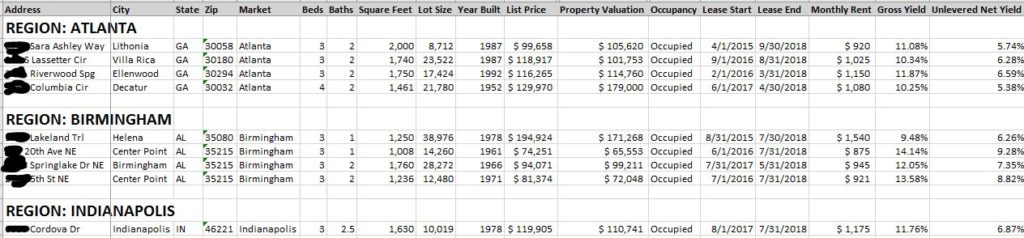
One of them Columbia is had $27K to get back online. Going to pay 37K to sell retail.
Another property Riverwood just went vacant. Going to pay 20-30K to sell retail too.
Talked with my team – PM, Contractor, couple other hui members
Is it a good area to go retail
Will I recoup capital overlay based on comps
Soon I will unrolling my private lending platform. CrowdfundAloha.com! So if you are looking for a 1st lien property with my partners let me know. We are talking about even providing turnkey services.
This is not really a money making things cause the margins are just really tough these days.
After over 1000 strategy calls with investors and coaching clients over the past couple years here is what I tell W2 employees… For those who are able to save more than $30k a year or have substantial liquidity (over 200k), being a landlord and especially flipping is a lot of work. If you like it cool/good for you… but just remember why we got into this… To be free from a JOB. A lot of us (80%) who stumble upon simplepassivecashflow.com and start drinking Kool-Aide will be financially free in 4-7 years pending taking action. So I always urge people to start with the end in mind and take a more passive approach.
Do the math here… you with 300 dollars per property (2 months of work to buy a turnkey rental) you are going to need 20-40 of these to replace your income. I have 10 of these and have systems in place but have 1-2 evictions a year and 3-4 big things that happen. Image if I had 30, just 3 x those numbers.
Directly investing in a turnkey rental or small MFH is a good way to start to learn and build up the war chest to go into my scaleable investments such as private placement syndications. Whatever you do, try to be as close to the investment as possible. This is the fundamental problem I have with Wall Street who takes too much fees off the hard-working efforts of the middle class.
Looking at some deals. So folks in the Hui Deal Pipeline Club (who have reached out to me and built a relationship) will see those really soon. 😛 I hope I have enough liquidity… I might need to borrow some money 😛
Single Family Homes becoming a legitimate asset class – Spring 2018 Conference
The lending requirements and new loan products is slowly changing. I know a lot of you have heard that Short Term Rentals (Air Bnb) income is starting to become part of the loan calculations.
Something I’m following is lending on large portfolios of single-family homes. Some of the highlights:
1) up to 10-year term with 1.25 DSCR
2) portfolios minimum size of 50 properties
3) assumable
Pilot program details download here – https://drive.google.com/open?id=1aTIbru2HEPbw_KLHTvU5-Iyk0aoQB8Gx
My takeaway is that this is important to monitor especially if you are developing because this is a leading indicator of softness in the market. It might be economic reasons or just because a bunch of new build inventory is coming online in that area. Either way…
Robert Kiyosaki has a saying, “there are three sides to a coin”.
People argue that its a good time to buy or bad time to buy. For example “mfh” is overheated or commercial is getting killed by Amazon and e-commerce. I think these are mental justifications by tire kickers not to do anything.
Sophisticated investors live on the edge of the “coin”. They buy deals out our reach of amateurs due to the lack for network/knowledge. These opportunities are undervalued, with undermarket rents, with value-add opportunity.
They are patient and don’t stray from standards that make them get crushed in a market correction. (Cashflow from other investments make this possible) They invest following the macro and micro trends and don’t gamble on gimmicks such as guessing where Amazon’s next HQ is going or where the hurricanes just crushed a market.
The trouble is as an outsider is figuring out which of these deals transcends the two side of coin and is on the edge. And starting out its going to be slim pickings due to lack of network but you have to push through this rough part.
I am from the camp that you need to become an expert or get beyond the surface level investor stuff in some freebie pdf guide or video. Or just find the right people to work with. To many people get shinny object syndrome and float from sector to sector, from a money-making activity to another, read book after book and never get anywhere. You see these people at a lot of networking events. There is a lot of movement but no tangible results. This is where coaching comes in but for some people not able to get over having another person call them out on their BS you need to get laser focused and take massive action or quit fooling yourself.
I’ll be at the notebuyerbootcamp on the panel for syndication in Chicago next week. Notebuyerbootcamp.com
Need a referral to a turnkey provider or broker? Sign up here.
Join us on our next Investor Education Tour – Sign up here
Dear prospective turnkey investor,
The following is my constantly updated guide to turnkey investing. Email me for any additions or feedback. In the spirit of the Hui Deal Pipeline Club where we crowdsource due diligence together!
Investing in Turnkey properties can be a very lucrative endeavor, and is where many in the Hui Deal Pipeline start off. It is the least risky investment you can make and is the pre-requisite for larger real estate deals.
What is Turnkey Real Estate Property?
From the word itself, turnkey rental property is a property that is readily available for turnover, and tenants can immediately move in, without the need for the property to be enhanced renovated. This property is managed by companies that practice buying and rehabilitating low-priced properties.
Investing in turnkey properties is an approach done by buying low-priced rental properties, by the investor for simple passive cashflow, that has been remodeled by the property management. The investors will simply “turn the key”. Easy!
Benefits
Create relatively stable passive income that requires only a couple hours a month to manage
Increase your net worth through property appreciation, mortgage pay-down, and tax deductions.
Built-in referral base. Turnkey companies can reduce the amount of guesswork by providing referrals to property managers, property inspectors, lenders, and insurance agents.
Start making money the day you purchase the property. There is usually a tenant in place before you close on the property, so profitability can begin immediately.
Risks
No investment opportunity is free of risk and Turnkey Investment is no different. Here are a few of the factors that must be strongly be considered before investing:
The condition and maintenance of the property – While everyone would like to buy a property that is either new or in excellent condition, the reality is that some of the properties are not in the best shape and are even located in low income areas. The responsibility falls on you, the investor, to make sure the condition of the property does not prevent your Turnkey from being profitable.
You will pay market value at minimum for the property.
Your profits are tied to the housing market.
Not all Turnkey Rental companies are reliable.
https://youtu.be/4tPe5Hfer1I
Is Turnkey Investing Right for You?
Turnkey investing can be a great entry point for beginners. Turnkey properties are essentially move in ready properties. Meaning once you buy it, you can start renting it out.
You live in an expensive area and want to invest out of state for higher returns, lower upfront cash requirements or both.
You have a full-time job and can’t dedicate a couple hours each day to real estate investing, so you need something that will not take that much time.
You’re a new real estate investor and are feeling a bit overwhelmed with everything it takes to find, rehab, and lease a property.
You’re primarily interested in receiving passive cash flow from your rental properties, and are less interested in price appreciation.
https://www.youtube.com/watch?v=ylpi6tGedDI
Another thing to keep in mind is that buying turnkey properties doesn’t have to be your “be all, end all” approach. You can start by buying one or more turnkeys and later transition to other strategies as you become more experienced.
When I started off my real estate journey, I was working a W-2 job, I was not looking for another job or chore. I am all about leveraging my money and more importantly, time. I did not want to spend my time painting walls, fixing toilets, collecting rents, and deal with late-night calls from tenants.
For people like you and me who live in places (Seattle, West Coast, Hawaii, East Coast, to name a few) where the Rent to Value ratio is 0.5% or less, we have no other option but to invest out of state. It drives me crazy when the Real Investor Peanut Gallery (internet forums known for big pockets small wallet) say we are overpaying… Our time is better spent at our high paid professions that we busted out butts going through a couple decades of schooling for.
How Do We Ensure Not Losing Money?
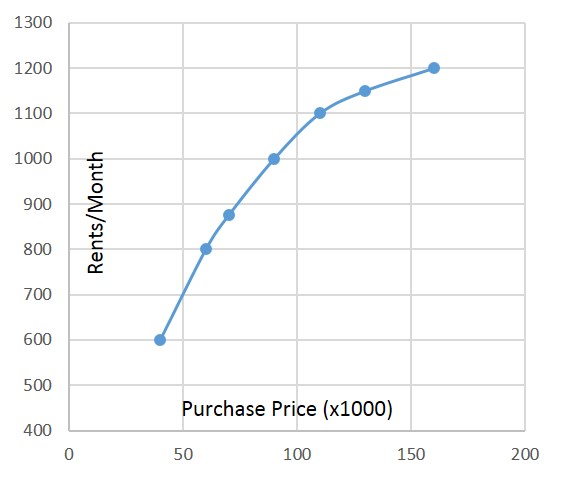
Buying assets where the Rent-to-Value Ratio of more than 1% is needed to be able to cash flow after expenses. You find the Rent-to-Value Ratio by taking the monthly rent dividing by the purchase price.
When I am looking at potential investment properties the rent-to-value ratio is the very first metric I look at with evaluating an investment. To calculate this metric you take the monthly rent divided by the purchase price/value. For example a home that rents for $1000/month that costs $100,000 has a rent to value ratio of 1% (1,000/100,000=1%). The higher the better. I typically look at a huge list of properties so using excel to make this calculation is the best practice. It’s sort of like using the dating app Tinder… but with a filter…. I’ll stop there… to learn more click here.
My full-time professional job earned more per hour than most folks even in real estate and more than these Turnkey providers do. So I’m like “Sure! I’ll pay retail and rely on their volume and expertise.”
It’s all about leveraging your highest and best use, which may be your day job. Sorry…
Being a passive investor is simple. Spend your time making the big bucks at work and invest for yield.
Download the free “real” hourly wage calculator here & get access to our share drive here.
TAKE NOTE: Investing for cash flow is not a get rich quick schedule, but a prudent way to build lasting wealth a few hundred dollars at a time.
The hurdle to real estate investing is that you have to find the right property, the right people to work with, and have a mentor so you are not getting screwed.
A turnkey company (which essentially is a large-scale home flipper) finds and buys a run-down house. These houses are often foreclosures, short sales, bank-owned properties or bought at auction. They are cheap, but often need significant repairs before they can be rented out.
The turnkey company uses its in-house rehab team to renovate the house and bring it to a rent-ready condition (which just means it will be competitive on the rental market).
Oftentimes, the turnkey company will find and place a tenant in the property before selling it. This isn’t always the case, but most turnkey providers will do this.
The turnkey company sells the rehabbed rental to you, the investor. These sales are usually off-market, meaning they are not listed on the MLS or available to the general public, so you don’t have to worry about a bidding competition. You buy it for the advertised price.
Once the purchase process is complete, you own the home and can start collecting rental income. The turnkey company will often set you up with their in-house or preferred property manager, or you can pick your own.
The vast majority of turnkey properties are single-family homes – typically individual houses on their own lot, and less frequently – condos.
Occasionally, you will see multi-family turnkey properties. These are buildings consisting of multiple units (or living spaces). A duplex is a home with two units, a tri-plex has three and a quad has four.
One type of property is not inherently better than the other, and oftentimes which one you like better will come down to personal preference. Here are the pros and cons of each
It’s unlikely that you will come across multi-family turnkey properties often, but when you do, I encourage you to evaluate them just like you would a single-family home, but keep their unique advantages and disadvantages in mind.
Single-family homes
Pros:
Easier to rent out – most people prefer their own space rather than having other tenants close by with shared walls
They are easier to sell
May appreciate more than multi-family homes
Cons:
The per unit price on a single family home vs the per unit price on a duplex is much higher
If the property is vacant one month, you are covering the entire mortgage
The value of the property is determined by other comparable sold properties in the neighborhood
Multi-family homes
Pros:
Have a lower price per square foot and thus produce a higher return on investment (ROI)
May have lower maintenance costs per square foot, as all units share one roof, yard, etc.
Cons:
Often located in lower-quality neighborhoods and may not attract the same quality tenants as comparable single-family homes.
Directly investing in a turnkey rental or small MFH is a good way to start to learn and build up the war chest to go into my scalable investments such as private placement syndications. Whatever you do, try to be as close to the investment as possible. This is the fundamental problem I have with Wall Street who take too much fees off the hard-working efforts of the middle class.
I currently work with one business who I can align with because they offer sort of a hybrid between the marketers (I know you know the reasons why to stay away from them), and going straight to the TKPs.
Since you lose a lot of the protections when you do that and it’s sort like signing agreements in the “wild wild west”. The reason I do it this way is that I get a licensed agent that has a fiduciary responsibility to your best interests and guides you through the transaction as you buy through the TKP. Basically, it’s like having MLS agent to cover you for the off market deals. All the properties are aggregated from only the good TKPs and the same price that you will find on the weekly digest that is sent out by the local TKP. This is the way I buy my properties and if nothing else it’s good for browsing what’s out there.
After over 1000 strategy calls with investors and coaching clients over the past couple years here is what I tell W2 employees, “For those who are able to save more than $30k a year or have substantial liquidity (over 200k), being a landlord and especially flipping is a lot of work. If you like it cool/good for you. But remember why we got into this. To be free from a JOB. A lot of us (80%) who stumble upon simplepassivecashflow.com and start drinking Kool-Aid will be financially free in 4-7 years pending taking action. “So I always urge people to start with the end in mind and take a more passive approach.
Do the math here: You with 300 dollars per property (2 months of due diligence work to buy a turnkey rental), you are going to need 20-40 of these to replace your income. I had 11 of these and had systems in place but had 1-2 evictions a year and 3-4 big things that happened. Imagine if I had 30, just 3 x those numbers.
Directly investing in a turnkey rental or small MFH is a good way to start to learn and build up the war chest to go into my scalable investments such as private placement syndications.
If your net worth (income minus expenses) is under $200,000 or barely save $30,000, syndications are not for you. Stick with these Turnkey rentals despite what Gurus (who are trying to sell you their program) tell you for now. They have a little higher gains (a lot more volatility) but a syndicator who is willing to put you in a deal with more than 10-20% of your net worth is asking for trouble.
My strategy when investing out of state is to focus on workforce housing where people need a place to live. I steer away from upper class properties and neighborhoods.
Breakdown of where Class D, Class C, Class B renters live. Source
As the prices started going up I was forced to go out of my comfort zone and purchase out of state rents because I needed cashflow in order to achieve my goal of replacing my W2 income as an engineer.
I work with a lot of engineers and a lot of them say they get analysis paralysis because they like data. I call them out of it and tell them they are just scared and that they are losing $500 of opportunity costs and time per month!
A real engineer would look at the numbers. IF rent minus expenses (with contingency) minus mortgage is positive THEN freaking do it!
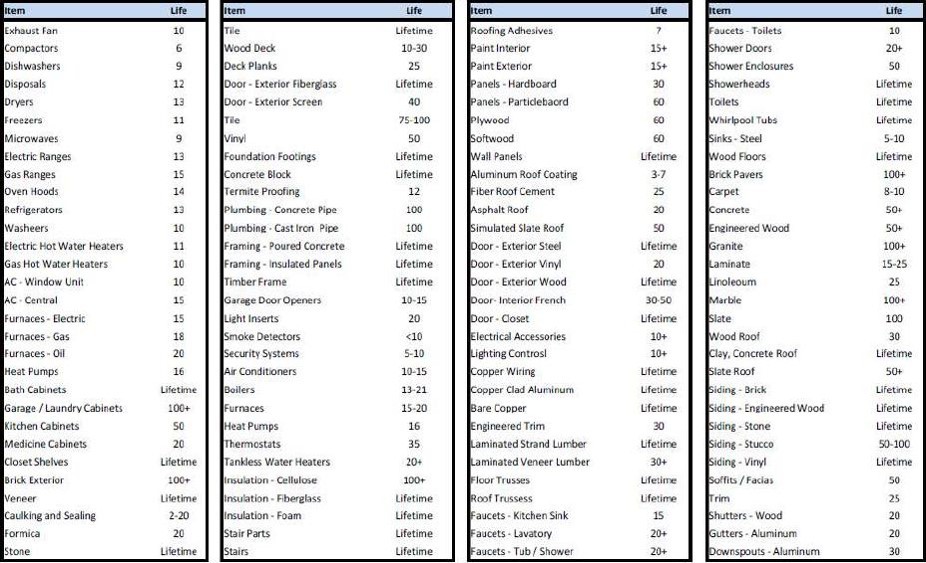
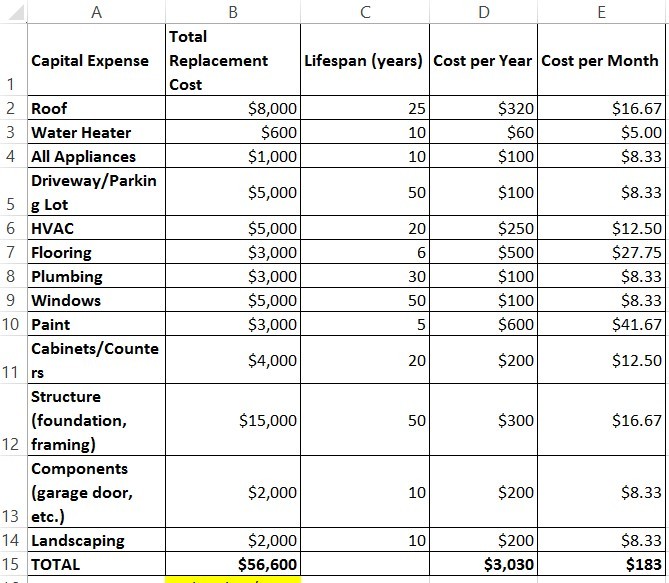
Example of capital expenses that need to account for in your expenses and contingency.
Unlike broke people, passive investors don’t need great deals they just need better than average.
When I first started buying the rehabs done by the turnkey guys in the blue-collar areas, if you posted “Hey, I’m looking for turnkey” in the forums you get the usual suspects soliciting you for marked up properties.
It’s off market because they rehab it for the investor with more durable and less visually appealing materials than your normal retail product. I’m all for the wholesaler to make money because they do spend a lot of time and money on mailers and advertising, but the layers of middlemen who add no value is excessive, and is almost as bad as Wall Street.
“I don’t work with top tier turnkey providers. For the same reason I don’t buy a Dyson Vacuum.. I’m cheap and buy value and buy the sub-100 dollar Shark brand from Costco with the excellent return policy.”
These days people in the Hui Private Group are not on internet forums. They say it’s 95% of active people who are not high paid professionals and marketers.
Here is some of the chatter from the Hui Private Group :
Previous
Next
Out of State (Remote/Absentee) Landlord Abuse
It’s no mistake that all of your providers/property managers/maintenance staff know you are not there to verify every little repair or check every bid of potential in-house or third party work 🙁
Previous
Next
This stresses the importance of building the right team!
The most important thing to do is to grow your network…
So you can bounce ideas off other investors and not a salesperson. I still do free calls but please review the free content I have put on this website first.
No, I do not just give recommendations to good people to buy from, because things change and I am not going to throw my brand around like that. And by the way that’s an “ask-hole.” I know your character and the trajectory of your success but how you add value to others first instead of taking first.
Some people are unaware of this which is why I’m saying something so I apologize. This could be the reason why people are not helping you out and you feel like a lone wolf.
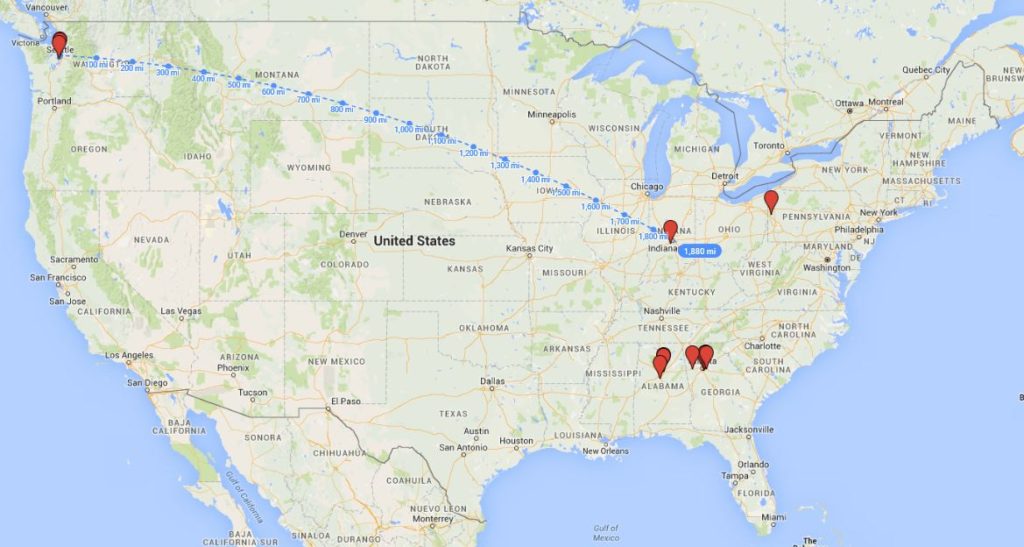
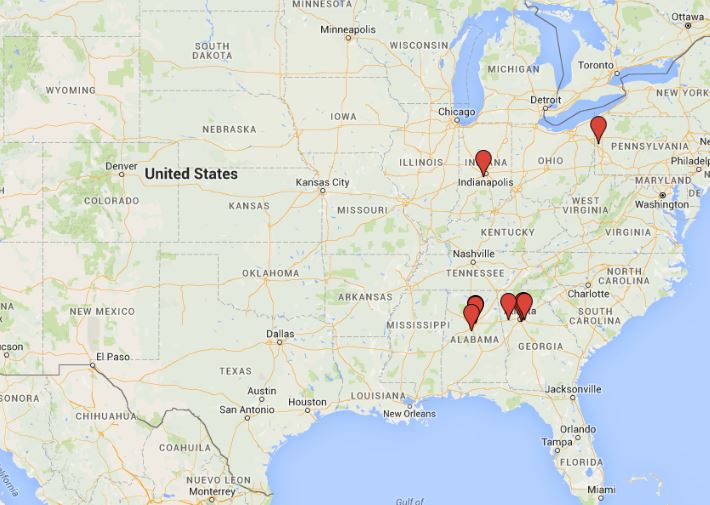
I don’t really see much difference in the secondary markets with robust economies (Memphis, Kansas City, Birmingham, Atlanta, to name a few).
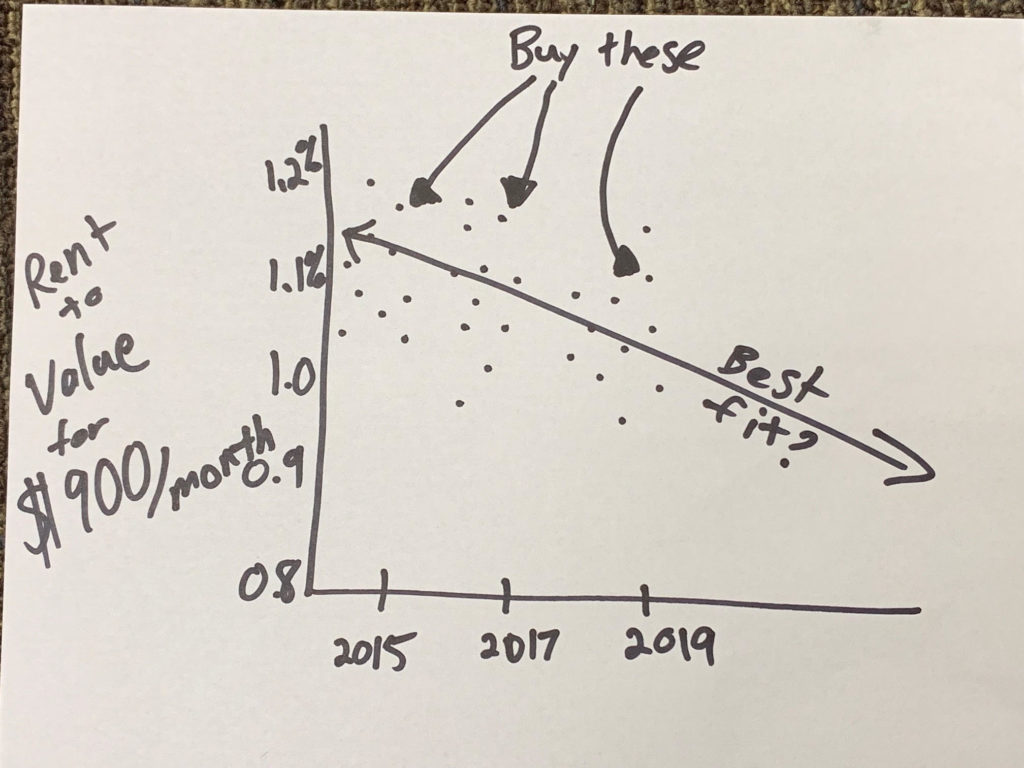
I have tried to set things up so my different markets complement each other. For the most part, I buy in the 1.1-1.3% RV range. I take home 70% in 2015 but now in 2017, I buy in the 0.9-1.1% RV range and take home 60% of the rents after all expenses (Turnkey rentals can be a PITA, but if you don’t have much money or time, you don’t have any other choice. Have more than $200K? Start thinking about transitioning to being a passive investor (Vacancy and Cap ex).
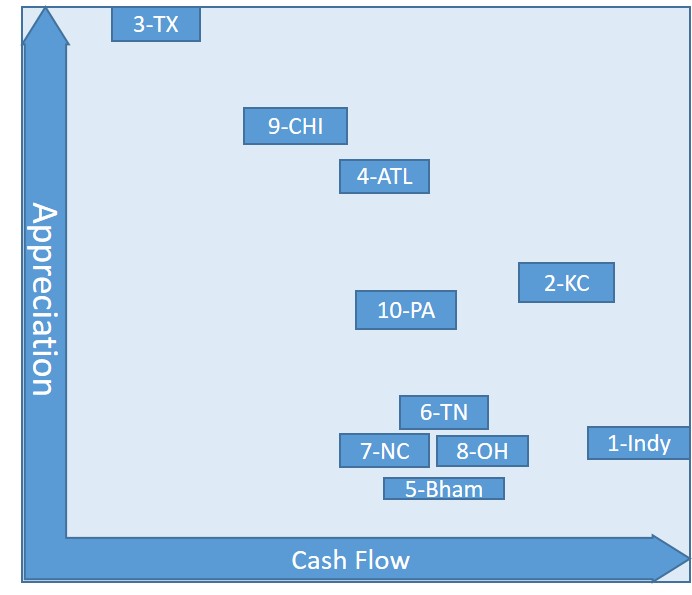
I made this diagram in 2016 and it illustrates some of the popular “secondary markets with robust economies” that a lot of out of state turnkey buyers like to invest in. Things have changed a little but as you can see you can either have appreciation or cash flow. It’s tough to get the best of both worlds.
I stress NOT to spend too much time picking a market. If you sign up for investor incubator as a Hui member you will get more than enough data to create analysis paralysis.
The biggest thing you can do is vet the people. As you can see the same principle is what I use in my syndication due diligence: 50% people & 50% the numbers of the deal.
There are three ways to purchase a turnkey rental:
Marketer – I would not recommend going through a marketer, they don’t even invest themselves and they did not add any value. The only one I can recommend is Marco but that is because I know like and trust the guy. By the time I bought my 3rd rental I knew way more than those folks did. Unfortunately, I probably overpaid by a few grand on each of those first few properties not knowing what I don’t know.
Work with me only if you want to compress time and want me to look over your shoulder to get my unbiased opinions and guidance. Plus you will be setup with a plan and not shoot yourself in the foot like I did by buying a dozen non-scalable investments.
Direct from Turnkey Provider – You cut out the middleman and go direct to the source, theoretically getting the best price. Just know that you are not represented by a broker who supposedly has a fiduciary responsibility to you. Note: never trust a broker. The transactions are done with their paperwork and their rules. They are the pros and it’s dangerous for a newbie to go down this route. There are household Turnkey Providers (TKPs) out there but I call them the “Prada of Providers”. You pay for what you get and often times more than what it’s worth – I’ll just say you are paying over 105% of retail.
Hybrid Method – When I was going through my buying spree in 2015-2016, I was going (off market) via an agent that had a fiduciary responsibility to me to check all the BS that the providers give you – this is what I recommend only after going through the process a few times. Usually, the agent helping you is not an investor and does not really know what type of amenities/floor plans and locations are best for rentals. You will need to drive the ship. Note: I see brokers all the time trying to sell junk to new investors.
Check Roofstock– Another cool site out there is Roofstock which is where I sold my turnkey rentals to step up to syndications. Use the link get a $500 credit when you register. They give me $50 credit but I don’t think I will buy another turnkey rental again.
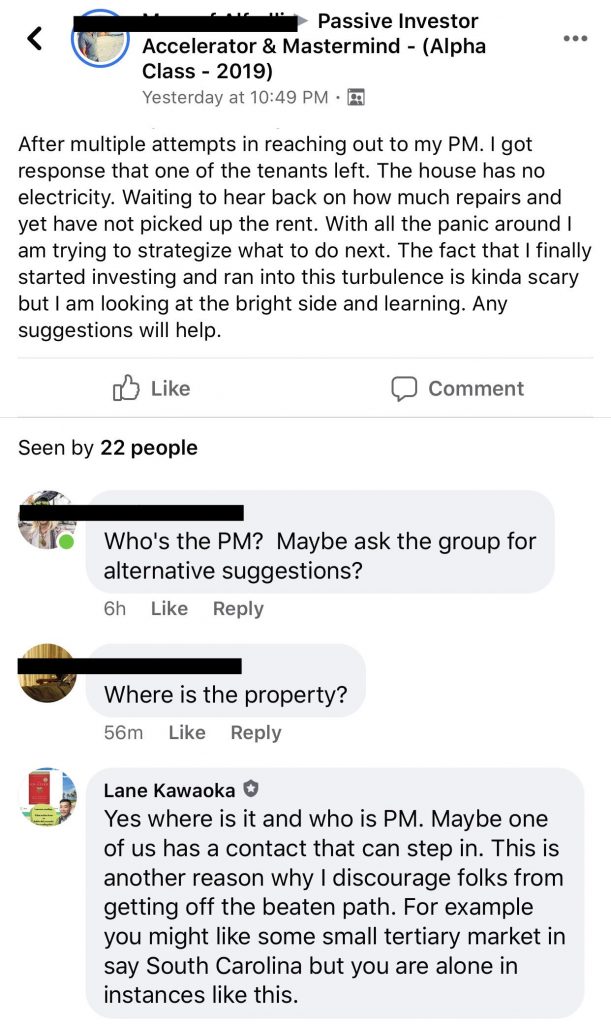
These photos below are examples of what happens if your property manager doesn’t properly screen your tenants. Check out these disaster photos from an eviction that ended up being a $37K repair bill… https://photos.app.goo.gl/R4PZLuOLGHONO5Rl2
Previous
Next
Stay away from turnkey providers who…
Don’t allow financing or a finance contingency because they are selling above market value (which will be revealed by an appraisal)
Don’t allow your own independent property inspection or referring inspectors to you
Are not realistic with their pro forma’s (i.e. they don’t include vacancy or maintenance projections or use unrealistically low vacancy factors) – just don’t take anyone’s proforma ever!
Require you to pay for any renovation upfront – sometime this works if you have worked with them in the past
Sell only in cheap or low end neighborhoods (Class C or D) and never trust what they say what Class it is.
As I was in the middle of my 1031 buying spree (#6 of 11), a lot of TKPs started to come out of the woodwork and offered their properties to me and gave me the royal treatment (discounted prices from what they normally offer).
I got to meet a lot of them via meetups and national conferences because I had this podcast and they were interested in getting at the Hui Deal Pipeline Club ecosystem.
Since I was experienced and they liked working with me, they offered me referral fees to simply send guys like you over to them with a simple “CC’ed” email, sort of like a referral source where they would give me $1000 per home sold.
I thought it made sense for them because it was a lot cheaper than paying $6000+ to a Marketer (#1 above), but as you know when you go with a marketer or this sort of referral program the buyer (you) don’t really get any value add. That said if you want $500 credit at Roofstock use this link.
Personally, I’m not really into picking up $1000 referral checks and passing you off to the TKP (never to hear from you again) since I’m more looking to give back to other investors and build my network for my larger syndication deals in the Hui Deal Pipeline Club.
“I have B- class rentals and high that rent for at least $900 a month and I am still having a hard time selling dang properties to other cheapo investors
Start Fresh
I strongly urge you to clean house (with the tenant) and start new (even though you have to pay your property manager a lease-up fee). That way you don’t have to inherit “step-children” tenants and can start out on the right foot to set the right expectations. This also eliminates excuses from your property management company because they put the tenants there themselves. I made this mistake because I wanted to save $500 bucks by not having to pay a lease-up fee and not have to go through a couple months of vacancy off the bat. Again, me being a cheapo.
Getting an Appraisal
Those of you buying your own rental properties with Fannie/Freddie loans are aware and probably agree, the appraisal piece of residential real estate investing isn’t a foregone conclusion leading to a successful closing.
Your deal could be shot down by an appraiser that can’t seem to understand how a $30k house with $20k of rehab can be worth $70k in a couple months.
Remember the vast majority (over 95%) of appraisers cater to almost exclusively the ‘owner-occupied’ property appraisals. Very few appraisers are well versed or adept in our non-owner occupied properties, especially when we throw in a distressed sale, rehab/renovation work etc.
As a result, we find ourselves (all of us) on occasion on the other end of a short appraisal that will either kill our deal or significantly reduce our profit margins. Now, appraisals do serve some purpose to determining value, but for more sophisticated investors find appraisals a little annoying.
A little backstory: Pre-2008 crash there was little regulation for appraisers and they could easily be bought off at the job site with cash or others on the job favors. The government got involved and they mandated that if you were going to get a government sponsored Fannie or Freddie loan that you needed to go through an AMC (appraisal management company).
This is the third party that the regulatory agencies of residential financing require we use for ordering an appraisal. Some lenders (Hui members will and especially Mastermind members will get referrals) operating within confines and strict regulation of housing/lending have created a short-list of ‘self-managed’ AMC that allows lenders to create preferred panels of appraisers in all the markets we lend in. In other words, you get to hand appraisers that you know.
When an appraisal order goes out, it now goes out as a random selection to this preferred panel of appraisers vs the master pool of appraisers within the entire AMC database. We’ve found this greatly reduces the possibility of a short value. This is why I like investing in real estate or when I know the right people because it’s essentially like inside trading.
There is really no reason why you cannot put in an offer on a property and start collecting $300 a month with a $25K down payment in under 90 days. Someone who is still “reading”, “contacting investors”, or “picking a market” frankly lacks focus (finish one course until success) or scared of making a move. Every day you don’t do anything is $500 a month of opportunity costs!
My rentals in Seattle were cash flowing each with $600-800 a month but it was because I bought at the right time and I did not look at the numbers like a sophisticated investor does.
Although my cashflow was good (bad in terms of percentages), I realized that my return on deployable equity was very low, in fact it was under 5%. Each rental I got after typically cash flowed by $350 but I think of it like $250 to be conservative and more importantly, my money is not being lazy. I think if you’re making less than 8 percent you’re better off in the stock market despite my aversion toward stocks or mutual funds.
A sophisticated investor does not say “well… at least I’m able to cover my mortgage”. They are constantly monitoring their return on equity.
I wasted a lot of time in 2012-2013 looking for rentals in King, Snohomish, and Pierce County (Washington state) and nothing cash flowed. I still have the spreadsheets where I underwrote how crappy the cash flow was. Now prices are even worse.
I helped dozens of people with this out of state investing game and have pretty much figured it out after making a bunch of mistakes that I didn’t realize till later – this is why it makes me laugh with the “do it yourselfers”.
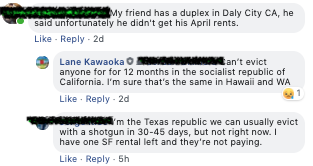
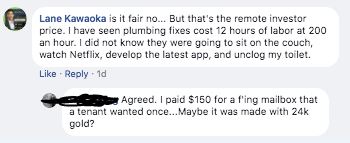
Lively commentary in our Facebook community. #Livewhereyouwantinvestwhereyoucanevict
One mistake I see people making is going after these sucker properties that only can be sold to “Californians,” “Hawaiians,” or any rich person not from the area perceived to have trees that money grows on, from a trust fund, and drink seven Mai Tais on the beach everyday.
These types of people (not followers of SimplePassiveCashflow.com) like to pay a plumber for ten hours to fix a small toilet leak.
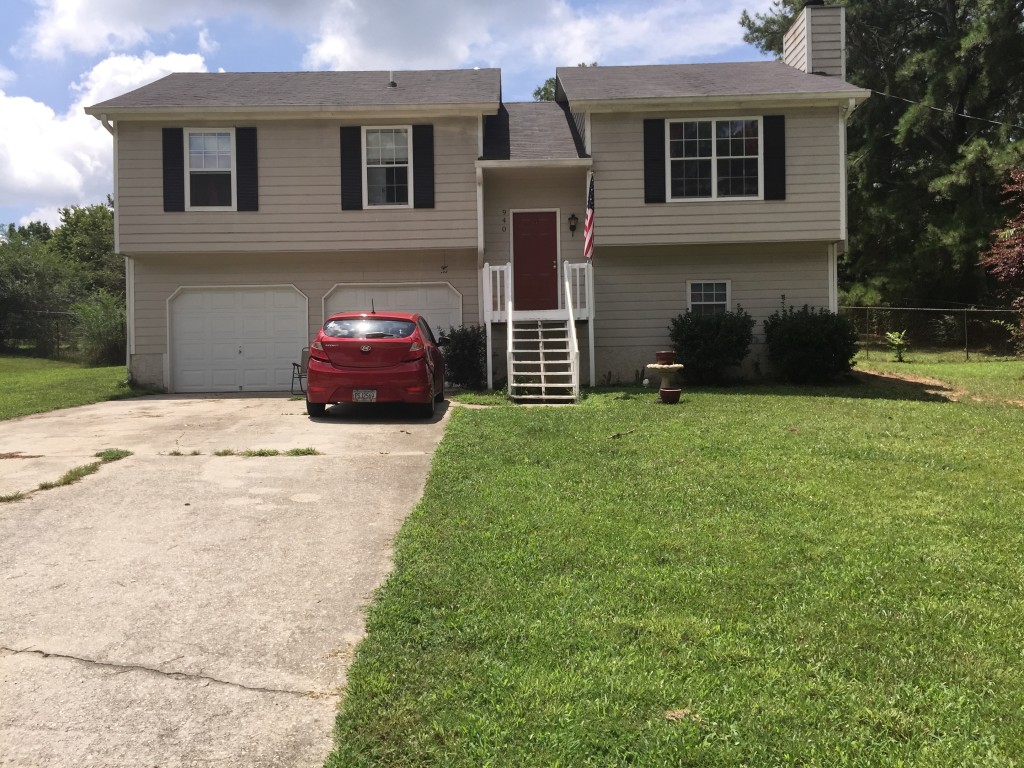
Sucker properties are in the wrong area that none of the locals would touch with a ten-foot pole. They are C or D class properties that the Broker calls “B-Class or good area” and usually cost sub $60K for $750 rents a month.
“It may look good on paper but stick to rents that are higher than $900 a month”
I see newbies buying 2-8 unit properties after hearing all the good things about multi-family and scaling. I think most highly paid professionals will graduate to syndications (which is why I structure business and own investing around them) and therefore will need to sell these SFHs to move up. The exit strategy on selling 2-8+ just is not there. They look good on paper but the exit strategy kills you. If you are thinking you are going to hold on to these properties for cashflow for 7+years think again because that is not what sophisticated investors do because they monitor their ROE and they know the cap-ex tidal wave will hit them in year 5-12 taking back all those profits from the earlier years.
How many turnkey homes are people buying? Here is one data set I found from one popular turnkey provider. Takeaway – most (82%) get a few properties and the rest don’t get it or are too lazy.
Join our tribe?
NOTE: I built everything on this website to be able to help out as many people get to financial freedom as a way to give back.
However, the biggest part of investing especially as you net worth goes over $250,000 is that all the knowledge will not help you. Instead, it is all your network.
This is where joining the incubator comes in. I thought I could do it all alone which is why it took me so long to get to 11 rentals myself. Until I found other high net worth investors to bounce ideas off of, I was just another Joe investor out there.
Here is just a tip of the iceberg but for now, I would dig up data on population growth of area and media income. Maker sure you dig a bit deeper on submarket think Arlington vs Dallas. The details are in the Sub market which needs to ultimately verified in a site visit. The thought here is that the more desirable areas have that built into the pricing. You are trying to find value. Also, check up large employers moving in or other new development. Those are the signs or future expansion.
I would do your own due-diligence and learn about rentals by talking to as many people as you can.
I know eventually, you will find that working with my team is the going to be the optimal path forward as I am committed to mentoring you as an investor so you will continue on this investor journey to bigger and better deals.
I stand behind REI Trader and support you through the entire buying process – I don’t just pass you off to the Turn Key provider and say peace out…
The properties have good value for the purpose of rental real estate. The due-diligence that we do after the purchase contract is signed is the secret sauce and the unfair advantage over other turnkey options. Yes, there are a few perennial Turn Key companies however you will pay over market rates (110% retail).
The broker that helps you with boots on the ground with REI Trader is property agnostic. In fact, they don’t care if you buy that property or not. We know you will buy the right one eventually. We want to build a relationship with you the investor. Most clients buy one property, come back for more, and tell their friends.
Normally, I don’t recommend these types of new builds especially in new areas. When a recession these are the first to go offline ass opposed to mature communities that have been around for a while and established homeowners.
Here is a spreadsheet with the math behind making your own turnkey company.
I think multi-family properties are my future 1-2 years from now. Would you start 4-8 units or get a partner and go bigger?
This depends on your trajectory (how much money you have and earning ability). High paid professionals I work with are going to go into bigger deals I would recommend going with SFH because you will likely sell in a few years and vault into bigger stuff. 2-8 units have a horrible exit strategy as only people who want them are cheap investors. “looking for a deal man!” My buddy FI Fighter also calls these Turkey rentals too but I disagree with his sentiment about going for the “best assets.” I believe you can invest in undervalued value add Class C and B assets as long as you have a capped time horizon. This is why I like to look for 1975-1990 properties because our business plan is the squeeze out the last of the value of these properties with still having high single digits of cashflow as the hedge to a downward turn in the economy. You can’t really do much with a 1960’s property. You really have to go through 500-1000 deals to find one of these and you are not going to find these being in the game with only 6 months of experience and no track record. This model is not infinitely scalable (and too small for the institutions to bother with) but what small sophisticated investors are quietly doing in the 2-8 million dollar asset range. Where do I get a loan?
First off do not go to a big bank lender like Chase, Bank of America, Wells Fargo. Even worse they use the same guy that got them their primary residence. Don’t use those guys cause now you are buying a remove non-owner occupied rental!
You are getting an investment property that you are not going to live in. It is a going to be a little different and a typical residential owner occupied property and the drone working at those big banks will just mess it up as the file gets passed from the sales guy (the one you interact with) to the underwriters (people who cover the banks butt).
Not all lenders are created equal. And it always preferred to work with a lender who is an investor too or works with other sophisticated investors to draw the best practices as opposed to it being a blind leading the blind experience.
If you are serious buyer join the incubator and I’ll connect you with who we use.
I coach our students so they don’t stay anything negative on the record so the lender does not get spooked. This is an example of knowing what you don’t know and where you are going to pay for your education in terms of a mentor or mistakes.
Although lending terms change check out this discussion on loans for 1-4 unit income properties here.
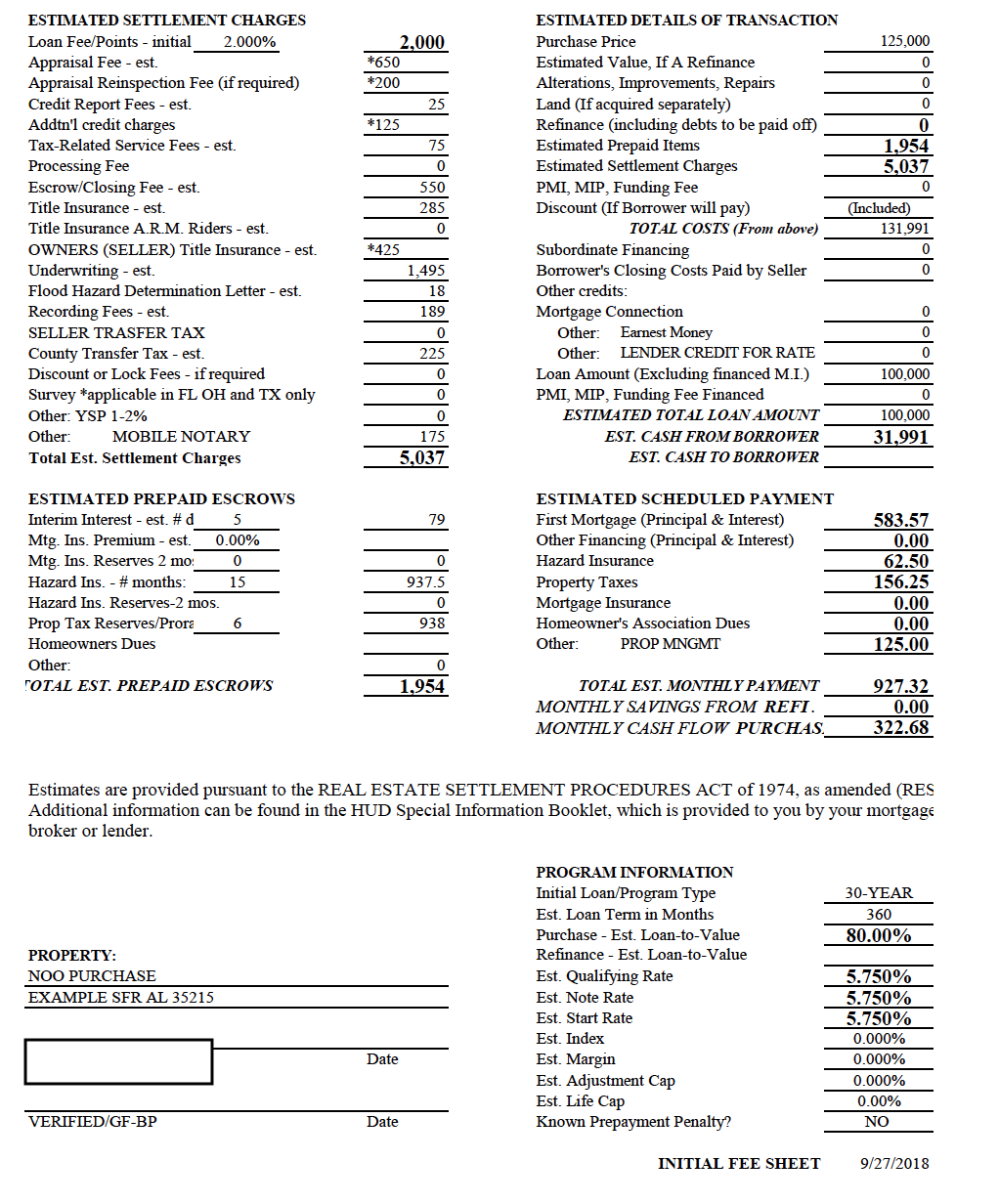
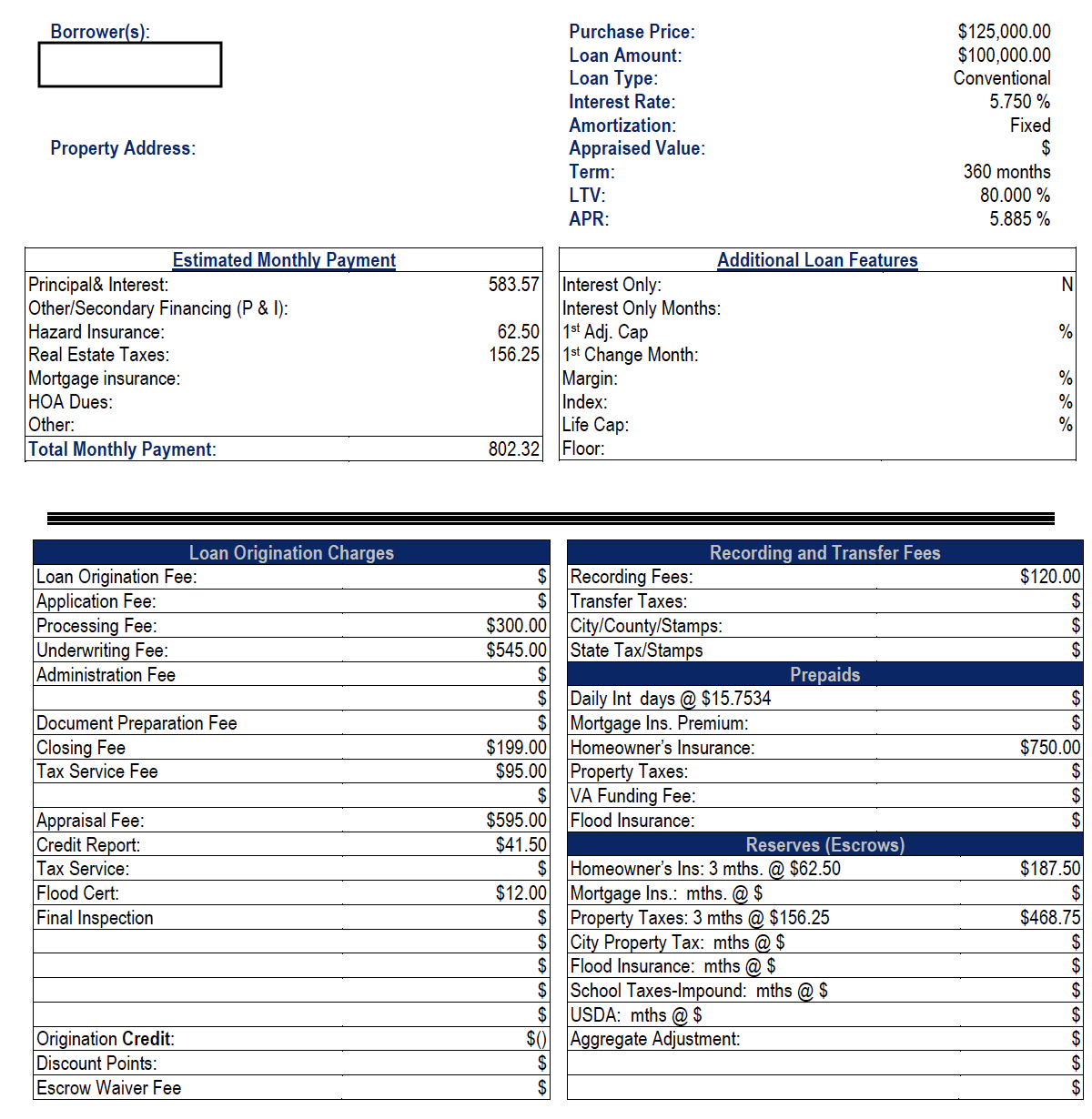
Rate Sheets for a Turnkey Rental to give you an idea of how much you will pay and how much you can potentially earn:
Turnkey Exit Game (2018-2019)
I began listing my Turnkeys on Roofstock.com who are a lot cheaper than a regular broker and there are more investors that are looking for an occupied rental property. So it is good how you don’t have to go without a tenant and miss out on the monthly rent checks.
The downside is that it’s really easy for buyers to put in lowball prices which gets pretty annoying. Although the certification process was not too bad since my property management took care of all the home inspections with the Roofstock inspector.
Out of 10 rentals a couple of them sold in the first few months of 2018, the action dipped dramatically. I was not desperate to sell because the properties were stabilized and giving good cashflow and I did not want to have too much liquidity. I was fortunate to find a lot of syndication deals to go into 2nd half of 2018 to go into which motivated me to sell these properties more.
“I honestly believe it is a fine balancing game. You can have a PM that is methodical and takes their time finding a “better” long term tenant and it may cost you a couple months of rent but you hopefully make it up on longer tenancies, less evictions, and less turnover costs.
On the other hand, you can be like one of my prior TK PMs and burn and turn the property quickly fill with a “decent” tenant but may have more risk of evicting and a costly turnover due to damages. The type and class of market greatly affects which side is easier.
When I start learning about the small margins PMs make for the amount of work they do, I can see why some prefer the latter. They don’t have to pay for the evictions, fines, and renovations. Also, since margins are small, they more likely have to take on more rentals, which then gives less time and attention to your property. The task is finding a PM with a great system in place and operates in line with your investing strategy but you have to understand it may be hard to get it all.
Work the PM, see if they can get it leased using promos or by lowering rent. Lowering rent by $25-50 a month for a year is less than another month vacant (unless your rent is less than $600).
This is from my limited knowledge and experience but is one of the reasons I got away from SFH. With my limited time, I didn’t want to have to deal with emails about missed rents or costly make readies. I also don’t have the capital to scale quickly enough to mitigate the effects of each incident.
What I found worked well was to rehab the 3-5 of the properties after the tenants just happen to turn over. Each time I was able to do 10-25K of rehab to get it close to retail status. Part of that cost was to just get the property cleaned up which I would have incurred anyway if I got it back online as a rental.”
“Even if you have a portfolio of 10-15 properties, you’re bound to have a big loss at one of your properties every year – whether it be HVAC, eviction, roof, vandalism, etc. I think, for me, I will concentrate on only syndications going forward unless a great deal presents itself. I believe in being really good at one or a couple of things and trying not to spread myself too thin trying in order to learn all sorts of different asset classes at this point in my journey.”
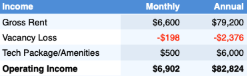
Here’s a quick summary of the properties that I sold (I still have a couple). NOI is the net operating income is calculated by the rent minus expenses (maintenance/repairs, property tax, insurance, property management fee, etc.). NOTE that the ROI shown below does not include the taxes, tax deductions, broker commissions, etc. to simplify things.
Property #
Years Held
Initial Capital
Equity
NOI
ROI
1
4
$26,975
$2,950
$9,069
45%
2
4
$30,773
$41,900
– $4,472
122%
3
3
$27,165
$7,500
$16,838
90%
4
3
$30,773
$25,500
$16,553
137%
5
4
$25,603
$46,900
$2,775
194%
6
3
$25,535
$5,750
$13,707
76%
7
3
$24,348
$70,000
$8,870
324%
8
3
$24,348
$44,900
$361
186
You may notice that for the entire time I held properties #2 and #8 the income I generated was actually negative or close to zero, this stresses the importance of having multiple properties to average out the bad apples!
Reminder:
For those who have rentals, you understand how ~20% of renters are like gold. They stay a long time (3 years plus) and are perfect citizens. A couple of my rentals had such tenants which I still own today and will likely rehab a bit to sell retail then. Part of this protocol is contributed to the fact that I don’t really need the proceeds of these sales to go into the next syndication because my W2 day job and cashflow kept me going. Only a couple of the renters I felt I sort of “forced” or did not renew their leases because I felt I needed to get my equity out and working again.
Don’t worry I was nice about that and I gave them a heads up and worked with their schedule while waiting till the springtime so I could time a summertime sale.
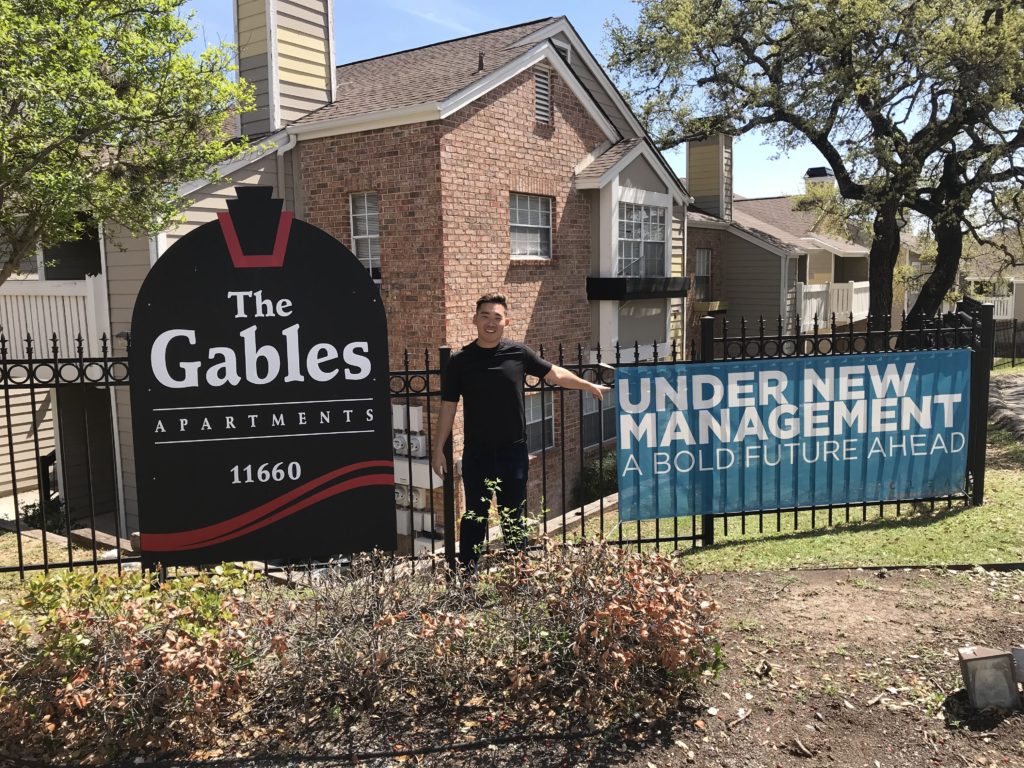
Today, I buy apartment buildings like this 193 unit in San Antonio where I work with a deal finding specialist on my team but it took me almost ten years to get there.
When I started this blog/podcasts I was totally into these Turnkey Rentals. I even started to blog on a couple of them in detail:
I moved onto bigger more scalable assets mostly because of stuff like this happening:
“I do have some unfortunate news. My crew showed up this morning and there was an empty police car in the driveway along with a note from the officer. Overnight, the outdoor section of the AC unit was cut and stolen (no sign of breaking in).
My crew said he spoke with the neighbors (to the right of the home) and at about 1-2 in the morning a black truck was going around the neighborhood cutting AC units and taking them. The neighbors called the police and they came out to do their work. I called the Dekalb County Police and asked them what I would need to do and what the next steps are.
They said, if we want a copy of the police report to come down to the office and present them the case number and if there is any news they would let us know. I have attached photos of the card the police officer left along with photos of the damage. It is very unfortunate and I do apologize this happening. The AC just got inspected and serviced yesterday and everything else is running smooth.
I am waiting to hear back from the HVAC tech about what it is going to replace the missing unit and repairs to the lines, once I receive the service report. I will be sure to keep you up to date with any news or information. Please let me know if you have any questions. Once again, thank you for your time and I do hate that this has happened.”
As much as I poke fun at the asset class and jokingly call it “turkey” instead of turnkey rentals it all started here and is the foundation of my investing portfolio.
If you need a referral to a lender. Join the remote investor incubator I only want to help you get to financial freedom and for you to find your endgame.
Setup a shortcoaching call because it will be worth it.Don’t be like me and buy 10 of these SFHSs because it will be a pain to sell them later to go into more scalable syndications. And really you have to get over the perceived risk.The riskiest thing is staying in garbage stock investments.Yes, I have had 10-15K repairs, but it’s not like its going to kill you if things go bad.
Lenders, turnkey providers, provided in the Passive Investor Accelerator & Mastermind-Mostly Accredited high paid professionals to connect with personally and build your own network (currently 60 members) -27 modules of content in a closed membership site -Bi-weekly Zoom Video calls (25+ on-demand recordings a year plus all library of past calls) -Now with a membership coordinator check-in’s to help facilitate what you are doing and connect you with the right people in the group (if you are shy)
Refer me to a friend via email and I will personally send you both my spreadsheets of usual suspects of turnkey providers plus the questions I used to ask them for due diligence. And let me know if you would like a referral to my exclusive partners.
Here are the books I think you should read before moving forward.
In closure, Turnkey rentals is where most people should start but its really the gateway drug to syndications and scalable generational wealth.
***Put a red circle on your calendar 60 days from now and see where you get… and how much of your family’s time you waste as you consume websites, books, and podcasts.
“I started the Hui Deal Pipeline Club because I want to see each of you get to your goals financially so you can focus on what is really important to you. There are other fundraisers out there that will train their investors down to 10-15% IRRs on crappy deals and do “deals to do deals” or to pick up acquisition fees. Between investing alongside you folks and wanted to grow my track record the right way with the best product I know you guys will keep coming back and bring your friends.”
I’ve noticed you have been lowering the upper limit over time for buying Turnkeys. It used to be <$750K, then <$500K, now it’s <$300K. Sorry, a $350K net worth is low and not likely to be sophisticated enough, and frankly a loss of $50K or $100K is huge. I know you stand to gain monetarily if someone invests with you, but you’ve been lowering the goalpost at an alarming rate. $300K and $500K are nothing with how much money is being inflated today. I like your original number – do active rentals, stocks, savings until $750K net worth, then start looking at deals that take non-accredited investors. It’s no rush.
https://youtu.be/sMGxgbMmsYs
Lane’s Response:
If you found me back in 2018-2019, I thought that Turnkey remote rentals were really easy and anyone could do them… that’s why it’s called freaking “turnkey”. But after realizing that most people don’t have the time to do anything these days (i.e. pick up a dumbbell or go on a light jog 2/3 times a week) there is no way they are going to build relationships with property managers, brokers, etc which is critical to setting up your organization. Basically, most people are incapable of buying a rental just like how most people will never and should never attempt to start a business… and this is why we have day jobs). A further revelation in 2018, was that I realized that my wife would never be able to procure or operate “a turnkey” on her own… now she is no idiot but it further made me realize this turnkey thing is not for everyone. Today my general advice is “it depends” if someone is technically inclined… well versed in project management skills, contracts, and/or good people skills it is very possible for them to go down this path as this ultimately will lead to a better understanding of this real estate rental business which will greatly improve their chances to vet syndication deals and build relationships with other accredited pure passive investors. Maybe I just want to shelter some people from failures or the few nightmare tenants I have had but maybe I am those who are less inclined who have the net worth to just skip to syndications sooner (well before getting to 1M net worth but well after 250k net worth) and take their chances with that. Hopefully they don’t invest with the wrong person who steals their money like what happened to me initially. Someone’s net worth really has nothing to do with their level of “sophistication”, in fact, it is my observation that people with less money tend to do better due diligence, unfortunately, they also tend to have broke, traditional thinking friends and therefore poor networks.
It depends… What interest rate is your debt and how much is your return rate if you invested.
From the macro sense if your rate of return from investing is higher than the rate of interest you pay to your debt servicer then you should invest. Duh. It’s simple. If you don’t get that then that’s what’s coaching for.
Sophisticated investors are able to make 30%+ annual returns with simple rental property (More info – https://simplepassivecashflow.com/returns/). The right choice there is… Invest! What are you waiting for?
Beware your problem might be lazy equity (SimplePassiveCashflow.com/roe) and the opportunity costs are eating you alive. Oh, the cost of ignorance!
All too often I just see this “student debt” or “debt” as a really lame excuse not to get started.
Below are a few affiliate links to loan consolidation companies that can help simplify your debt payments and get your focused on making more money instead of paying off debt.
I tell people you want to minimize your money paid upfront and put money into investing so you want to structure your payments to be more drawn out. Don’t worry too much about the interest rate. Loan consolidation also makes things a little easier because time should be spent on more meaningful things than sitting in front of a computer getting a handle on this stuff. This concept was discussed on Podcast #60 – #LaneHack – Lease Don’t Buy, Push money into the future and invest – https://simplepassivecashflow.com/podcast60-lanehack-lease-dont-buy-push-money-future-invest
Forbes Business Council combines an innovative, high-touch approach to community management with the extensive resources and global reach. As a result, Forbes Business Council members get access to the people, benefits and expertise they need to grow their businesses – and a dedicated member concierge who acts as an extension of their own team, providing personalized one-on-one support.
There are numerous platforms for business leaders but in Forbes, credibility and trust are already engraved in their name.
Lane Kawaoka, Podcaster & Real Estate Syndicator of 1B AUM (7500+ rental units), has been accepted into the Forbes Agency Council, an invitation-only community for executives in successful public relations, media strategy, creative and advertising agencies
Lane Kawaoka joins other Forbes Agency Council members, who are hand-selected, to become part of a curated network of successful peers and get access to a variety of exclusive benefits and resources, including the opportunity to submit thought leadership articles and short tips on industry-related topics for publishing on Forbes.com.
Lane Kawaoka, says “Excited to share my viewpoint of real estate investing to help the hard-working middle-class emulate what the wealthy do and interacting with this exclusive group within the Forbes Real Estate Council Members”
Scott Gerber, founder of Forbes Councils, says, “We are honored to welcome Mr. Kawaokainto the community. Our mission with Forbes Councils is to curate successful professionals from every industry, creating a vetted, social capital-driven network that helps every member make an even greater impact on the business world.”
Featured Articles
How Rising Inflation Impacts Real Estate Investments read here
Why Buying A Commercial Property Is Not Necessarily Your Ideal Investment read here
Expanding Your Real Estate Portfolio: Types Of Real Estate To Considerread here
How The Pandemic Changed Industrial Property: Trends In The Industryread here
How Business Execs Can Better Support Women Leadersread here
Business Slow? 13 Ways To Attract Customers And Increase Salesread here
15 Business Leaders Share Their Best Tips For Improving Customer Acquisitionread here
Want To Retain Your Best Employees? Offer These 15 Perksread here
15 Tips For Entrepreneurs Building A Business From Homeread here
15 Characteristics Every Successful Salesperson Should Haveread here
Sifting Through Mountains Of Resumes? 15 Tips To Sort Them Quicklyread here
14 Strategies To Keep Your Content Platform Ad-Freeread here
Heading A DEI Initiative? 15 Recommendations For Successread here
These 15 Key Factors Will Give You An Edge Over Your Competitionread here
Going On Vacation? Here’s How To Prepare Your Team In Advanceread here
Looking For New Business In A Market Downturn? What To Do (And Not Do) read here
15 Seemingly Innocuous Behaviors That May Be Having A Negative Impact On Your Teamread here
16 Essential Facts Every Founder Should Know About Sellingread here
16 Ways To Balance Growth With Your Social Responsibility Goalsread here
16 Simple Ways To Affordably Grow A Small Businessread here
Want To Be Seen As An Industry Expert? Try These 15 Strategiesread here
Want Better Customer Feedback? Avoid These 15 Mistakesread here
14 Specific Actions For Creating Or Improving Your Product Expansion Strategyread here
Here’s How To Think Long-Term, Even In The Face Of Business Uncertaintyread here
Want Hours Of Time Back Every Week? Try These 15 Small Adjustments read here
13 Effective Strategies For Increasing Market Shareread here
Here’s How To Strengthen Your Online And Offline Brand Presenceread here
15 Expert-Recommended Strategies For Keeping Up With An Ever-Changing Marketread here
Thinking Of Rebranding? 14 Steps For Successfully Making Changes read here
13 Ways To Ensure Regular, Effective Communication Between Departments read here
15 Strategies For Balancing Competing Stakeholder Prioritiesread here
15 Ways Managers Can Encourage More Voices In Virtual Meetingsread here
Here’s What To Do If A Top Employee Seems Stuck In A Rutread here
13 Strategies To Shield Your Customers From The Increased Cost Of Doing Businessread here
15 Key Actions Leaders Can Take To Improve Team Communicationread here
14 Strategies For Leveraging AI In Your Customer Experience read here
13 Gmail Add-Ons And Features To Increase Business Productivity read here
14 Tips To Create An Effective Strategy For Resource Planningread here
10 Innovation Tips Big Businesses Can Learn From Small Businesses read here
12 Free And Low-Budget Strategies To Increase Business Cash Flow read here
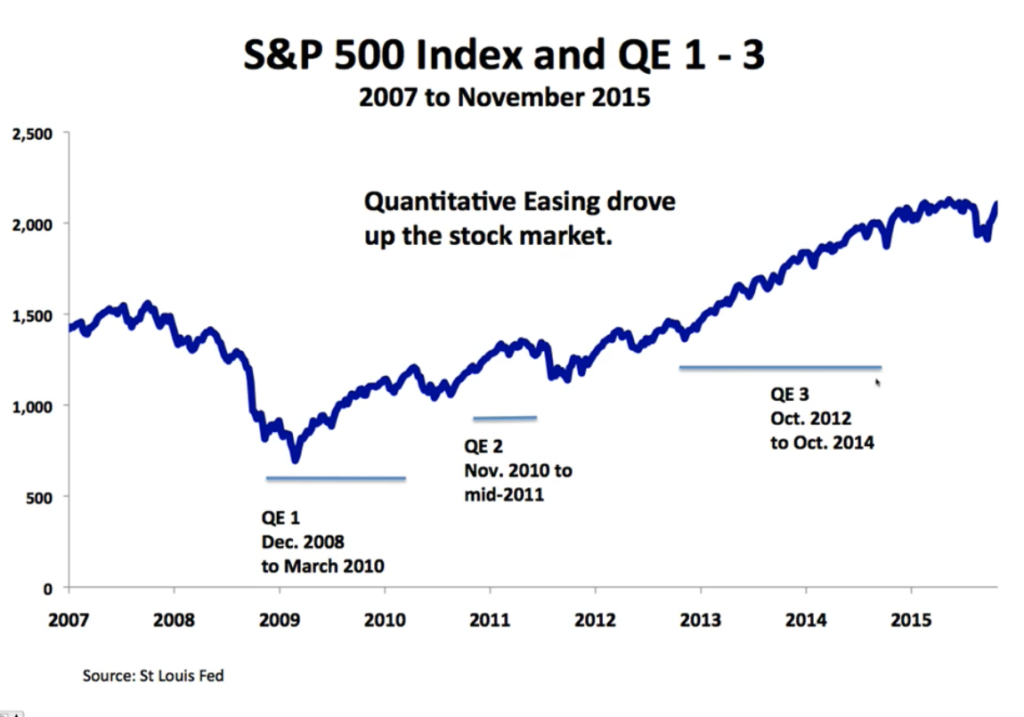
Quantitative Easing created $3.5 trillion from 2009 to 2014
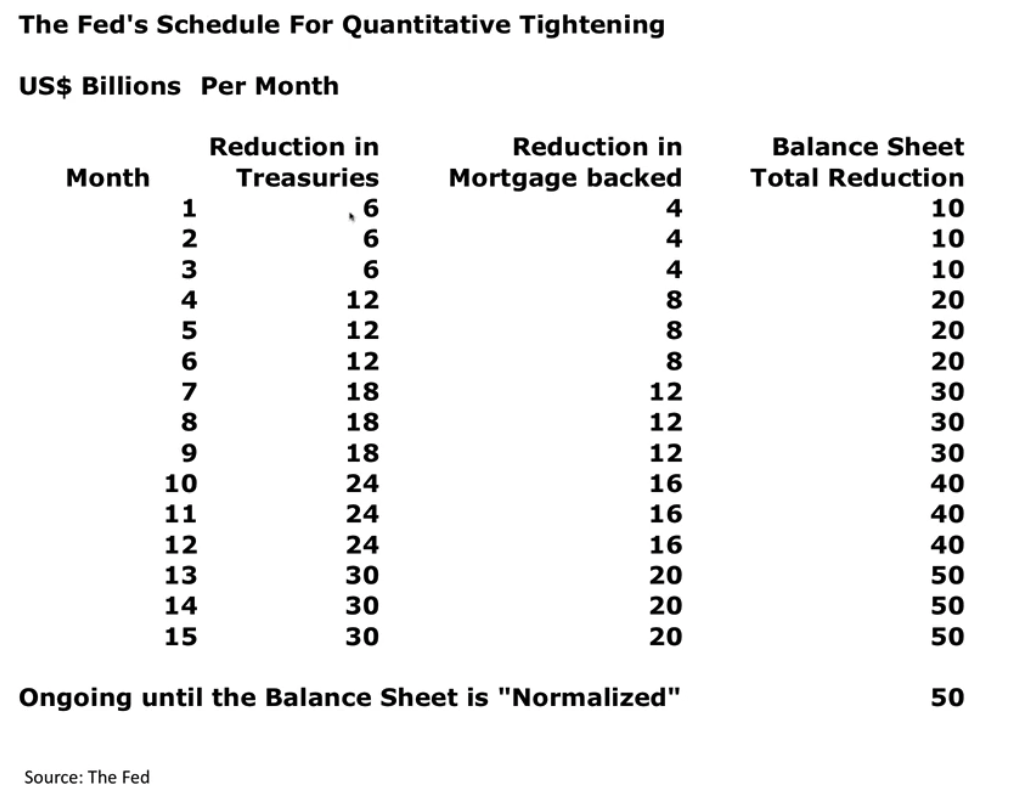
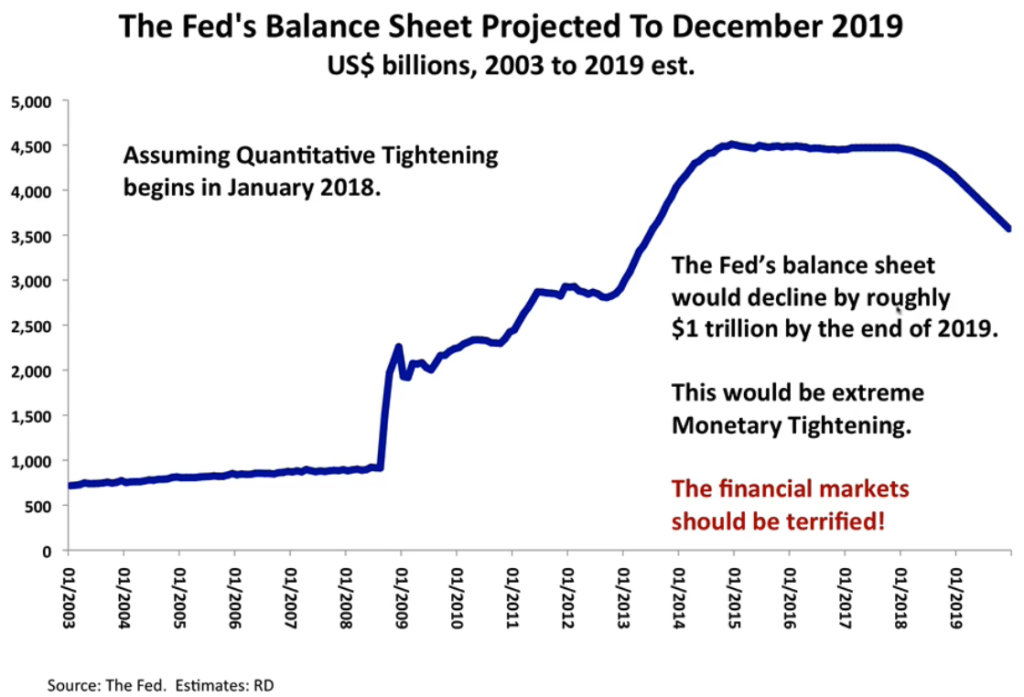
Now “Quantitative Tightening” is coming and will drain liquidity from markets
No launch date but says late 2018 but here is the Fed’s schedule
Do I think there will be a slight correction but the FED is trying to get back some “dry powder” to be able to stop a monumental slide? If there is a 10% plus correction the FED will go back to QE3-QE4.
In the end, don’t freak out just buy investments that are undervalued. If you are new well sorry you need a mentor or you need to push through lukewarm turnkey deals as fast as possible.
Andrew Savikas- Investor, advisor, writer, father. Founder at @yieldtalk. Ex @oreillymedia, @safari. Occasional consultant & speaker. Chronic reader.
1) Your background and your Real Estate investing track record? Andrew Savikas andrew@yieldtalk.com My own journey through crowdfunding, especially real estate
Importance of new crowdfunding choices in helping fuel entrepreneurism (and overall economic growth), especially serving traditionally underserved categories (eg non-males and non-tech companies outside of Silicon Valley, NYC, and Boston)
You should also ask me about the time I had to pick between the Google IPO and a new couch (I picked wrong!) criteria in your site, insights from looking at all though sites, and your recommendation for people to invest in rentals, crowd funding, or direct syndication.
2) Something that you have recently or thought about “burning your cash” on for time savings or an improvement in quality of life. [Andrew] After leaving my last job (CEO of an ed-tech company for 5 years) right after my second child was born, deliberately moved to a lower-cost-of-living place and dialed down work commitments to have more time with my kids while they’re young. Definitely worth it! But I’ll never forget the night I was putting my son to sleep soon after my daughter was born and contemplating the return to a very demanding job that was only going to get more so, and imagining myself 5 years in the future wishing I could trade the money I’d made for more time with the kids while they were growing up.
3) Something that you changed your mind on? Our ego often gets in the way of greatness. [Andrew] Having kids definitely changed my perspective about the opportunity cost of my career trajectory. Has helped me see the benefits of a more balanced portfolio approach compared with driving 1000% down one path. Also, what it means to have a “balanced” or “diversified” portfolio. Was profoundly influenced by Nassim Taleb’s “Anti-fragile” and the concepts of convex and concave risk (and the notion of a “barbell” portfolio).
4) Anything we missed and contact info if you would like anyone to get a hold of you. URL? [Andrew] I’m a voracious reader, and as a side project I started posting lengthy reviews of books that have shaped my thinking about leadership, strategy, business, and more. I’m also super into meditation and mindfulness, and have written about 10 books that helped me apply mindfulness to my life in general, and doing better work in particular. And speaking of books, 13 years ago I wrote a book about Microsoft Word of all things.
OPM (Other People’s Money) concept does not apply to investing in business alone but to real estate as well. It is a strategy most financial savvy do to leverage, borrowing using other people’s money for capital to increase potential returns.
Why burden yourself when purchasing properties for investment if you can pool OPM (Other People’s Money) to start and strategize earlier?
Time is gold, and the clock is ticking!
Crowdfunding resembles the OPM concept. Wherein not only does one investor shell out money but a group of investors pools their money to purchase rental properties, multi-family units, or commercial property.
In a crowdfunding platform, they offer a minimum amount to start investing. It will use that money to manage a diversified portfolio of property projects all over the U.S. A scheduled payout will be established as the investor’s shares grow in value, still depending on the status of the property.
They were one of the biggest Crowdfunding sites however they went under because they can’t afford to secure additional capital to fund additional investor acquisition.
In other words, the marketing to get people to sign up is coming from outside sources (venture capital) and not from their business. This is typical of a tech startup.
How Real Estate Crowdfunding Works
Crowdfunding has websites that most of the time act as the connections between the company behind the website, the one looking for investment opportunities, and the investor.
A well-founded crowdfunding website (or company) must be a good negotiator of properties that they’re buying and can attract legit investors to profitably fund the opportunities they’re eyeing for. Moreover, they need to collectively pool money that can be used to invest in the company’s future.
Advantages and Disadvantages of Crowdfunding
Advantages Accessible to anyone No experience needed Exhibits positive returns as compared to a savings account
Disadvantages Capital can be at high risk Undisclosed penalties may be present Lack of control as an investor Poor liquidity
I’m doing some research on Crowdfunding sites (although I always prefer working directly with the operator as opposed to using these middlemen platforms). A lot of Hui Deal Pipeline Club members have been collaborating on this and been using Equity Multiple.
As a syndicator I don’t like using these sites to raise funds because: 1) I don’t have access to the investor contacts which totally kills the referral marketing for future deals and 2) we tried it on a previous deal where the Crowdfunding site committed to raising a small portion of our total raise and they fell on their face..
Not saying that the Crowdfunding sites will never be effective but at this time it is not a useful means for experienced syndicators who already have investors of their own..
Beware as an investor! Its like trying to find a mate on Tinder, this is a controversial subject I know. But for many, there is a reason they are on the “open market” and cannot attract “capital” on their own from their own personal network..
Fundrise & Realty Mogul have launched “eREITs” which tries to tackle investment vehicles other platforms are not capitalizing on.. It’s interesting to watch how they trademarked “eREITs”.. Definitely a sign where investing is going.. Again institutions controlling and taking a cut away from the little guy.. 🙁
BLACKHAT TACTIC 😉 Some deals are put out to private networks (like the Hui Deal Pipeline Club) and these crowdfunding sites simultaneously..
Many times the crowdfunding site offers a 7% preferred rate where the direct source offering gives a 8% preferred rate. Tricky ,tricky if you ask me!.
Now one could backward engineer this all and go around the crowdfunding site but still, like I always say, YOU DON’T KNOW THESE GUYS..
Syndicator’s are running around out there without any operator experience or portfolio of their own and doing deals with people just off referral.. A recipe for disaster if you ask me!
Here are comments from Hui Members:
“I’ve invested in 10 you have listed and am familiar with quite a few others. The best on your list are yieldstreet.com, groundfloor.us and streetshares.com. I have had 12-14 % returns with all three. Hedgable.com is also a good site for investing in the stock market.”
“Some of the companies have questionable backgrounds make sure you google ‘company name + SEC infraction.”
“Chicago company that was recently shut down for allegedly running a Ponzi scheme. They promised investors returns of 15% to 20% on Chicago real estate. This is a huge red flag in my opinion. Those returns are extremely tough to achieve in Chicago, even in “high yield” areas.” Read the related article here.
“The returns started around 15% using my criteria but have leveled off to about 8% since then and I expect it to remain as this level.”
“Lending Club – This is UNSECURED debt. This is also known as peer to peer lending.. Like a guy needs to borrow 3k for a table saw for his business or someone has a broken car.. Good user experience and the information on the dashboard provided is much more readable than Prosper.com.. One user says “my net annualized return is 12.37 % and Adjusted net annualized return is 5.6%.. Both information is easily readable on the dashboard and it gives an easy to read view of the payments of how much principal, interest, late fees.. Also gives a good view of the notes itself like issued, in grace, fully paid, late by 16-30 days. It has automatic re-invest and liquidate quickly.”
“PeerStreet – Works like Lending Club but is Secured by real estate.. They also give you quite a bit of information on borrower as well as the property details (LTV, Stressed LTV, Improved LTV, borrower’s FICO, etc.).”.
“Prosper – It does same as above Lending Club but not as good dashboard information interface.. It has automatic reinvest.”
Crowdfunding websites seem to show a lot of opportunities. Perhaps in a decade or more, it can be a viable solution or alternative to syndication.
https://youtu.be/1ErFrGnkcH4
“Yieldstreet – It’s for accredited investors only – So basically for people who are Rich already!”
“Some of the more established crowdfunding sites are starting to lower their returns because they have achieved a good sized crowd.. It’s still a wild wild west space with many platforms/website jockeying for position.. Many are offering high rates of return and under-collateralizing themselves in my opinion for market share.. Beware some have fraud in their past so make sure you do a little Google-stalking to dig up the dirt.. When I evaluate deals for the Hui Deal Pipeline Club, I realize there are so many deals out there that if someone has a questionable past, I just move on.. Too many good people doing good deals to not be choosy.. This is a newbie mistake I see a lot in private placement investors that they marry the first deal they get pitched at a local REI meeting.. It happened to my partner who lost $45K and myself who lost $40K.”
“Overall what I hear from you folks trying this method of investing is that the default rate is higher than what is expected and the middle man (crowdfunding site) is getting rich here.. But hey if you are not good at networking these are the table scraps you get.”
Note: There is a lot of consolidation in this new space. Think of the many competitors there was before there was the eBay or the Amazon. I get website alerts of the below sites going offline all the time.
https://alphaflow.com AlphaFlow helps investors build diversified real estate portfolios across the crowdfunding industry. Make informed decisions, faster.
https://agfunder.com AgFunder is the premier marketplace for the most promising Ag and AgTech startups seeking to raise investment capital from accredited investors.
https://1000angels.com Build your own venture portfolio, free of management fees or carried interest.
https://angel.co – OUT OF BUSINESS. Private single-deal VC funds led by top angels.
https://yieldstreet.com YieldStreet connects investors to originators with deep expertise in alternative lending.
https://circleup.com CircleUp lists companies for you to review across a spectrum of consumer product and retail categories. Browse or search our portfolio to find opportunities that interest you.
https://crowdfunder.com Venture Capital: Crowdsourced. Invest in many deals at the same terms as leading VCs
https://www.crowdstreet.com CrowdStreet provides superior technology solutions that enable all investors to directly connect, invest, and create wealth through real estate.
https://fundable.com Fundable is a powerful fundraising platform that enables Startups to quickly engage a large network of Backers to raise capital.
https://fundersclub.com Invest in the world’s most promising startups. Diversify your investment portfolio with insider access to highly vetted startups from Silicon Valley and beyond in just minutes.
https://hedgeable.com We are the only digital wealth manager to offer curated investing in venture capital.
https://homeunion.com – OUT OF BUSINESS. Build a diversified residential real estate portfolio using HomeUnion’s end-to-end services of property selection, acquisition, management and sale to match your financial goals
https://ifunding.com -OUT OF BUSINESS. Revolutionizing Real Estate Investing. Individuals invest as little as $5,000 in institutional quality real estate.
https://lendingclub.com Build a diversified portfolio that can offers solid returns, low volatility, and monthly cash flow
https://lendingrobot.com Automated management of your existing Lending Club, Prosper, or Funding Circle accounts.
https://lendinghome.com Build your own diversified, institutional-quality real estate portfolio in minutes. LendingHome offers high returns and durations of just 12 months or less.
https://www.macrocrowd.com We work with investment specialists who have vetted billions of dollars in real estate developments. These industry giants provide us with exclusive investment opportunities for our platform’s investors.
https://microventures.com Get access to highly curated early and late stage investment opportunities
https://nextseed.com Invest in exclusive, pre-vetted deals that used to be available only to the wealthy and well-connected.
https://peerrealty.com PeerRealty is the premier real estate crowdfunding platform. Gain insider access to high quality opportunities with top developers.
https://www.peerstreet.com PeerStreet is a marketplace that provides unprecedented access to high quality real estate loan investments.
https://prosper.com Investors can earn solid returns by investing in personal loans listed on Prosper
https://seedups.com – OUT OF BUSINESS. Connecting Investors with Technology Startups
https://selequity.com Selequity connects accredited investors with the sponsors of commercial real estate (CRE) investment offerings. Our national network of accomplished real estate professionals assures you’ll have unique access to investment opportunities.
https://sharestates.com Invest in real estate with as little as $1,000. Faster access to capital for real estate developers.
https://upstart.com We go beyond FICO scores to finance people based on signals of their potential, including schools attended, area of study, academic performance, and work history.
https://wefunder.com Back founders solving the things you care about. Grok the risks, then join 93,004 investors who funded 155 startups with $35.5 million.
https://acquirerealestate.com –OUT OF BUSINESS. Acquire Real Estate identifies, underwrites and pre-funds high quality commercial real estate properties. We then offer the opportunity for accredited investors to invest alongside us.
https://www.wealthmigrate.com/ Wealth Migrate is the leading global real estate investment marketplace, giving investors direct access to exclusive real estate investment opportunities in premier markets around the world.
https://neighborly.com/ Invest in the places you live, work and play. Neighborly is modern public finance.
https://www.instalend.com Invest online in senior debt real estate opportunities and earn monthly distributions
https://www.realcrowd.com Build relationships with commercial real estate companies and invest directly in their investment opportunities.
https://www.venture.co Diversify how you invest with access to new private companies in exciting industries raising funding with offerings open to both accredited and every day investors.
https://streitwise.com A new way to invest in real estate designed to be rewarding and accessible for everyone, stREITwise cuts out the middlemen and passes the savings on to you, the investor.
https://www.iselectfund.com/ iSelect works with accredited investors to assemble a diversified portfolio of the Midwest’s most promising emerging growth companies through their own financial advisors.
https://www.realtyevest.com RealtyeVest is an online marketplace that connects investors and sponsors (real estate owner-operators) to crowdfund exclusive real estate investments.
https://www.arborcrowd.com ArborCrowd is an online commercial real estate company. By allowing people to co-invest with successful real estate deal-makers, ArborCrowd enables millions of investors to maximize their financial returns.
https://crudefunders.com Using Crudefunder’s innovative online investment marketplace, we provide sophisticated and beginner investors with the opportunity to invest in Oil & Gas Projects.
https://www.cityvest.com CityVest is an online marketplace where accredited investors can pool their capital to buy shares in institutional real estate investments.
https://www.rabbleworks.com Rabble is an impact investing platform that connects people with projects that strengthen communities.
https://firstrealfund.com First RealFund’s Mission is to identify, offer, co-invest, & manage superior commercial real estate investments with capable owners and quality assets.
https://www.honeycombcredit.com/ Honeycomb allows local businesses to borrow loans of up to $50,000 directly from their own loyal customers for business expansion projects.
https://fig.co A publisher where you can get a share of revenue from game sales – we bring together developers and communities from all over the world to publish great games.
https://www.buytheblock.com Buy The Block online investing in real estate with your peers. Pool funds, share knowledge, vote on a property to invest, efficiently manage accounts online.
OPM (Other People’s Money) concept does not apply to investing in business alone but to real estate as well. It is a strategy most financial savvy do to leverage, borrowing using other people’s money for capital to increase potential returns.
Text “simple” to 314-665-1767 to download the Hui Google Drive files and the 2018 Rental Property Analyzer
Please help the show by leaving a review: http://getpodcast.reviews/id/1118795347
Join the Hui Deal Pipeline Club! SimplePassiveCashflow.com/club
Pardon the grammar – I’m an Engeneer, Enginere, Engenere… I’m good with math! Here are the Show Notes:
Currently have 5 rentals and 80k of income and trying to paying off rentals because near retirement
Also flips properties where the goal is 20k profit
He outsources much of the work
Got rentals in 2011 and regret not doing it earlier
Got hammered in 2008
Got out of the market in 2000
Interest rates are very low which is different that past times which means a good time to lock in loans, stocks are pretty high
Real estate is not for everyone and might have a wrong skill set
If you don’t want to do the work be a hard money flipper but only make 10% (you need to have the money)
Don’t lend to someone doing their first flip
Need to hire a virtual assistant – 5 properties can manage by self
Let go of politics
Marriage advice
Begin with the end in mind – He already knows his legacy and just lives it
Teaching kids financial principals – mindsets and habits
To teach a 12-year-old – give them money
To teach a 30-year-old – they need to want to fix the money problem
Letting go to be happy
richersoul.com
Text “simple” to 314-665-1767 to download the Hui Google Drive files and the 2018 Rental Property Analyzer
Please help the show by leaving a review: http://getpodcast.reviews/id/1118795347
Join the Hui Deal Pipeline Club! SimplePassiveCashflow.com/club
Pardon the grammar – I’m an Engeneer, Enginere, Engenere… I’m good with math! Here are the Show Notes:
Mark Allen is a broker
Started in 2009 and went to Westpoint Academy
Got a $35k loan to get started in FL
Started with subject to or assuming the loan method of acquisition
2015-2016 sold initial properties and started flipping properties while working the day job
lead to MFH
Saved the money from flips and day job to go into MFH
You can find Mark at SVN and check out his podcast
ROI on time is more for Commercial than residential
Provide value by driving properties, pictures, transaction beat
Yadi matrix, co-star offer owner data
Face to face is better than email or phone
Bring 80-year-old sellers flowers
once or every two months a touch point with some value
As an investor go right to the broker and all of them
CCIM is a higher level designation (but that’s your job as an investor to know what a deal is)
Loopnet/correct C is a good way to find active brokers who are perhaps hungry
SVN, Marcus, Colliers, JLL, CBRE are popular brokers
Call brokers and introduce yourself
Share pitch deck with broker and share team so you show that you are credible






 –
–