Should You Buy a Tenant Occupied Property?

https://youtu.be/QVI18k0phOM

Yeah, my question had to do with tenanted versus non tenanted properties. And this question is coming from a place of, with the government prohibiting evictions. If you will, what are your thoughts on purchasing a, like a tenanted property? Is it better to go to a property that is intended to, so then you can do a more, I suppose, thorough background check on income and things like that.

I’ll give you my thoughts, but everybody has different thoughts on it. If you have section eight and non section eight type of property, so that’s a class C or worse or B or better, I’d say it’s two different answers. So maybe I’ll break down the section eight on first on a lower class property, I would always recommend having section eight with it, guaranteed rent that clientele under 800, eight 50 a month rent, which I never recommend.

Yeah. I still see you guys looking at pieces of crap properties for $60,000. Stop doing that, please. These guys, they don’t have any money. They don’t have 500 bucks in their checking account. You need the government to be paying, hang their rent for you. And I think you’re pretty solid in terms of the government’s always going to be paying that, that program stock going to be going away.

I mean, a lot of the stimulus money is going to bolster those reserves that said if I were to be buying that lower class property, I would want a in place only problem with section eight there. I think they’re better tenants too. Because they want to stay on that coupon program. They don’t want to get kicked off and they’re screwed.

The only problem is like getting the people in there. Cause it’s a little bit more stringent regulations. So I’m getting them in there. I don’t know, I’m not a property manager. I’m a passive investor, but like things like the baseboards on the walls need to be a certain height. So the rats don’t get it like silly things like that.

Your product and your property managers should know all these. And when you interview them, you should check the box. Yeah. If that’s section eight, I know, I know the depths, the inspector comes in and inspects the house for these lists of things. Yeah, no problem. Then that should be the answer. If it’s a nicer class property, this is where, like in the beginning I would want to be cheap.

I would want to buy the property with a tenant in place. Cause I thought I was. Being super clever and saving 500 bucks, at least something fee often when you’re cheap, easy and free, you get burnt in the future. And I did because come to find out that seller just wants this stuff, any warm body in there.

And I had no recourse and I had no insight on what that tenant was. There are some ways you can mitigate that by saying, Hey, I want to see their credit report. I want to see the background check on this person and running yourself. Sometimes they’re not going to give that to you. And then I think the best practice is to get your property manager.

On board and have them tenant to house themselves that way it’s their fault. If they bring in a bad person, they don’t have that excuse of like, yeah, I was a stepchild. I just inherited it. There’s stability with a tenant. The tenant is like, what the heck? I just signed with this guy and I got this new dad.

It just makes that sweeter transition because you’re always going to have a changing of a sheriff. Type of situation and you want that more stability to me, I would just, when you tenant get a tenant in place, when you buy it, you’re saving two 5,500 bucks, like a half a month’s rent. I would just rather pay my new guy to do it.

This is getting a little advanced, but maybe I would tell the seller like, Hey, can you just drop the price by 500 bucks or 200 bucks? I’ll go get my own tenant. At risk. I’m cool with not having intentions and they might actually like that. Right. So it’s, again, it’s a conversation again, I wouldn’t be making decisions this decision on your own.

I would run it through your property manager and saying, Hey, here’s this dilemma I have, I can either get it tenanted, or I’m going to have you do it. What is your thoughts here? There’s risks, right? He could not tenant for you for like two, three months. That’s a risk that you have to take. Chad, Peter, you guys did it both ways, too.

What is your guys’ thoughts? Well, my case was kind of special because I bought my property at the start of COVID. So my property, when I first purchased, it was not tenanted. And then COVID happened, then everything was shut down. So I couldn’t get an inspection section eight inspection for a couple of months.

So that kind of slowed me down on getting my first tenant in the property. So mine’s a little bit special. I think for me, um, I don’t have any section eight. I try to stay away from it. If the purchase price or the deal makes sense, then maybe I would consider it. But I just can’t, I can’t really speak to the section eight itself, but then when I’m looking at new properties, although there’s, there’s a lot of, you’ll see on the MLS that has 10 occupied it.

And the least goes to whatever, if it’s a good deal, then maybe, but I consider it a risk just because I don’t know the tenant. And I don’t know how well the property management, the former property management company did things over there. So, you know, there could be issues that you’re not aware of, but especially.

From the tenant side. And you can ask like, you know, Hey, give me your rent roll and try to verify things like that. But it’s not a guarantee you might look good, but you don’t know anything about the person. So all the properties I bought there were, there was no tenants in there. So, I mean, that’s just my opinion.

One on a clean slate. Give me something that I can work. My property management teaming, like what lane said, put them on the hook. It’s not the former. People’s fault. It was just do it from the beginning and just start claim. But I expect a lot of deals out there in the future that will have tenant occupied until something.

And so that’s just something you need to consider, but work with your team and figure that out. If you find a good deal, then it’s worth exploring by. I try to avoid it. With the whole COVID element in play. You’re right. There is a little twist on occupancy is done by maybe a couple percentage points of guests.

But again, you’re trying to buy the best rental property on the block. That shouldn’t matter. You should transcend any big data. Anyway. And a lot of the people not paying rent are mostly people in the blue States, right? I’m telling you this from experience, I’ve got over 4,000 units. Now, people in red States, Midwest, South, Southeast, they just have a different work ethic.

They’re not this like socialists capital of California, kind of nonsense of hashtag free rent. They have a good work ethic. They understand it.

Accredited Coaching Call – CPA from Hawaii

https://youtu.be/0NaO8faSOdY

What’s up guys on today’s podcast, we are going to be interviewing on a coaching call and a credit investor who is a CPA here in Hawaii. We’re going to dig in and see what his net worth, see what he’s been up to and advise them along. But before we get going, and I just wanted to give some commentary on where we are in the year 2020.

I think most people will say, it’s been a pretty rough year. depending what you’ve been up to. we’ve been. In our week group, we’ve been pretty much prudent picking up deals that cashflow staying away from more of those class C deals that have bad collections, that tenant base. And I’m thinking of better assets with better tenants, with a little bit of a value add.

I don’t see all the strategy can go wrong, right? if it’s cash flowing day one, you underwrite it where the occupancy can drop 20, 30% and you’re still in the black. I don’t see why. Why you would need to wait like this narrative, a lot of people go by, Oh, I’m waiting until their lecture. I’m waiting until next year. Just three reasons why I think waiting is just a bad idea here. Like number one, you’re not gonna have access to those deals. If you’re not already in the game plan, you’re not going to have access to those relationships, the lender relationships. And you’re not going to know what the deal is.

Most people who say that assert the guys get started. Number two, I’m not buying assets that are distressed deals. Anyway. if you notice that my stuff is 90% occupied or more so I can get that Fannie Mae, Freddie Mac debt, but you per se, I don’t really go after distress assets. And I think like a lot of these guys are saying, they’re going to wait till this distress inventory comes online and I’m like, dude, you’re not even a sophisticated investor.

You haven’t bought anything. What are you going to do with the distress asset? It falls into your life. You’ll probably screw it up. I don’t want, I don’t want to touch those distress assets. Neither, personally. I like stabilize ass to make it go. And lastly, by the time you’re ready to jump in. How are you going to know?

Like we, did you jump in around 2009 to 2014? No, a lot of people did it. They didn’t know when the bottom was maybe because they didn’t have the relationships and connections. Those who are already in the game strategically and prudently picking up Castro were the winners back then. And I think that’s what it is now.
And I do believe that this will all pass and I don’t follow people who are trying to get rich off doom and gloom and getting people to buy gold and get a little bit affiliate commissions done in that way. A little bit of me personally, lately, I’ve been trying to not work 12 to 14 hours. Been taking a little bit of a lunch break.

Normally I just work right through, but I, make my simple little lunch put on the YouTube. And yesterday I was watching a video by Kevin O’Leary, the shark tank guy, people call him mr. Wonderful. And I’m looking here with a video. If you want to look it up, how I made my first million dollars part one, it’s a 20 minute video, but I thought it was pretty cool.

And he talked about it, the story of how. No, you can get tricked into taking a salary. He gives a story. He repeats a story a lot, but I’ll summarize it, he, his first job was working in ice cream shops. Who’ve been ice cream. And the reason why he did it was there was like a cute girl next door in the adjacent store.

He wanted to be close to her. So he took that job. And after his first day at work, he was scooping ice cream and they’re wrapping up shop and. normally when people ask for samples, they throw their gum on the ground. And it’s, I guess it’s really nice Mexican tile. It looks really beautiful.

And so he was wrapping up and then the owner told him to go pick up the gum that people dropped on the floor. And of course, he sees the girl in the adjacent story. He doesn’t want to bend down and do it. And he’s no, you paid me to scoop ice cream, not like scraped gum off the floor.

And then she told him to get on his bike and never come back again. And today he’s very thankful for that. Because after that, he said he never really worked for money now, I think not a lot of people were like, mr. Wonder, he comes, it comes across as a little jerk. But I think that, a lot of people that they follow their career path a little bit too long and it never really go after their passions.

And maybe they’re, they just want to hit a financial freedom. That’s cool too. And a job is a means to the end. Not everybody’s going to become an entrepreneur and crack that $5 million, $10 million, $15 million net worth level for a lot of us, they listen to the civil past the cashflow that come out to our events and know your guys’ profile. You guys are hardworking professionals. It’s not practical to tell your boss that you’re just here to scoop ice cream. You’re not going to pick gum off the floor. You got to go pick up gum off the floor because you guys got a, you got families and you got to put food on the table.

But I think for me, the takeaway and where I disagree with mr. Wonderful. Here, you got to pick up gum off the floor, but if you put your money to good sound investments that all perform the retail stock and mutual fund market, and he’d do it in such a manner where you paid very little taxes. you guys can check out my taxes on school, passive cashflow.com/tax, but that’s enough on that.
you’re going to get financially free. And, I’d say under a decade, if you’re able to save 30 and $50,000 to investments every year. maybe your goals as in five, 10, $15 million, but mr. Wonderful kind of also outlines, how do people get to that level? Five, 10, 50, a hundred million dollars net worth.

Now maybe I don’t aspire to be there and maybe you don’t either, people who get to that level. There was always this getting to this pedestal of your first million dollars. And somebody talks about in this video is stories was going and learning how to be a cinematographer, making videos.

And that was his trade. He made a deal with his business school to make a MBA video promoting the program, but he just made like 40,000 bucks, but he parlayed that into another venture. Putting together short bits. And then he eventually sold that company or a, undervalued dollars amount of money, but that allowed him to get into the next software venture with another person who did the software.
He sold it. And that was obviously a soft key and his other business there that parlayed into the five, $10 million plus range. But yeah. all these entrepreneurs that you see that are very famous, it’s usually about two or three steps, two or three things that went right for them to get there.

And they’re outliers, I’d say most of us that are listening on the podcast. We’re just trying to get our first one and then invested smartly. And yeah, you may not do some business venture, but your job can get you there. Especially if you’re making over a hundred, 200 grand a year. If you just invest there, Be smart with taxes. You’re not going to make soft key, like how Kevin Larry did and sell it in a few years. if you work at your job for 10 years or maybe even 20 years, if you’re doing it the slow mutual fund way, it’ll get you to that first level. And once you get up to that first level, that’s where you take it up to or legacy wealth creation.

I talk a lot about, getting to your first hundred thousand dollar level for the guys in the incubator group, getting their preferred keys. And then once you get up to the half, a million million dollar Mark is a net worth, and then you get to this, a credit investor status. But for those who are credit investors, the next nice threshold they get to is a three and a half, $5 million market.

At that point, you’re able to live pretty comfortably. And when he talks about this video as most entrepreneurs. At some point, they just realize that they’re rich, they’re affluent at that point. And it’s a very binary thing that you’re living very cheapy me personally. I feel like I’m still pretty poor at this point.

Maybe I’ll one day I’ll have that epiphany, but check out the video, how I made my first million dollars part one asked mr. Wonderful is the YouTube and continuing to watch more of these, inspirational videos. But yeah, enjoy the coaching call. And if you guys would like to get on a coaching call and we still do these four volunteers are willing to put themselves out there.

I haven’t checked out the website yet, and there’s a whole bunch of stuff out there. One thing I would suggest is if you’re looking for some kind of activity to do in the winter time from home, try and check out our guide on trade lines, go to simple, pass a castle.com/trade lines. It’s a great way that I made at least $10,000 these past two years doing this on the side, renting out my credit card slots, my authorized user slots on my credit cards.
And if you haven’t yet join our club at simplepassivecashflow.com/club. 

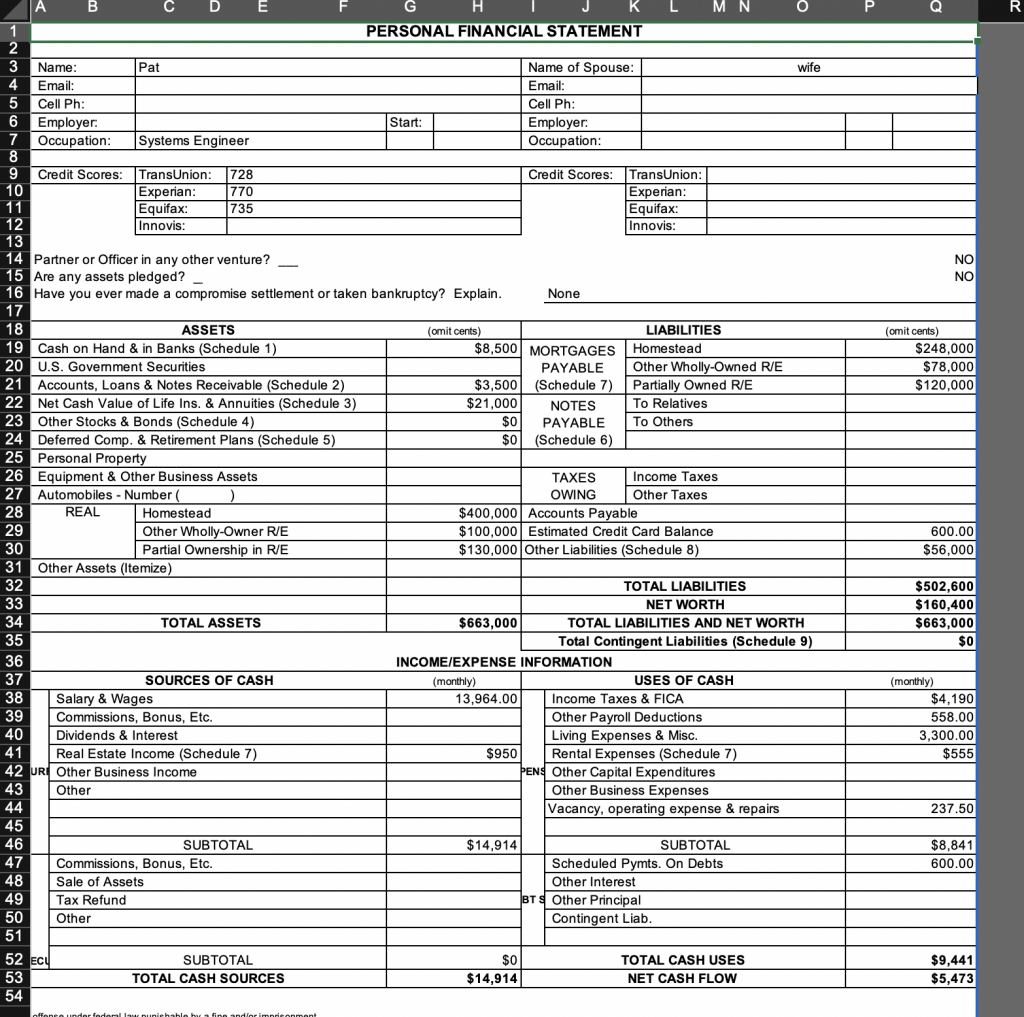
Hey, simple passive cashflow listeners. Today. We are doing a numb, another who we member coaching call. And I think this one’s gonna be a good one. We’ve got a credit investor here worth 1.2 million bucks, a semi high income earner, not too high, like in the three hundreds, like some of the doctor dentists we’ve got, but definitely making a good professional salary.

So this should apply to a lot of you guys. But we have Brian, who is a CPA from Hawaii, a local guys here, but yeah, Brian, why don’t you tell us your story a little bit. Give us the context. Before we start digging into your personal financial statement. Yeah, sure. So like many folks, I ended up leaving Hawaii and I went to college on the mainland.

I got my undergraduate degree from Oregon, a school in Oregon. And after that, I was fortunate enough to get a job here back in Hawaii. So when you get a degree in accounting, usually start off as like in public accounting, working for a firm. So that was the route I took. I was doing, assurance or audit work.

And after about three and a half years there at that firm, I was like, I don’t think this is really for me. I don’t think it’s going to be, I’m not going to be in the partner track. so to speak. So I jumped off and went to private industry and I’ve been there ever since. I’ve worked a few different jobs.

I actually ended up working for a few real estate companies and I’m still working for one right now. They’re a developer of resort properties. And golf courses and similar type acids and yeah, that’s basically it. Oh, and prior to that, I was working as an analyst for a home builder, a national home builder.

So I was able to get a good grasp on the numbers side of working for a real estate company and working real estate deals. But now I don’t really do that. I focus more on the accounting side, so not as cool. That is exciting. And sexy, but it’s a job. Yeah. Pays well. And just for a little context, probably of a, I would say nine, 10% of the members are actually here from Hawaii, but it’s so Brian and I actually went to the same high school.

I don’t know. We haven’t seen each other since what, like 15 or 20 years ago. we’re on the golf team. We both kind of suck. yeah. And for those of you guys don’t know the bottom tier guys. Yeah. Like they send us out and because we have to play for a position, but it’s just we’re just here because it’s free.

And our parents told us to do it, told us to do it because this is the way to stir up resumes to get into college. At least that was what I was told to do. but yeah, so people in Hawaii, they usually go to school in the mainlands because the school is not too good here. Yeah. How long were you on the mainland?

Like after college working? I actually didn’t really work up there. Stayed up there for a little while after I graduated, but I graduated when times are pretty tough. So to speak is like 2010, 2011. So there were too many jobs available. I probably didn’t do a good enough job marketing myself when I was in college also.

So yeah, it was, I was lucky to get a job here. I think. Yeah. Around that time. Yeah, no offense, man. But you and I are similar. We’re like underperformers at the, the corporate life, which is probably why they didn’t read, circle you to a be partner or level thing, which is why we’re here.

And this is why your net worth is this way, because you chose a different path along the way. Possible. Yeah. Any feedback for younger guys and the CPA track? Cause you, you look like you’re 25, but you’re really actually Oh, you’re two years younger than myself. You’ve been working for quite a while.

how does it kind of work? You’ve worked for four years getting coffee for people or. How does it normally work? Yeah, I think it’s probably similar across the nation where you start out at a firm, you work these long hours doing pretty menial tasks. You’re the grunt, the low man on the totem pole, but I still would recommend.
That folks that are doing accounting out of college do work for a firm. I think you gain really valuable experience doing those horrible menial tasks for years and making a pretty poor salary. But yeah, overall, the experience I would say is it’s pretty good. And you come out of college with.

Sort of a year, your own group or cohort people that are similar aged with you. And they all are hired to firms at the same time. So it’s a nice stepping stone into work in the real world, so to speak. So you’re working with people that are your same age and similar experience and background a lot of times.

So it can be fun a lot of times. And also horrible, but yeah, I’d definitely recommend it. Yeah. So we break that we work backwards. The net worth is the score, right? A $1.2 million net worth. You make about 90, a hundred grand a year, living in Hawaii where salaries are maybe like 20 or 30%, less than counter promise on the mainland.
When I first see this, I’m a, head-scratcher all the C I do, unless somebody gave you a lot of money. She think you got a little help, I think, right? Like shit for a down payment, but not much, but I automatically know right now that you did something real estate probably related. I’m just have a hunch.

I kinda know, but tell us about like, when did she start investing in real estate? Because I see this all the time, right? Like doctors, for example, they make over 300 grand a year. I very rarely see them above one to $2 million network. But the guys who are investing and doing this stuff, like there are like three, four, five plus million at least.

So it’s like night and day numbers don’t lie. So tell us, how did you get to 1.2 here? Yeah, I guess part of it was luck and a lot of. some unlucky ness also, but I started young when I was about maybe two years out of college. I bought my first unit and it was a fixer upper that required a lot of a sweat equity, so to speak.

So I bought it. it was what’s called a leasehold property, which is common here in Hawaii. So people were overlooking it and while it was a leasehold, the fee was actually for sale. So you could buy it. Outright and own the unit. So I was able to get it all in with the fee at about 300 little over 300,000.

And I put in about maybe 20 or $30,000 of work and materials. And that was my first place. And I lived there for about three years, maybe two or three years. And I had a roommate also because it was two bedrooms. So that helped me out a lot, as far as paying down. My monthly expenses. So how’d you get the dump for that?

Cause it was like, yeah. So I was able to save up enough for the down payment myself. But on the fee portion, I had, a loan from my parents that I’m actually still paying them back right now. So I borrowed about maybe close to a hundred thousand from them to purchase the fee on the unit. And eventually I was able to refinance the whole package together.

To get a fee simple loan on it. So yeah, my parents definitely helped me out with my first place with the cash. they own rental property themselves. They used to. Yeah. Yeah. And the one of the units on my sheet is really, I code with them. So that’s a rental unit that they own, and they actually bought it for me when I was in college with the intent that I would live there.

But I stayed up on the mainland for a little while and then they ended up renting it out to a family friend. yeah, it’s the one that’s like on the bottom, the last one there. Okay. Yeah. So I. Yeah, I don’t really have anything to do with it, honestly, but I put it on there because I was able to get a line of credit on it because I’m technically the owner on it, but yeah.

I mean that worked right. That got you started. we could have, they could have not done that. You probably just working on your ratchet Subaru WRX drinking beers in someone’s garage right now. Just go into your day job, right? it couldn’t, that could very well happen at that point.

Yeah. Yeah, no, definitely. I, my parents definitely had a positive influence on labor. They’ve had rental units as far as long as I can remember, they had some, even off Island and out of state. So not anymore other than this one, but yeah. Yeah. that’s why we both went to the mid-back writer turns to cut in and have some money.
Not rich, but yeah. It was, I was fortunate enough just like you. I think my parents actually sold one of their houses, I think too, to put me to mid back in college, but I never really did that. though, they just did. Okay. Yeah. Yeah. But you and I both know that a lot. Yeah.

All of our classmates started like trust fund kids. And their parents did it incredibly the wrong way where they just paid for college. They, the kids didn’t do anything. And now we’re seeing them all like the grandparents, parents dying right now and giving their one to two to $3 million estate and then just buying a bigger house to live in.

What they did here is not to say there’s a lot of different ways to generate the second generation wealth. But this worked. So note that, some of the older listeners can, I think can, should think of that. what, looking back, would you do the same thing? you don’t have kids, but like that’s sparked it.
All right. Yeah. I think so. It was a good experience fixing all my first place. Some of it good. Some of them did that, but yeah, it was definitely a learning experience. Yeah, for sure. I think that’s the hard thing. A lot of people just can’t get that first 30 grand right. To get started. Yeah.

Yeah. so the next thing I look at here is after we look at like the net worth, I know where to start which side of the couch to start shooting. And then I break down the sort of the sources, which is you make a decent salary. You’re obviously not Like you said on the partner track, but Hey, that’s cool because your rental income is more than that, right?

You probably make, you probably make more money than your boss’s boss at this point. I don’t know about that patient. She’s a pretty, is a pretty successful dude. but yeah, I think I’m on the right track and I just, I need a while. I was hoping to get some guidance and maybe just if you were in my shoes or what would you do next steps wise?
career-wise, you’re already on the right track. you’re at this point, like when I got up to I’ll be on 11 rentals back in 2015. That’s like when I hit the hockey stick. And you’re right at that cusp. it took you what, 10, 12 years to get up to this point to build your passive cashflow up to about a few grand.
to double that it’s going to be like a quarter of that, That’s why I’m saying like, yeah, you’re just going to blow past your boss’s boss. Take home. Very soon. Yeah. I’d hope so. the tough thing is in Hawaii, I have a few condos here and the cashflow is really not that good. So I think long term, I’d like to sell them.

That was always the intent actually, but it just worked out where I kept having folks that wanted to stay in rent. So like I kept rolling. Yeah. And that’s the hard thing, right? Like you, I tell you one thing. But like until you go remote and you see it for yourself and get comfortable with it, it’s hard to get away from almost paid off.
Like these condos you have in Hawaii, you got a pretty good equity position and which is not good.

Yeah. Yeah. Yeah, but they don’t really produce very much monthly cashflow, really nothing. I just look at them as pretty much breakeven. At least they’re paying off my monthly mortgage and maintenance, but. Yeah. you’re playing the appreciation game and up to this point, you’d been, you invested in the right decade and with the whole pandemic happening and the short-term sellers market, I think it’s a great time to start selling them off slowly, but we can get boring in that, but yeah, wrapping up that, and then I just peek over.

you’re pretty good. Your net cash flow, which is like your take your, how much money are you able to put to a new investments? Is over 60, 70 grand a year. That’s awesome, man. that’s, this is the most important number. I don’t really care how much money you make. It’s the kind of the net, right?
there’s so many guys and like the Bay area or bigger cities that make three times as you, but make, are able to see half this. Okay. Most people in our group, they’re able to save at least 30 grand a year. You’re in like the top 10% ish, but I know you. Yeah. And I didn’t really budget in for any major repairs or anything.

So that number can definitely go down pretty quickly. But I’d say in a good month, I guess that would be where we’re at. Yeah. I would say you. You’re already on the path and it depends like what your goals are. Like, if you just want to like stomp on the gas and get there really quick and love.

I know you probably live a little fruit, Billy. what car are you? Oh, I have a Ford truck. Yeah. Yeah. Go figure. look, if you want to go and spend like 10, 20 grand a year on a vacation or a nicer car. I wouldn’t have any Harper. It’s the guys who are able to save less than 30 grand a year.

That’d be need to type with bell a little bit and Schrader Tesla for that for Chuck or the, maybe not on the civic, but let me skid the Camry or something decent. But yeah, this, these are all, this is like your cash flow, right? This is your, where, what direction you’re heading. And I’m telling you, man, like you’re going to get there pretty damn soon, like three to five years to financial freedom.

So you can get there in two years or you can get there in four years, but like actually live a nicer life start living. that was. Like, there’s nothing sweeter than taking some of those cashflow and buying something nice for yourself. You never know what you’re going to die. Definitely. I think though, part of the reason why I listened to you and I started really getting into your content is I’d like to have the freedom or the option in the future to look elsewhere, for employment or maybe not work.

I probably would always work, but maybe just doing. Something else or just having the option. So I think that would be my main driving factor right now is just freedom. But yeah, on a scale of one to 10, how stressful your job? Yeah. It goes up and down and ebbs and flows, but I would say on average, it’s not overly stressful and I don’t not like what I do.

It’s not horrible. So it’s something that I could definitely keep on doing, but just having the option to maybe go on and follow something that I’d be more interested in or have more passion. I don’t know, maybe work for a nonprofit, even something with the mission really resonates with what I’d like to.

To see happen in the world. I don’t know. Maybe I’m speaking too crazy right now. it’s, I think it’s idea. And unfortunately, unless you’re like, you’re able to free your time up and get three to six months of twiddling your thumbs doing nothing. You don’t find that thing you’re talking about right now.

It’s just an ideal, but it’s not like a concept people see will take to get there. So what I’m probably hearing, I’m just assuming this, like you’d rather take the 10, 20% pay. Cut. For a little bit or chilled job. Yeah, I think so. Or maybe not even more chill, but just having the freedom to look for something that would be a little bit more of a passion project, so to speak versus like just clocking in and clocking out.

Yeah. Unfortunately in your career, even still you gotta go like full-time right. You got to stay full-time. Yeah. I was just going to say, I might even consider working at a job like this, but just not full-time. I think it’s possibly an option, but I don’t know. I haven’t really explored it because I don’t have the ability to really, yeah, who does, right?

it’s funny people who do this stuff and then they go have that conversation with their boss. It’s funny that they often get more pay and they get a few days. Taken off of the week. Nobody has everybody else lives by this paradigm where they’re like their employer has a by the balls and they have to keep them.

Working and coming in just like everybody else, but yeah, you’ll get there, Matt. What’s your like your living situation and you’re married. You got 50 kids. Just get some context. I have, I have a girlfriend, lead. We both live together. We actually bought, if you look on my sheet, I think it’s five under the real estate tab, the primary residence there, we just moved in earlier this year and we bought a place here.
So that’s like she and I are both 50% on that are our primary. And the, we bought a big house here in Hawaii and we’re able to rent out half of it or so, so that’s why there’s some income there, but that represents my 50%. house houses here, like pretty crazy, ridiculous, expensive.

So yeah, that’s actually a cute house, right? 700 grand in that kid. She’d possibly. Oh, no, that’s well, that’s my 50%. That’s my 50% of the, okay. Okay. So it’s a $1.4 million house. That makes more sense. Yeah, we, we paid like 1.2, 1.3 million for it, but yeah, luckily we can rent out a lot of it or a portion of it.

So it helps us quite a bit with our money. Otherwise, we’d be stuck with this big bill every month, but what did they do for work? she works for the government for the state. So she has a pretty stable job, not really high, super high earner, but yeah, she has a stable career, I would say. Ooh. I don’t think she likes her job very much right now, actually.

Perfect. Perfect. I know she makes less than you. So at some point you guys need to start doing the real estate professional status gig. Yeah. I heard you talk about that before and she can get her license and we can get some better deductions, right? Getting your real estate license and doing 1000 hours of real estate has nothing to do with real estate professional status.

it’s going to silver. Yeah. She just has to have active participation in your real estate portfolio. But we talked a lot about this in the mastermind where it’s a little bit of a gray area, which is why I don’t like to record this type of stuff, but it’s totally legit BAE. It needs to be like 700 fishing.

It doesn’t have to, he can’t have a full-time day job, which I’m sure the state will be cool with her going like part-time at some point. And she has 750 hours of active participation using your portfolio. So at this point you’ve already got a lot of voice stuff, but we’ll talk a little bit here. I’d probably want you to unload the Hawaii stuff because the rent to value ratio soccer, right?

Like I would say like maybe think about doing like a little thinky, Airbnb rental or something. An average change sheets for 750 hours a year. That can be an option or some of the higher net worth investors. They like to come on as a general partner in our deals. That can be another one, but yeah, a myriad of different ways.
of course. Talk to your CPA attorney, but yeah, I would say that’s in the cards for you guys, maybe in the next, not now, but. I would say three, four years from now and beyond, but this is all coming together, right? this kind of optimal, she makes probably way less money than you. She doesn’t like your job.

Cool. This is really hard for me. When you guys love your job and you make a lot of money and I’m like, God, dang it. it’s hard. That’s hard. It’s good. When people have a mismatch in salary. So you cool. clear path there. But it makes sense. Okay. yeah. That’d be perfect.

she wants to stay, she wants to be a stay at home mom slash wife eventually. So that’s your girl. Yeah. that’s good for you, man. unfortunately that Mary or like a rich doctor, sugar mama, but this is not a bad second option. Maybe that was the one that, yeah, I hear what you’re saying.

The one that got away right by the one. So look at if they quit or went part-time, you still probably be good, right? That cashflow. there’s, I would say as long as you keep that above 30 grand a year, you’re already on crew, you should already be at cruise control at this point.

It’s just a matter of just digging into these properties and. I don’t know if you saw my return on equity spreadsheet, folks can download that@simplepassivecashflow.com slash Roe, but it’s basically what I’m the exercise I’m going to do right here is just figure out what your debt equity is at.

So I’m going to take your fair market value minus your how much work you have on here. I’m a sum them up. Does this make sense? You’ve got like about 1.1 million in equity. Does that sound about right? Or maybe, yeah, that sounds probably about right. like I was saying that last property though.

I don’t, I sorta, I wasn’t even going to put it on there, but I just put it on there because I have a line of credit on it. So I dunno, maybe it’s, it would be more accurate. You’d just take that off. Okay. Okay. Yeah. at some point, yeah. At some point we play around with it. I don’t even know if I spelled that.

But, so this is really bad, man. Like your net worth is 1.2 and your dead equity is 1.1. That’s really bad if I was a doctor. And these are like your vitals, right? I would probably wonder while you’re still living. So in this sense, I would probably picture a really like my, like really cheap, wiser, who is house rich or EKI rich or super poor and just rise, like drives around in a POS.

And it’s super cheap. I dunno. That’s how you feel like, but that’s how, if I didn’t know you and I was just looking at this, that’s how I would think, and people. Maybe people don’t give people more context. People in Hawaii, this is very common, right? And people are very debt averse, and they’ll have $1.2 million homes that are paid off, but they don’t even have money to fix it down roof because they don’t have cash.
She’s a strange phenomenon. It’s very unfortunate. But yeah, I do feel like that sometimes. Like I just, I have a decent amount of assets, but it’s, I know I’m not really utilizing them utilizing the assets to their full potential, I don’t even know if that’s the right verbiage, but yeah, I get what you’re saying.

So that was one of the reasons why I wanted to talk to you. Yeah. you can make up your own decision, but let’s just figure out which does sell first. So you can do it two ways with one, like how I outlined it here and just go after the biggest fish. Or you can go by percentage of equity, which one of these is making you the least amount of return based on equity or return on equity percentage.

So like you take this property, this condo, how much money you making per month on this one? What’s the rent. Yeah, I 25, 50 a month, but again, I counted as almost just net zero. Maybe I cashed a little positive, a small amount, but. Yeah, so that’s pretty common, a half a percent method evaluation in Hawaii with the big ass HOA and just sucks it dry.

So I would say probably be the first candidate to sell because of equity positioning or it’s one of the bigger fish plus it has the lowest amount of return on equity. you can probably, you should probably sit down and really watered down, but that’s what I would do both first after. And then probably this one, I, and I know this one has the highest amount, but like you said, your family part of it, right?

We don’t want to give mom and dad a heart attack. They’re old. Let’s get some, let’s get some proof of concept with these crazy ideas and filling your head with first, before we, we tell mom and dad. Maybe get married or something or have kids that are happy and then three candidates to that, but that’s a couple of years or something like that.

So I think the point money, especially for you, that someone super new at this stuff, like 200 grand deploying that in one year is going to be, I think that might be a little bit ambitious. So this is now I’m like starting to like Mark it off into a year. So like 2000 and. 20 2041, 2023. And you can make the diagram for this, for yourself later on, but I would invest maybe.

A hundred or 150. I don’t know. what do you want to do? Do you want to buy some turnkeys on the mainland or do you want to do like passive syndications? What do you want to do? I don’t know. I guess that what I was one of the questions that I had say you were. In my position, what would you be looking for and how would you want to deploy, say I was able to sell these places.

How would you want to deploy it? Would you try and look for syndications or multi-family or single-family home deals? That’s where I wasn’t too. Sure. Especially now the times are a little uncertain and shifting around everything is shifting around. So yeah, I was going to get your take since you’re pretty plugged in and tuned into this stuff.

I would just do also indications, especially if your network is over a million bucks. I think, what is seriously? What is like a hundred thousand dollars kinky property in Birmingham going to change your life other than just keep yet another headache, but it will. you already know how to be a landlord.

Yo, you already know how to dance. I, so I don’t think you would gain much in terms of experience being able, just buy like a turnkey or even you certainly shouldn’t do a Burr, That’s just for like broke people. We’re trying to, they need to take more risks and they need to go after business.

She’s thinking about, I was actually thinking about trying to do some out-of-state burgers after I listened to. I think one of the guys you had on your podcast was talking about managing burrs from auto state when I was like, Oh, that sounds interesting, but it always sounds interesting.

And then when they talk about it, they rave about all these returns, but here’s my thing, man. You’re fighting with one arm tied behind your back on somebody else’s home court. I wrote a big article on this, like why would not do like burgers, but like number one risk of embezzlement with contractors.

I comes from like construction management, right? So I’m the one who always works change orders with the contractor. I not pay these tasks, but dude, you’re, you’ve done this in the past. But most people they’re trying to play like. Owner and trying to do this, like it’s just outside your realm.

And you’re doing this remote me I’d much rather have you just flip a house in Hawaii, At least you’re you see this stuff as opposed to relying on a third party to do it. And it’s just not worth the risks. Yeah. Bezel man. Shit. Why I’m over large sums of money and you’re not able to verify the scope of work was completed and to what level of quality.

And everybody knows. You’re just some rich person from Hawaii, even though that’s not the case. You got to like a piece of junk Borg Ford, They don’t know that they, their ideas, like you’re just some like rich investor, polite drinking, pina coladas. Yeah. I just don’t think it’s worth it for people making over like 80 grand at their day job.
And especially having a net worth of over half a million bucks. But if you enjoy it. Yeah, man do it. But I think maybe a hobby, maybe I think it detracts, right? I think like the name of the game is networking and building relationships with higher net worth higher credit investors. That’s where you should be focusing your time and energy on.

Not to screw it around with some toolbox Tim out in Indianapolis or something like that. It’s no carry over. What are your thoughts on I have a line of credit on my place in Las Vegas. And I was thinking, instead of selling those two rentals I have in Nevada and in Texas, because they pretty much have been managed themselves.
they manage themselves, but there hasn’t been too many problems. There I’ve got pretty good tenants so far, not the wooden pretty good property managers. So I was thinking about maybe just pulling the money out of there and trying to do something with it. Instead of selling them off, that’s a good intermediary strategy, For an hour, To get you. We’re trying to get you proof of concept right before you go all in. So like when you have equity, if you have three options, you can sell the asset. Which is what I’m proposing. You can do a cash out, refinance get at it. But unfortunately you got to pay the lenders.

Love it, right? Because that’s how they make money. If you come to the origination fees or like you said, do a hilar, right? The problem with the hilar is that it’s, you’re not getting at the full, in this case, 194 grand probably wouldn’t get at half, but the half of it, you got a lot of money there.

Half of it. It’s enough to go into a couple of deals. It’s you proof of concept that way. you have so much equity here. I would say the HELOC is a great way to just test the waters and then eventually sell. But whatever you want to do, man, I think all those are all steps in the right direction.

is that what you’re probably going to do? He locked that thing and then play around with a hundred. Yeah. I already have a, I have a hilar on that property, and I, when I refinanced my first condo here, I paid off the loan on that house. So it’s, that’s why it’s free and clear right now.

So I was thinking, yeah, I was thinking I could take some money out that way. And just like you said, proof of concept and try it out and see how it goes. Yeah. however you want to do it either. This one or this one, getting a lock on both. Get it now. it’s just filling out the same paperwork, emails, just cut and paste the name and do it.
Get a geeky Lux on them. All. The locks don’t cost anything. And so what about as far as, what should I be looking for in say I do go into syndication. What should I be looking for? You think I see they have these ones that give you a debt position versus an equity position or some that are like value add plays.
And they’re trying to fix it up and refinance out or more of a, like a yield play. I saw some of those as well. what would you think would be the best that’s syndication as a very general term? You can syndicate anything. You can send the, get very like conservative stuff, like a debt position, or like value, add a light value, add yielding assets.

Or like a brewery, a restaurant like developments, like you can syndicate anything. It ultimately comes down to your risk tolerance. Like when I first started it, I was looking more for like late value, add more cashflow based type of deals, things that were cash flowing right away. And, or you start to collect checks and the second border, that’s what I thought was a prudent way to dip my toes into it.
And that’s what I learned. And I built my community around that, but I would say stick to like more of a debt position or pref equity position or more of a lighter, medium value add type of project where they’re, maybe putting in definitely less than $10,000 rehab, continuing every unit, but yet stay away from The developments and all that heavy stuff for now, I would say, especially, it’s baby steps, right?
I know you’ve been involved in a lot of these syndications and a bunch of folks that do this type of syndication deals. have you ever seen one that went wrong or went South and what happened? I’m in one of those, I had a bad partner and that’s pretty much the risk, right?

Like syndication deals. You’re going to always going to be better. If you invest with honest people that are competent and that’s the, to the GP kind of went astray on you. Yeah. Yeah. So then I had to involve my GP rights and I don’t want to go down a rabbit hole still fighting through it, but yeah, great example.

And that’s with uncertainty, right? You want to be investing with the pros, right? I would say this is probably the end of the road for most people. Who’ve made it as far as you, at least. That’s the way I saw it. I don’t think you can do this remotely. I don’t think you can. certainly you can’t run a syndication deal from Hawaii.
It ain’t going to happen. I have operational partners that are boots on the ground. And it has to be like your full-time day job, none of the site gig stuff, When you’re taking other people’s money, it’s gotta be full time and these guys can run it better than you. And I think what a lot of people don’t realize is if you’re working with the right people, they have much better deal flow.

They’re getting like the one out of a thousand deals because they’ve closed big deals on the past. And that’s just something that you don’t have access to, but it’s hard as an LP to figure out what’s what, because anybody can pay some VA 20 bucks to make a really nice, shiny PDF pitch deck.

Often there’s nothing in the pitch deck that tells you if it’s a great deal. So it ultimately comes down to your network. You need to build a network with other high paid professionals, people that do this stuff and kind of get referrals. And who are the right people to work with, Because you’re not shied away so far.

Yeah. Yeah. and this is why I’m like, don’t screw around with a Burr. That’s just a waste of time. Okay. Yeah. Going back to your point. I think that’s why I’ve strayed away is because I don’t really know exactly what I should be looking for in a syndication deal. So to speak. So that’s what I was trying to get your take.
And I did the same thing, right? Like I had 11 rental property and I knew about a performance in vacation, but what I was doing was working, I got in my net worth up to a substantial level by myself. And it was working, but I knew that it wasn’t going to be a long-term sustainable solution.

So I went and I eventually slowly went into it after I’ve built my network around it. And I was able to ask these guys, all right, are these deals actually really work in it, who to work with? So that was how I eventually I fell into this and I transitioned to bowl for, but that’s why it’s a reboot.

You’ve got to come into different circles and then you got to learn how to evaluate deals from more of a passive investor standpoint. But a lot of that is just can be like proxy by just. Building relationships with the right people. But I would say stay away from class C properties there.

They don’t really cash though, like how they do on paper or just stick to good yield based assets. And I think that this is where it’s a lot better than turnkeys cause turnkeys. Yeah. You’re not buying value. Add you’re not buying, you’re buying retail price. So if the market insurance on you or you’re gonna lose the value of your property, Maybe 10, 20%, which is fine because ultimately you’re just buying an income stream, but with a apartment deal that’s value add, it has real value add in under it’s in the right way.

In times of trouble. You’re often forced to appreciating that property. We haven’t units increasing NOI faster than the market can be tracked. So it’s the ideas like a turnkey you’re on by yourself, right? You’re in a little rowboat by yourself, but. In a syndication deal. You’re a passenger amongst a big priests battleship.
And that battleship has engine, which is in this metaphor, like the forced appreciation, couple of hundred to fight the tide, which is the market. It’s a good metaphor. Yeah. I had a lot of time to think about it. You want to join Noah’s arc? Who would you like to just be out there by herself? You got like ducks and events.
Monoceros to have every time. Okay. that’s what I think I’ve been with just shooting from the hip, on my own, trying to figure things out. I think there’s a lot of people just like in your same pedigree, where you in your twenties, you bought properties, you actually fixed it up yourself.

You save 10 years later, you have mass a pretty good at net worth. There’s a lot of people like that in Hawaii, everywhere. And. To me. I think all roads, the syndications, there’s no better way to scale up, build your wealth and especially with all the taxes, right? this is, this deal stuff is only a third of it, right?
Like in the mastermind, we like, it’s all about legacy creation. If net banking, if tax legal, like paying no taxes, like uncle Trump, right? It’s funny. People are talking all about that. Like he’s not paying in taxes. yeah. everybody does that. Biden does that too. Mick Romney did it.

Like we should be asking, how are these people doing it? I know how they do it. But we should be trying to implement their strategies. Instead of just saying that there are deed, right? I would say just to give you like a working blueprint care, maybe invest maybe a 20, 20, I would say invest like 50 grand and just so you can see like a Q1 come back March of 2021 and you can see, Oh shoot.
This is what that’s, what that damn Costech segment. No, I know. Understand why the rich do this. They’re getting the bonus depreciation. Now. I really love those house slippers because they pay all my taxes for all their active income taking all that risk. And the bird people.

And then I would say maybe get on like a routine where you go into a deal. I don’t know, every six months. So that’s like a hundred grand. And then at that point you should see these deals start to cash flow, Versus six months, it usually takes the deal to restabilize. And then maybe around late 20, 21, you should be able to realize, all right, where do I go for my next traunch of capital?

You’re still messing around with the hilar. So it was awesome. Like a law. This is first of all, You don’t have to sell anything. You don’t have to pay a mortgage broker to originate them a new loan and pay feeds. But eventually now you start to go pick her, You a hundred. And then you do that for a couple years.

Then you’ve deployed all this money, right? If I just sum this up, that’s 750,000 bucks. And then at that point, I would say around 20, 24, you might have an instance, we’re selling. deal in Atlanta that we did two and a half years ago. And we’re two and a half exiting people’s money. that’s, it’s phenomenal.

it’s not typical. But I would say if you go into four or five deals by year 20, 24, it won’t be that five-year period where we it was projected to sell. But I would say pretty confident. You’d see at least one like refinance. And then at that point it’s Oh boy, like this stuff works.

And that’s when you go to mom and dad and say, Hey, I’d like to buy you out for this thing. And then look at like, all this deployed capital. You’re not making any cashflow here. You have $750,000 on 0.2%. Well done. Let me go just 8% a year. That’s 60 grand. Tax-free right, because you’re going to have so much passive losses.
You’re not going to know what to do at that. it’ll sit this stuff. I’ll certainly be tax-free in the first three years, every year, the cashflow. And this is not what you’re not seeing now. You’re not seeing this additional sum come to your bottom line here. And if I just plugged that in year, cause right now this stuff just levels off.
You’re making 3000 a month. But if I just increased it by three valves and. see what that does now you’re making an extra 40 grand a year to put some more investments, right? this is a good problem that happened. Like it’s like eating Skittles on the rainfall. I can’t stop eating Skittles.

There’s so much Skittles because once I put more Skittles up there, it comes in my mouth. Like one of those unicorn rainbows, right? This is where it starts as the most important, all this stuff will just happen. That’d be good. I can get some losses and enroll them if ever sell those. Let’s talk about that.

When I sold my seven rentals in 2018, Ida $200,000 capital gain. And because I went into four, I think four deals at that point I had over three, I think at $300,000 of capital gain. So I bought the 300,000 or 200,000 other passive losses offset the capital gain. And this is why 10 30 ones are obsolete at this point, as long as bonus depreciation is in play.

So let’s just say you sell. You sell this one, right? Your cost basis was two 50 and you sell it for that much. I would say you’re actually, it’s the same thing as me, right? $200,000 capital gain plus depreciation recapture 200 grand. That’s not about right. So you’re, you probably have a lot of passive losses built up right now.
I’m guessing you might have 50 grand. I’m just guessing, but when you go into these deals, He put in 150,000 bucks, you probably will get maybe a hundred grand of passive losses from this. Of course, you’ll see this firsthand, right? don’t listen to me. It’s see it for yourself on the Caitlin, right?

With this first 2020 K one, which you’ll see in 2021 March. So you’ll have a lot, 150, a hundred thousand dollars of passive losses. Plus you have, like I said, you probably have $50,000 of passive losses now. So $150,000 passive losses. And that is what offsets this sale. But if you’re smart, you do it.

You sell the asset probably in 2023. When you have, when you’ve deployed this 200 grand and you’ve gotten in another hundred grand, a passive losses from that. So total you’ll have $250,000 of passive losses to offset this $200,000 gain. And you still have passive losses, the despair that may make sense.

Yeah, definitely. Yeah. Yeah. Why would anybody want to flip houses, right? Yeah. How the wealthy deer, I don’t know what I was thinking of doing, but I just wanted to get some. Confirmation. yeah. Yeah. that’s hard, right? who the heck does this, right? Yeah. Yeah. It’s hard. Other than reading, like blog posts or watching your videos since like you I was still felt like I was piecing it together myself, so yeah.

I’m, this is the public service announcement. Like I am not a CPA. I’m not giving you tax illegal advice, but. I think I, Michael, is to empower you guys with a working knowledge of this. So you can have the right information to go have an educated discussion with your CPA. Be tax guy. Because you’re the one who should be driving the ship.

Most CPAs and tax guys are lazy and they don’t know what they’re doing. That’s why they have a day job. Any last questions, maybe some specifics on what, as far as a syndication deal, I should look for any regions maybe that you think are worth looking into, or I don’t know, maybe even diving down into some of the.
Yield percentages are, what should I be looking for? I, this is where you just talked to you build up a network and you ask people, what are you investing in? Why? What is your risk tolerance? if you asked me, I like stabilized deals from the get-go, where it’s already cash flowing, and there is a proven concept for some value add where you just do simple things and you change out the flooring and new appliances.
You’re not putting any more than like $6,000 to rehab into a unit like value add. And if you can lock it up for like under 3% debt, I think that’s a no brainer in secondary markets, tertiary markets in both population areas and in red States. So that’s what I do. If that doesn’t make sense to you, but we’ll go find something else.
But I think that’s. Again, it comes down to your network. Your network is your network. Everybody has a different investment philosophy, too. But to me, for the greatest amount of success, with the least amount of risk, I don’t think that there’s anything better than that kind of strategy or risk return spectrum that you staying in that middle America, where the rents are 700 to a thousand bucks a month.
The pandemic it’s pandemic proof it’s been proven. Okay. So stay away from C-Class jumping into a good cash flowing syndication with some trusted partners. Right? Sound advice. Sounds good. It’s all right. It’s all simple. But it’s the hard part is connecting with the right people, right? Because they’re not at the local RIA.
They’re not at. the free websites, right? Just finding the guys who are just here, that real estate is a great way to make some money, to get on broke or get out of debt. Okay. And maybe you could speak a little bit more by your mastermind group. how exactly does it work? So my group is all about, we split the group up.
I have a incubator group for like people just trying to get their first rental property. That’s probably not for you. But that allowed me to make the mastermind group or for accredited investors. But I do like a mastermind in January. If like people want to check out the last name and go to simple passive cashflow.com/ and check out what we did there last time with great opportunity to meet past investors, accredited investors and.

Drink beers, go hiking, build a real relationship. That’s the key here. I’m thinking about doing, I gotta do some meditation on a plane here shortly. I think I might do the thing virtual this year. I was in another mastermind and we did it virtually. And then the organizer, there was a lot of planning involved, but they hadn’t been, we used the breakout rooms very creatively in a very different formats.
So I think that might put this thing together for a Chile. And I think that’s, you’re not gonna there. Ain’t going to be some that comes close, man. You don’t want to sound off over profit, but I’m super confident that this is what I would want it right when I was starting out. Unfortunately I had to spend almost 50, a hundred grand to get into groups, myself and do a lot of travel.

But, we do things for our credit investors here in Hawaii when people are, there’s no pandemic, but I’ll let you. Okay. That at least you can actually see cause. I think that’s the trouble, right? if you’ve never been in, you never been around. Yeah. More than two accredited investors. You don’t understand what the value is there.
And that’s why I think why I want to do that for actuals networking. I’ll be at like a two day event, you get it. And you’re like, there’s no going back to rubbing shoulders with not a credit investors anymore at that point. Yeah. I think that would be super valuable. And like you’re saying, just to hear what they’re doing and where they’re investing and how they’re investing.

I think it’d be really, yeah. Cause there’s discussions. Turn more into like, all right, yeah, this is what everybody is just doing. Check. I answered that question, but now you can build relationships to have discussions on Oh, you’re 20, 23. When this, when you go all in, right? that’s where your life starts to open up.

Maybe you, you already got a big house, but maybe that’s when you like you quit your date or you have your spouse quit your day job at an old car. Yeah. Okay. But that, those are like those higher level decisions. And then you wonder if you want to send your kid to private school. It’s the first world problems. Sounds good. Lang yeah. Anything else? ELLs? I think, yeah. I’m just leading you to water, right? Like it’s the people I know, like I think that’s pretty much it. I think it’s been really helpful. Like I said, just talking through this. Yeah. Like I say, I’m pretty impressed.
Most people are H with good paying jobs. They’re lucky if their net worth is half a million bucks, if they invested in that garbage stock market 401k stuff. Good job, man. thank you. High five. Yeah, this is a clear indication of how real estate works right here, but you can do a lot better.

And now I would say you got to focus on most credit investors. The goal is to get to four and a half million. That’s the real goal. That’s like a seat wealth right there. Cause you can have two, you can have two or three bonehead offsprings, send them the mid pack, have them do whatever. And it’s really hard for them to squirrel what you built.

Yeah. So gotta make sure they on the golf team though, So that’s where the apparently that’s where we met. All right. Cool man. Cool. If you guys like this and you guys want to do one of these two, let me knowLane@simplepassivecashflow.com. Join the, clubs, simple, passive cashflow.com/club, and yeah, be on the lookout for the next mastermind, whether it’s in person or virtual, a simple passive cashflow.com/week three was last year’s event.

You can check out the video there. And I’ll see you guys next time. Bye
website offers very general information concerning real estate for investment purposes. Every investor situation is unique. Always seek the services of licensed third party appraisers inspectors to verify the value and condition of any property you intend to purchase. Use the services of professional title and escrow companies and licensed tax investment and or legal advisor before relying on any information contained here.

Accredited Investor Coaching call w/ Dr Kim


0:00

If you get a good tenant, they’ll stay in there for a long time. And that’s really very magical moment when that happens. This

0:08

is a story about a dude named Lane he moved to the mainland and bought one place to stay. And then one day he went try to rent them out. And then he became one real investor Tell me

0:22

a simple passive cash flow listeners. Today we are going to be doing a live coaching call with a physician who is fits in the category of a lower net worth but a high salary. Definitely be on the road to being an accredited investor here in the next few years. Introducing JP Kim who took me up on the offer to record their coaching call, which is still open for folks and if you guys haven’t connected with me, please sign up for the investor club at simple passive cash flow comm slash club and I reach out this cam. Thanks for doing this. I want you to give folks a little bit of quick background on You know, or you have kind of been doing the last 20 years of your life

1:03

for the last 20 years. Okay.

1:06

Well, I, I was a non traditional medical students so I decided to go into medicine enter medical school in my late 20s. And then I graduate from med school after five years and then I did my residency training. I got out of training about five years ago and then I’ve been working as a locum tenens traveling physician, seeing geriatric patients in three states, California, Arizona and Indiana. So I I started my job as a 1099, you know, independent contractor physician, so I’m not I’m not in a hospital. I’m not a hospital employee or clinic employee. I’m considered an independent contractor person. So I I only get paid when I’m working. You know, there’s no like paid time off or anything like that. The company That I work for, luckily pays for my travel likes, if I had to move to a different state, the airfare, the hotel accommodations, and then the rental car expenses are all paid for. So as a single person, it’s been a really exciting journey past five years. The money just keep stacking up,

2:21

right? I mean, no

2:22

expenses. I don’t really have any expenses. So like, I don’t have to pay for my own primary residence mortgage or rent, because it’s all you know, being paid for by my company. Yeah, I know, I don’t have a car payment. I used to have a car that I sold because I don’t use a mic my own car anymore. I always get to use a rental car to drive around. So it’s a very unique situation. But then, in about four years ago, I started noticing that, you know, I’m only making money while I’m working. And even though I like to travel and stuff like what if something happened and I can’t work anymore than My income will stop coming in. So I had read Robert Kiyosaki his book, Rich Dad, Poor Dad and the cashflow quadrant. And it really made sense to me that like I should start, you know, buying income producing assets that bring in positive passive income. So even when I’m not working, I still have enough income to pay for all my expenses so that I can help maintain a good quality of life. So I started taking, like the rich dad education seminar, I started attending some of these conferences, and I hired some mentors, who were really successful in real estate investing and learned that buying and holding cash flowing income properties as a way to is the way to get started. I was initially in California when I was working in 2017. That’s when I was going through all the real estate investment education. And I tried to buy a house there, but it was it was extremely Very expensive and competitive to to get a good deal. So after trying for several months, I kind of gave up there but then I started my fellowship at University of Arizona in Tucson. So I would go to Tucson and I noticed that in Tucson It was so much more affordable to buy houses there in comparison to California. So I thought, I thought okay, maybe I’ll buy my first single family home in Tucson, so I just kind of found a property that was going to cash flow. And I got it under contract in in late 2017. And then I closed on it using a conventional loan with 20%, down in early, early 2018. And then I was able to find a property manager who could manage it for me while I’m traveling. And they found a tenant right away and then so the tenant moved in and then they were paying down the mortgage. So it’s been pretty good and then right after that, I decided that I had since I didn’t have a primary residence, I learned that some people do house hacking. So they can use an FHA loan. So a very low downpayment loan to purchase up to a four Plex. So you can you can purchase your primary residence, that can also be a rental property at the same time. So the rent, you can live in one unit and then rent out the other three units and have that rental income from the other three units cover for all your mortgage, your expenses. So that’s what I pursued for the next few months after I closed on my first property in 2018. And this is all under the guidance you had paid like quite a bit of money right for like, quote this coaching, right? Yeah, yeah. So I spent the entire like 2017 going to all these symposiums How much did

5:49

you spend like for all this stuff? And why?

5:53

That $26,000 plus traveling fee, I would say about like, 30 grand on that.

6:01

Yeah,

6:02

I mean, I mean, I’m actually calling on my mission just kind of destroy these type of companies out there taking this money. I mean, I think you’re fine. Like you you had money to invest. So it kind of made sense. I mean, it’s a starting point, right? What a problem like a lot of these guys, they cater towards people without any money. And you’ve kind of reached the, the limits with them kind of where your net worth, or earning potential is, like a lot of these guys, like the best stuff they have for high paid working professionals is the house hacking thing or quadplex, which I think as you’re seeing as you kind of go through our group, I mean, it’s it’s the tip of the iceberg, what the wealthy people are doing, and they just don’t have any insight into that type of world.

6:44

Right, right. But because I had never bought a house before and I never owned any property before. I think it was a good learning experience, just to know, just to get to know how your qualifying for loan works and how to how to put it off.

6:56

right and i think you know, like that. Just kind of Your profile here we have a lot of folks that are kind of in your category where lower net worth kind of starting out in wealth building, again, net worth of a quarter million dollars. And but very high earning potential. Your current active income is about $20,000 a month. So do the math that’s around, you know, quarter million dollars. I mean, most, most doctors are making over, you know, specialists, especially they’re making over three to 500,000 at least a year. So a lot of this is, you know, I think you found this at the right time, and we’ll get you to where you need. We’ll take you from 25 miles an hour up to 70 pretty quickly here.

7:46

Well, yeah, that’s great. That’s Wait,

7:48

that’s the plan.

7:51

So um, here’s the big question. I asked a lot of people, so we have your net worth here. And then your active income is about Not quarter million a year. But you know, with your expenses right now how much you actually stick in the bank every year? How much of it Do you not spend on like food or your lack of car, you said,

8:12

save a lot of money because I don’t really, I don’t have kids yet I’m not married. And I don’t have to spend money on utilities or car payment, like car registration fees or insurance. So I would say like, maybe like 70 of my 80% of my monthly income, I’m saving in the bank, and I’m using it towards either downpayment for for investing or I’m using it for going to these networking events, conferences for real estate investing. I’m also in the process of learning how to build an online health business as well to build another stream of passive income. So for that, I mean, I’m, I’m pursuing like a mastermind group as well, mastermind education So I basically I spend most of my money on on those things, educational activities and self development, growth books, courses,

9:09

just to get it sounds like it’s, you know, 80% of a quarter million. I mean, you’re able to put away 150, at least a year, which is phenomenal. I mean, I, let’s say most people in our investor club, some of the beginners are at 30,000 a year, some of the ones are a little bit better than most are about 50 a year. But I mean, in theory, you’re able to buy 123 probably five turnkey rentals a year, right, which is phenomenal. Not saying I mean, you wouldn’t want anything to do with rental properties. I mean, it’s just not scalable for your, your, your earning power at this point. But I mean, just it’s just the kind of thing.

9:46

Yeah, so owning the single or

9:52

have a good property management company employees. And I had I had to go through a lot of trials and errors during that because because good ones, they got burnt out easily and they quit after a few, you know, a few months, and then I would get a new property manager on that I never had a rapport with and then they would do something that would just that wouldn’t be in alignment with my my investment goals. And then I’ve had a lot of turnover from with my, with every single one of my properties. And that’s been costing me a lot of money. So I’m noticing it wasn’t, I mean, it’s so much headaches that I don’t really feel like I want to pursue buying more or more of these properties anymore. by attending some of the events where there’s more seasoned real estate investors, I learned that people with high net worth and you know, billionaires, they tend to invest in syndications. They network with people who find a really good deals. So it’s like a totally passive investment so you don’t have to be so involved in managing your property manager so that you You can just do invest your money sign that sign the documents and then you just get your your cash flow and then your your appreciation and then all the tax benefits coming in but without having to deal with those headaches. So right. I just learned about that in October 2019 by going to Hawaii and that’s where I met you lane. Right. And then I learned about your syndication deal. So, in February 2020 right before the covid pandemic hit us I I invested my you know, in my first syndication deal, which has been good so far, right?

11:42

Yeah, yeah, checks are coming out here soon.

11:46

We after we read after we closed on the deal, so my goal for the rest of the year is to network with other syndicators and then just learn about these syndication projects and I’m hoping that I can sell these the single family home And for four Plex. Luckily, the Tucson market has been pretty hot. And the the property values have gone up. And I’ve met with the, with a realtor or listing listing agent who who did, who kind of did the comparative marketing market analysis recently. And she says that I will be able to sell those properties at a significant profit. So my goal is to sell those in the next within the next month or so and then use the game to to participate in more syndication deals by the end of this year or early next year.

12:40

Well, and, and a lot of, you know, I would say you’re, you’ve got a lot more time on your hands than the average folk out there. So you’re able to kind of go around and network a lot more travel around the conferences, which is exactly what you need to be doing as a passive investor since your network is your net worth. But for those of you guys listening, you know, that’s why We have the passive investor accelerate mastermind, it’s our online group of it’s kind of a pay to pay program. But you know, it’s the way of building relationships with those, you know, high net worth mostly accredited investors to get deal flow that way and build relationships. jp, let’s you had some, you know, a few questions you had, I think the first one was like about student loans, once you kind of go over, like what you what you are doing in that category for you up to now and then we can kind of talk through the path for it there.

13:30

Yeah, so when I was grad when I graduated from medical school back in 2011, I had about a little bit over $200,000 in student loans. You know, during residency, I was only paying off a little bit like minimum amount and it was only paying off a little bit of interest, so kept on going and growing and growing. So once I, you know, finished, got finished with residency training and started working as a local physicians, you know, making like six figure income was paying off my loans back then the loan payments, the monthly payments were over $3,000 a month, I thought it was kind of high. So by then I had established better credit, my credit score went up. So I checked in with some, like student loan private student loan companies, and they were able to refinance me at a lower interest rates. So it was able, I was able to lower my monthly payments down to 1200 and $48 a month.

14:32

What What did the rate go from? And then now it’s what 5.8 All right. Well, yeah, initially,

14:38

my my student loan rates were like 8.75% when I came out of med school, so now I refinance, to like 5.875%

14:52

were those first loans, the higher rate ones were they like government subsidized or like kind of like a Stafford Loan or anything like that. Or would they just privatize government subsidized loans? Yes.

15:04

Okay. So I think I think that’s, there’s a lot of US companies like so fi that will do it. And we have some of the resources on my website that will do this for folks with a lot of student loans. I’m a little skeptical, though. I mean, I think I mean, everything from the high level looks fine, like the interest rate lowers, and obviously, that lowers the monthly payments. But what I’m concerned with, and I mean, what you’ve done already is done, it’s over. But if you guys are listening to this in the future, I think something to look into, is where you’re going from like a government subsidized loan to a privatized loan. I don’t know. I mean, even if it’s a lower interest rate, you may or may not be worth it. But just something to think about if you guys are doing this in the future, if you guys are listening to this, but did you did you do any kind of research on that? I mean, I mean, you just kind of looked at the interest rate. I mean, you’re gonna pay it off. Anyway, I guess. It’s just more about payment,

16:01

right? So I was debating if I should focus my efforts on, on paying off the student loan first before jumping into real estate investment. But then when I hired the real estate mentor, she mentioned that dumping all that money into trying to pay off the student loan first is actually it’s a sunken cost. And because if you if you find good real estate investments, and you can bring these income producing assets that will bring in more cash flow than the monthly payment, or student loan payment, so even if I were to not work, the income producing assets will pay for my student pay down my student loans, and then when the student loans are all paid off, I’ll still have those assets. Right.

16:48

Right. Exactly. And, you know, kind of, for me to explain it in a different way. A lot of you know, just interest rate arbitrage from a certain extent So, I mean, I have an article at simple passive cash flow calm slash returns, where I kind of just break down the returns that you get from just a typical turnkey rental and you’re looking at 20 plus percent. I mean, 20% is greater than 6% here, so it’s a no brainer, right? But, you know, most people are able to make more than eight to 10% in their, you know, crappy stock investments, right? So you can see why for most people, it would make sense to pay off your your student loans or pay down your mortgage first, but I mean, maybe since I mean, you’ve come to this, this realization, what was for you that kind of tipped the scale in your head that kind of get it? If you think kind of remind remember, sick kind of lot of people are just on the fence, right?

17:48

Well, I mean, there’s always an opportunity cost of doing something so if you spend all your effort on paying off your student loans, your that’s going to delay being able to buy income producing assets. If you Like, like my mentor said, if I if I’m able to buy a income producing asset that not only has good cash flow, but also appreciation, and then the tax benefits, then that really Trumps you know, the interest rate of a student loan. So she was telling me just set you know, refinance my student loans to the lower monthly payment. So you can always pay more if you wanted to pay sooner, but if you but if you keep your student loans at a, you know, higher monthly payment, what if something happens, you lose your job, you get sick, you get into a car accident, then you can’t make your loan payments, and you’re more likely to default on it right? It looks better on your credit. So she was telling me it’s easier if you just kind of refinance it and minimize your monthly payments. And then if you feel like if you’re making good money at certain points in your life through your cash flowing assets, then you can choose to make extra payments to pay down your principal and paid off sooner. But like it just gives you more options to refinance it and minimize your payment obligations as well.

19:00

Well, so good doctor, well said.

19:04

And this kind of carries over also to the whole argument of you do like a 30 year mortgage or a 15 year mortgage mortgage. Right? Like, I mean, like you said, in our camp, we do the longest that we can. And if we choose to, we can pay it off, but debt elimination and is not really correlated with financial freedom. But yeah, I agree. Yeah, delay, you’re paying off your your student loans as long as you can, you know, a lot of people are doing they do this like 10 year, and they work in like a low income area, and they forgive other student loans. Have you kind of looked into that option?

19:40

I looked into that option, but I also heard that if even if you get your loans forgiven, you get taxed on that amount. So you’re gonna have to pay tax during during that time when you get forgiven and it’s really hard to qualify for that too. Yeah, I mean, I’ve heard people you know, spending all that time doing public service and then after After the term, they realized they didn’t qualifier so

20:06

been investing with hp since 2017. To buy distressed mortgages and discounts to offer struggling families sustainable solutions to stay in their homes or homes were vacant. HP recognized that lenders frequently struggled as they tried to limit their losses. That’s why owner George Dewberry founded pre aureo, a platform that gets these vacant properties into the hands of local investors like us during the foreclosure process, which mitigates losses to lenders and accelerates returns for investors a win win. I’m very excited about this platform that connects local investors with board appointed receivers in their area to cost effectively repair, lease and maintain and rent vacant homes during the foreclosure process and ultimately make a profit. I’ve been checking out local properties here in Hawaii and I think it’s a great way to finally pick up my home to live in. Even though I think homes, the buyers are the best You can learn more about pre Rio by going to simple passive cash flow calm slash v. Rio.

21:09

Yeah, I,

21:11

I’ve heard of this, this these companies that they’ll put your stuff in like an LLC, and then they create a nonprofit. And then what they’re doing is they’re gonna show it give you a kinetic excuse to write it off for a nonprofit for 10 years, which I think is kind of shady. Or you can create your own nonprofit and kind of do it but that’s like, you know, that’s more more technical, I guess, then what we’re looking to do. But, yeah, I mean, any other questions on the student loan thing or what’s kind of the next issue at hand that you want to tackle?

21:46

So I have different arguments about you know, so my rental properties right now I’m going through some turnovers because one of my tenant died. She was an old lady. She was really good paying tenant and then now that she died unexpectedly. In May, we’re having to find a new tenant we’re dealing with, like, you know, turning over the property. We are, of course, increasing the rents, but it’s going to take, I don’t know, maybe it’s going to take maybe a few days or weeks to return it over. There might be more than maintenance issues. I’m kind of waiting for that call from a company manager about what’s going to happen about maintenance issues. So is it really worth keeping those properties? So I’m right now I’m deciding if I want to just sell them,

22:28

when which which property? Is this or what’s the what’s the monthly rents on this one?

22:34

Or if some people were telling me I should keep those rental properties because I have direct control over it? Because, you know, sometimes if you get involved in syndication deals, sure. It’s passive, but you might lose control over your money.

22:49

Which which rental property are we talking about here? Just the 1200 a month one?

22:53

Well, I was thinking about selling both

22:57

and what are the rents now

23:00

single family home brings in 11 $95 per month of rent, and then the mortgages 860. And then the four Plex the rents are like 30 $100 a month and the mortgage is 1600 and $9.

23:16

So, I mean, just to kind of follow my logic here, like with your net worth and your kind of your, your high value in time as opposed to money. If you had, like $60,000 property pieces of junk, I would say yeah, unload it, like yesterday, near single family home, it’s probably it’s a decent property, right? It’s more of a B class property and then your duplex and that’s probably a lower class asset. But you know, I mean, it’s there’s some decent scale on that thing. I would say you know, right now you’re you’re kind of one foot in the syndication private placement world in the other foot still in direct ownership, right? You a lot of investors in my group They’re kind of been very the same thing. And at some point, and I think we could both agree maybe in the next three, five, certainly before you know, you retire, you’re going to be all in on the private placements and syndications. But, look, I mean, you got to just when you’re comfortable, you know, you sell these assets. But I have no problem. You know, you kind of holding on to it a little bit longer. You know, if you have enough time, right? If your life gets busier, then yeah, you unload them, but I wouldn’t be buying more properties. You know, I mean, like direct ownership. And yeah, if somebody had the same situation, but they had like, lower crop class properties, more headaches. Yeah, I would try to unload them as soon as possible. That kind of makes sense.

24:44

Yeah, so I’m looking into maybe selling the four Plex because the type of tenants that I’ve been attracting were like lower income people and then we had to go I mean, we had to deal with evictions.

24:59

Which is Not so cool.

25:01

Yeah. And I get the feeling like just your personality, you kind of, I mean, you’re not too bad. But you know, you stress out about this stuff a little bit, right? Like you’re kind of a hands on person in a way.

25:12

No, I like to have a little bit of control over my properties. But at the same time, I didn’t like I really did not enjoy it hassle dealing with the eviction, like my property manager. I mean, she was a new new person that I’d never met before. So I had to kind of wait and see to see if we had an a rapport. Sometimes we had some conflicts, and that that caused a lot of stress. So I’m kind of debating if it’s really worth having to deal with that situation anymore. So luckily, I will be making a lot of profit if I if I were to choose to sell this in the next month or so. Because the Tucson market, they weren’t really affected too much by the pandemic. I mean, they’re their business are still operating and people are still working. So The tenants had been paying rent, you know, a lot of people are still paying rent. And they say the rental market is pretty hot these days. So they’re able to find tenants right away good paying tenants. So, if the listing agent turns out that she’s able to market the property really well, that I will be able to sell it at a pretty good price, and then move that money over to doing more syndications in the future, you know,

26:28

yeah, so what I mean, I made this decision that I was going to I was in one foot in syndication one foot and my 11 single family home rentals back in 2015 16. And then, in 2016, I kind of made that defining point. You know, I think your podcast ad I think was that was that point where I just where I kind of made that decision and for you, this could be three to six months from now, right? When you finally make the decision, it could be a year or two but I took it took me all of 2017 the cell actually hurts yet 2018 to sell seven properties 2019 to sell two and 2020 to sell the remaining two. So you don’t really need to sell this right away. But I would say, maybe the best strategy for now I don’t, I don’t, you know, you don’t need to do something out of haste, but maybe put the duplex on the market and just let it sit there for whatever it takes six months to two years and get your price that you want. You know, you can be that unmotivated seller and maybe do that the same thing for that single family home. I mean, with a single family home, what I would do is if the tenant if you have a good paying tenant, those guys are gold. Maybe you haven’t realized that yet. Because people get it they internally understand that after about a few years of rental property landlording if you get a good tenant, they’ll stay in there for a long time. And that’s it. Really very magical moment when that happens. But if you might have that in this property, and if so that’s cool. But as soon as this current tenant moves out, what I would do is I would fix it up to go retail. So you might have to put in 1020 $30,000. But you’re going to sell this to a nice retail buyer who’s an emotional buyer is going to pay, you know, potentially over 200 250,000 for this thing, and that’s your exit strategy. But you know, that Domino could could topple six months from now, three, four years from now, we don’t know. But your destiny is shaped in your decisions, as Tony Robbins says, and yeah, you’ve made the decision, you’re going to move to private placements, but you don’t need to take the action on it now. Just let it let it happen. Okay. But I think that’s the by doing that strategy, you’re able to extract the most amount of dollars out of it. And, look, I mean, there’s still good rental properties or cash flowing for you. I would say the other question I had that maybe it may impact this decision. is how much liquidity Do you have right now? And how much dry powder? Do you have to invest? sure the deal come up, you know, next month in the in the syndication deal. I’m just looking. Yeah, that number kind of at the top of your head, how much liquidity you have to go?

29:18

Well, assuming that I’ll be continuing to work. I mean, luckily, my job. I mean, I didn’t really get impacted so much with the COVID-19. I know a lot of doctors got furloughed and we had to stop working. But for me, I was doing telemedicine, I had consistent income. So I still making money and I’m still going to be working. I’m still working. So I will continue to have $20,000 $20,000 per month.

29:44

Yeah, you’re saving what 80% of that amazing, right? But currently, I’m just I mean, looking at some of these accounts. I’m in it looks like you have not including our self directed Roth which you can take that out context free. Because you’ve already paid the taxes and penalty free on the on the contributions, but, you know, you probably have about 100 grand on liquidity. So that’s enough to go on to two deals at 50 grand. I mean until you burn through that I wouldn’t I see no reason for you to unload these two rentals. I mean, maybe if you had no liquidity then it would be you’d be a little more motivated but yeah, just you know, this is where your your lazy equity is not doing anything. Get that working first before you you get this stuff for me and for the bottom as much money as you’re able to save. You may never run out quiddity

30:43

is a cool place to be.

30:44

Yeah, but it’s assuming that I’m still healthy that I never get coronavirus infection, you know, and I’m still you know, working at my hundred percent capacity. Yeah,

30:52

I mean, you know, you know, you’re you’re kind of amazing because most doctors I come across, they have this false sense of self Security where they think that well they make so much freakin money. Right? And they never think to invest outside of the normal financial planner stocks. I mean, it’s good that you’re investing in this stuff that you’re very unique.

31:13

Right? Well, I made that mistake during residency. So I What, what I did was that I did contribute to my 401 b during residency training. And the residency director had some some GL advisor, like some company who was like a financial manager company for physicians. They came and gave a presentation and they talked about how they can manage the doctors money because the doctors are so busy

31:38

doctors, which is a complete scam. Usually these guys get kickbacks for that. And

31:44

so I actually hired them to manage my money and what happened during those during those several years that I was in residency, they were managing me money, I would maximize my contribution to my Roth IRA, 401 b and everything. And then they were they were invested. That into like mutual funds, but like, the money wasn’t growing, you know, except for me country contributing. And then towards the end, like after like a year after I got out of residency all of a sudden I found out that that company was prosecuted because they were they were caught frauding with the investors money so they totally like went out of business and all of a sudden my my 401 b money and then my Roth IRA account money was left without a manager without a financial manager and I was like, holy crap, what am I supposed to do and I had no knowledge about finances. So that’s when I like started reading, you know, Rich Dad Poor Dad cash flow game, and that’s when I started scrolling through Facebook to look for information about real estate investing. And then when I you know, that’s when I went, Oh, you know, with mutual funds and stocks, you really don’t have any control over your money, right. And then You can’t stick it out until you’re certain age, whereas real estate you can, you can really find the right cash flowing investments and start making money right now start making cash flow right now that’s generating passive income that can cover for my student loan payment. So that’s, that’s the route that I took after I after making that huge mistake. But luckily, during that time, we just kept it at, you know, at the same amount

33:24

when it comes to something. That’s an amazing story.

33:28

I mean, I don’t know where’s your Where’s your headspace on it. I mean, in in hindsight, I was probably the best thing to happen at the time. Right. So you know, you live and learn, right? Yeah, I mean, so many doctors out there that are just totally still believing in the Easter Bunny and the tooth fairy is going to give them money. 401k is going to work right. You know

33:48

what, like a lot of doctors, you know, when they were hit by COVID. They’re realizing

33:54

everyone’s just kind of in a panic mode. Right now. We’re like learning how to invest in generate other You know, multiple students with passive income so a lot of doctors are getting into the investing world right now, like outside of stocks and mutual funds. Realize like our job is no longer secure anymore and like, the way like the hospital ministration cheated a lot of doctors like rolling doctors and cutting, arbitrarily cutting their salaries to like, you know, if I have a lot of private practice doctors, you know, the doctors, orthopedic surgeons or neurosurgeons or, you know, plastic surgeons, they a lot of they make all their money through elective cases and they’re not able to operate their business and they, they still have to pay their employees, you know, you know, fixed salaries, but they don’t have any revenue coming in because the COVID-19 and now they’re all realizing, oh, you know, we’re not no longer high income earners anymore, you know, during this pandemic, so, I think a lot of doctors are scrambling right now to learn about other other passive income generating opportunities.

34:56

Yeah, I mean, we have like a lot of guys in our kuih that work. You know, general dentists and they were all out of the job. And yet they were the ones gone through life in residence or all their training, thinking that everybody’s going to need their teeth clean come hell or high water, but well, boy, were they wrong. But I mean, at the end of the day, it’s

35:17

like, multiple streams of income is what reigns supreme.

35:22

Right? And there’s no guarantee in anything, right? Yeah.

35:29

But um, let’s say you have one last thing here. I wanted to get to you have you you’re in a place in life where you’re not, you know, you’re not accredited yet in terms of network. But you’re going to be there very quickly. And I like how you kind of like you have some bigger goals, right, that are kind of bigger than yourself, where you want to build enough wealth to build a new medical school at your alma mater, maybe talk to us about how that idea came about. And how, how kind of you’re pulling yourself to that goal,

36:01

well like for me, like personal experience, I went to college on a full scholarship. So when I graduated from college, I didn’t have any debt. But when I went to med school, I had to take out like significant amount of student loans like more than $200,000 even though I went to a public school in California, and it just really it’s been, you know, weighing down heavily on my chest like I always feel like I have an elephant sitting on my chest and a lot of doctors come out there to like he said, You know, my my medical school, going going to medical school, I had to take out a lot of student loans and coming out of training, I always felt this heaviness in my chest with that debt, burden of debt, and, and then the lack of financial education. So I really want to contribute to the society by utilizing my knowledge of business investment. To starting a medical school that focus on integrative medicine but also like on business and investing education so that the future doctors can come You know, they’re not only good clinicians but also really savvy business investors too.

37:16

So what’s um, how much money are you going to need for that? Or what’s the what’s the plan timeline like that.

37:24

In the next 10 years I you know, want to build wealth through doing real estate. It’s mostly like passive syndications and also network with other high net worth people and collaborate so it’ll be about at least 100 million dollars to do that project of building a new medical school and also want to make it very tuition free for all the students who get accepted. So I’ll have to have like a scholarship foundation as well which is like a nonprofit. So once I have a you know, a nice vehicle of money making money More money every year, that can be a lasting legacy that, you know, continues on and on even after I die, you know, I can hire people who can carry on the legacy. I mean, if I have a goal like that, that will keep me motivated to keep pushing through all the hardships and challenges in life. Right?

38:18

Right. Right. And you know, kind of very similar, just different, you know, different end goal. I don’t want to make a medical facility but I would rather I’m trying to create like a financial education program that’s more free and affordable for networking professionals. The LLC is called f5 for the worthy you will find that financial independence is not for everyone, but I kind of want to bring it to the working financially responsible for masses. So yeah, I mean, exactly what you’re doing, you know, trying to put my own oxygen mask on for for now, pretty much there. But um, you know, you need capital to make these big dreams happen, right? So, so for me maybe would be a few more years, maybe 510 more years to get myself up to that point where I’m set up personally and then maybe even the next year or two, I start the nonprofit LLC. I know you’re a little familiar with that. But um, yeah, I’ll let you know how it goes. I mean, the that’s really how big things happen and how money can grow tax free. There’s so many benefits of being a nonprofit. And it’s all predicated, of course, you using that money for good, right? Not just personally benefiting from it. But if you have some bigger dream, that nonprofit is the way to go. But of course, um, you know, there’s definitely going to be some learning lessons down the road, but I’ll let you know how it goes.

39:44

Yeah, yeah. I mean, we’re both. I mean, we have

39:49

tax advisors and CPAs who were really

39:54

they specialize in, you know, real estate investing and then setting up these business entities and nonprofit organizations to protect you from having to pay too much income taxes, right? So I think that helps to, you know, legally minimize income taxes and you can generate more profit and then use that money towards investing in more income producing assets and go from there. So, I think we’re all learning,

40:19

right? And if you guys want to, um, I have a little working page on this whole concept of a nonprofit and simple passive cash flow, calm slash legacy has a whole list of things on there that the benefits to having a nonprofit, you know, like, just kind of reading some of them real quick. I just looked it up. Actually, I don’t have it up. But like things like you until you look forward. Like you don’t realize how many like tax benefits nonprofits have and that really helps you grow your money on restricted to kind of do these bigger, bigger things. But um, Miss Kim, anything else you want to talk about or think for now?

40:59

Oh, Do you have any recommended resources to, for me to keep expanding my network? You know, I need to I mean, in order to get to where I want to be quicker and faster, I need to leverage, you know, good people, right good network and people with the knowledge, the skills and then people who have already have good networks.

41:21

Yeah, I mean, like the, like, the best thing that my guidance for that is like, you got to start with the right people, right. So people with money, and going to the local Ria, and, you know, a lot of free internet forums out there, we all know those websites are some of the worst places to go, because they’re just the cheapskates that are trying to get rich get rich quick. I mean, I’ve I’ve been fortunate to do this podcast where I just attracted you know, all these passive and high net worth passive accredited investors and I find the ones that are kind of thinking the same way as us and, you know, they join my passive investor accelerator mastermind, you know, maybe we can move Work out something I mean, as a current investor in the week club, you know, we can talk offline about that. But for other people listening in you know, that’s that’s kind of the option, right? Like you can either fly I mean, I did it for years, right? You go to all these silly like real estate conferences and you just find it’s a big pitch fest with people on the stage. They’re really not that proven. It’s just like there’s all these Internet’s and ships and stations overnight in real estate and you start to realize that you go there and you meet you meet a lot of cool people, you have some cool drinks but like you, you you go home with like a dozen business cards, and never never formulates to anything and you wasted like $1,000 in the conference and other thousand dollars on the hotel and food and all your time you spent you wasted that you only have so many vacation days. I mean, you really have to be selective. I mean, you know, I would I would invite you out to like the hooey mastermind that we have once a year in January. Last Yeah, last time we did was you can check out the video at simple passive cash flow calm slash QE three. Sure the next one will be called hooey for. But yeah, I mean, just I try and cultivate a group of like high quality genuine people, you know, that have, you know, bigger goals outside themselves. So it’s a good community. And, you know, we kind of kind of play watchdog out for each other, but that’d be my suggestion. Yeah, I mean, other than that, you know, you have the other options are going to the country club, or I know some guys they go to like the cigar room, and they kind of rub shoulders with high net worth people. But the problem there is you’re meeting with a lot of second third generation wealth, right? Like you and I are first generation wealth. We’re kind of building this legacy now. We didn’t nothing really got given to us. So it’s a different mindset. They’re the very narrow band of people you’re trying to find. Yeah, thanks for doing that. So we can do do a little check in next year to you probably get a lot different place, I mean, you’ll probably be very well fit the next three years. If you kind of keep hitting on this trajectory,

44:12

we’ll see how it goes like I will I do want to attempt to sell these rental properties that I have so that I have more cash and more liquidity to kind of jump into the good syndication deals in the next few months or so. So keep me in the loop please. Okay, okay.

44:31

This website offers very general information concerning real estate for investment purposes, every investor situation is unique. Always seek the services of licensed third party appraisers and inspectors to verify the value and condition of any property you intend to purchase. Use the services of professional title and escrow companies and licensed tax investment and or legal adviser before relying on any information contained here and information is not guaranteed, as in every investment there is risk. The content found here is just my opinion and things change. I reserve the right to change my mind. Above all else, do your own analysis and think for yourself because in the end, you’re the only person who is going to look out for your best

45:07

interests.

Habits

“Dude, you can’t just rely on willpower. Need to create systems.”
Lane Kawaoka
Industrial (Systems) Engineer


I have been to Tony Robbins twice and every time pretty much all 10,000 leave that arena on fire thinking they can do anything. They unleash the power within and normal life weighs them down. One major indicator of success is doing the right things time and time again.

I have also spend well over $100,000 on various non-traditional education which includes many seminars and masterminds. Everyone who joins those programs has the peer group and the ecosystem to make what they want come true but why do most (99-95%) fail?

Systems and execution is the answer.

I can’t sit next to you everyday to help you execute. The best I can is jump on a private call with you on the Accelerator every two weeks but between that you are all on your own.

But I can help you create your systems and habits.

Jerry Seinfeld

Comedian Jerry Seinfeld has a famous hack that you can learn more about here.

I urge you that while you are making your goals consider performance goals which are daily or weekly habits.

Remember that it typically takes more than 21 cycles to turn a habit into a long term baseline behavior.

Make your 2020 goals here

Tips or suggestions to add to your habit list

  1. 2-minutes of ab exercises every day (my 2020 goal I am tracking on my $100 Daily Habit Board)
  2. Cold showers
  3. Intermittent fasting (something I have done since 2011 – and has sort of lost its positive effect?)
  4. Going to the gym 3 times a week
  5. Reading 20-min before bed
  6. Reviewing your goals nightly or in the morning
  7. A weekly date
  8. Watching TV (something bad) with running treadmill (something good) an example of pairing activities (or habit stacking)
  9.  Drink 2L of water
  10. Take you kids to school everyday (not in a rush)


Buy the same Daily Habit Board

When is it time to Retire? Accredited Investor Live Coaching Call


Summary: Live coaching call of an Accredited investor. Discussing when to retire and how to transition to cashflowing assets such as multifamily apartments or syndications.


Start learning about real estate investing – SimplePassiveCashflow.com/start

Subscribe to the Top-50 Investing Free Podcast – https://podcasts.apple.com/us/podcast/simple-passive-cashflow/id1118795347

_________________________

Top SimplePassiveCashflow Posts:
This website has been going through daily improvements everyday since 2016. I admit things are a bit all over the place as I learn about these investments and wealth tactics.

Events – SimplePassiveCashflow.com/events
Past Projects – crowdfundaloha.com/past-projects/
Simple Passive Cashflow’s Investor Friend Finder!!! –SimplePassiveCashflow.com/friends
Menu of Investing Options – SimplePassiveCashflow.com/menu
LaneHack – SimplePassiveCashflow.com/lanehack
Passive Investor Accelerator eCourse – SimplePassiveCashflow.com/ecourse
Passive Investor Accelerator eCourse & Mastermind – SimplePassiveCashflow.com/journey
Coaching – SimplePassiveCashflow.com/coaching
Join our Private Investor Club – SimplePassiveCashflow.com/club
Join our Team – SimplePassiveCashflow.com/jointeam
Our Mission – SimplePassiveCashflow.com/mission
Partner Opportunity – SimplePassiveCashflow.com/partner
Products I support – SimplePassiveCashflow.com/products
About Lane Kawaoka – SimplePassiveCashflow.com/about-me
Quarterly Investor Updates – http://simplepassivecashflow.com/investorletter
SPC YouTube Channel – https://www.youtube.com/channel/UC3cIIsGKx3osVU5rt2P0HfQ
Real Estate Book Recommendations – SimplePassiveCashflow.com/books
Backwards Engineering Happiness – SimplePassiveCashflow.com/happy
Rental Property Analyser – SimplePassiveCashflow.com/analyser
Visit Lane in Hawaii – SimplePassiveCashflow.com/retreat
Start Here – http://simplepassivecashflow.com/start
Ultimate Simple Passive Cashflow Guide to…
1031 Exchanges – Simplepassivecashflow.com/1031guide
Newbies – SimplePassiveCashflow.com/noob
Infinite Banking – SimplePassiveCashflow.com/banking
Your Opportunity fund – SimplePassiveCashflow.com/ofund
Taxes – SimplePassiveCashflow.com/tax
Tradelines – Simplepassivecashflow.com/tradelines
Turnkey Rental Guide: simplepassivecashflow.com/turnkey
Syndication Guide – simplepassivecashflow.com/syndication
Crowdfunding – SimplePassiveCashflow.com/crowdfunding
Networking – SimplePassiveCashflow.com/people
Private Money Lending – SimplePassiveCashflow.com/lend
Investing in Coffee/Cocoa – SimplePassiveCashflow.com/coffee
Investing in Non-Preforming Notes – SimplePassiveCashflow.com/ahp
Rent don’t buy – SimplePassiveCashflow.com/home
Investor Fallacy: Return of Equity – SimplePassiveCashflow.com/roe
How to Calculate Investment Returns – SimplePassiveCashflow.com/returns
Why you should break up with your Financial Planner – SimplePassiveCashflow.com/fp
Quitting your job – SimplePassiveCashflow.com/quit

Transcription:

0:07
What’s up simple passive cash flow listeners once in nounce, the first multi day we mastermind in Hawaii will be holding it on my island of Oahu, Honolulu is on President’s Day 2020. And that’s February 14 to 17. And a reminder, Valentine’s Day is the 14th. But we’ll keep that evening for you. families and couples want to come on down for that we’re actually encouraging spouses and families have come down, because that’s part of the whole experience. Getting to know other families and getting to know other committee members is gonna be a big part of this. So what to expect

0:49
structured

0:50
networking and masterminding with existing CWI investors and other affluent investors. We’re going to create the time in the environment to build real relationships that you can take For forever and for you, a students out there will do even be doing a full day of networking and mastermind and education. So once again, bring your families we’re going to have optional excursions such as a luau, happy hours dinners and some other activities to be able to have fun in the sun. And, you know, space is extremely limited because my vision is to kind of create this as a more intimate

1:29
environment

1:30
where we’re all one big little ohana here. So come in and combined business and pleasure in a little tax write off hopefully you can get that right off in before the 2019 ends. Those signing up now we’ll be able to get a free one on one strategy session that if you want to stick around till Tuesday, you can knock that out or if you’re leaving early, we can try and get that done throughout the weekend. But Hope to see you out in Hawaii go to simple passive cash flow. dot com slash week three and we’ll see you guys here

2:06
a simple passive cash flow listeners today we have Mr. accredited investor Lee here we’re going to be going through his personal financial sheet and hopefully I would say a lot of you guys are in this situation is on the verge of being accredited so let me introduce codename Lee here How’s it going? Good yes so once you kind of give us the high level and and where you’re at with life and what you’ve done up to this point and a little bit of your day to day because you do for work and tell us a little bit about yourself.

2:34
Okay, I’m a engineer for general contracting Hawaii and I’ve been doing it or been with them for about 20 years I’ve been in the business about 35 so I started investing in about five years ago started with get

2:48
funding for flipping houses here in Hawaii and then I started going to the mainland because they had a little bit better profit. So you kind of came to this a little bit later. I mean, you are no more investing for one K off market or a decade or two, what wish you to look elsewhere?

3:04
Well, it kind of started late in my time in investment. So just looking at the time I wanted to retire and the amount of time I had now needed to accelerate my portfolio for my retirement. So I figured real estate investment might be a good idea to meet my retirement goals. Being an engineer, you can kind of do the math math doesn’t lie but what you end up with

3:25
Yeah, so that’s what I did. I was coming up short so I figured I needed to find another way other than stocks and going K to meet my retirement goal see are mostly a passive investor doing private money lending to a bunch of local flipper, what were some of the the rates you’re getting there. And how did that go for you,

3:41
the local vendors, I would say like 10 to 15% 15% would be kind of lucky.

3:49
that a long time ago though, right now, like cap rates are getting compressed now. So everyone’s starving for deals, that’s still the going rate.

3:56
Now, so I would say about five years ago, so not that long, but it’s getting harder the margin is getting harder to get 15% 10% is kind of the norm but even that I think it’s going even lower because of the offer ratio so I went to the mainland and went to this seminar and kind of bought in and I did three deals one I made out maybe about 20 to 20% profit another way just broke even and third one

4:22
I lost everything What were you guys doing was the operation was flipping houses

4:25
okay Roman oh

4:26
yeah all over the US different cities I’m making you can make money doing it. But I mean, I live in Hawaii too. I’m actually got the rehabs in the progress right now. And I’m know I’m getting gouged on price but I have no leverage being remote mean I know people get an inspector to inspect the work part way but I don’t know. I think it’s just a single point of failure and you’re gonna get screwed at some point. Yeah, I noticed a key so you gotta have a good contractor realtor and like you see an inspector and some of these people that you deal with, you know, they were all part of a group but you don’t really know that. And their experience so if they don’t have a good contract there it’s like the first time they ever worked with them and you know the history and background like one of my deals contract actually was doing shoddy work so we had to do that on goal me being a passive investor I didn’t know who this contractor was or what his experience was unfortunately they found somebody else to finish up the job and so when we broke even we didn’t make anything but we didn’t lose anything and I think one thing I noticed a lot of people just don’t realize flipping houses you’re a private money lender you have no upside you’re not equity investing is a debt investor and even when you’re doing your own burst out of stage and all these profits are all active income and as I learned from very high net worth investor the game as much attacks game as it is making money game, you know, you’re not getting any depreciation there too. Yeah, that’s

5:48
correct. You’re absolutely right. The profit I made I have a sequel. Yeah, the tax you off of that profit. And so there’s not much tax relief on that. Yeah.

5:58
I mean, whether you have an LLC or something Corporate all falls down to yourself.

6:02
And then when you take it out to your personal then you get taxed again. So it gets kind of a double tax.

6:07
So which might be fine if you’re a broke guy, right making like 2040 grand a year but you’re not a broke guy so I’m kind of digging into the personal financial sheet and you guys are looking at the YouTube channel we have this displayed on the screen. So if you guys want to go over there and check that out, you know, a bunch of other coaching ones that we’ve done just like this, but I’m looking at celje 38 years monthly salary is 9000 bucks a month. That’s pretty good in Hawaii. Right took I took like a 30% pay cut. When I went from Seattle to Hawaii,

6:39
you did Oh my goodness.

6:40
I don’t know people survive out here but so that every dollar that you make private money lending or flipping a house gets taxed at a pretty high rate exactly what it is that like 20 to 30% there. So the way I break down this personal financial, the first thing I do is I look at this upper right hand quadrant and I’m just kind of seeing where you are in terms of network. You’re right under a million bucks. So that’s good. And then I’m trying to look at your income and expenses. This is sort of your monthly cash flow. Right? And what I’m looking at is, you know, as much as I praise the higher salary there, you know, that doesn’t matter because I talked to a lot of people that make 250 Grand 400 grand a year yet they can barely save $10,000 a year, which is just like boggles my mind.

7:24
Yeah. So lifestyle, I guess.

7:27
San Francisco and ours.

7:31
Once your world changes of their anyway, it’s this bottom left you 53 cell, which is the net cash flow per month, so you’re able to put away probably about $30,000 a year. That’s about right.

7:45
Yeah, that’s about right.

7:46
Yeah. So I will put you in like the top maybe 80% of my podcast list, or I mean, I think the top 510 percent are the guys able to save 50 grand a year but then hey, this is doable, right? I mean, at this rate You’re able to buy one turnkey rental a year and a $30,000 downpayment. But your net worth is high enough where I wouldn’t really suggest buying single family home but like I tell people, you don’t want to be like me and by 11, turnkey rentals, you’re just going to realize you’re just like, create another job for yourself. Yeah, I

8:16
don’t want to deal with the management and the idiq.

8:18
Right. So you’ve got a lot of your assets are sort of tied up in equity in your home. So let’s kind of dig into that currently, your home is appraised at 525. Okay, balance of 385.

8:33
Part of that was investing in these flips, so I will use my healer. Okay, so part of that is coming back and once a clip is completed, and right now I was doing some private lending to one of the associates I’ve been dealing with, and she just needed a kind of like a bridge loan. So it was about eight weeks, so it should be due in a couple of weeks. So reduce debt, he lacked balance.

8:56
So first question I would ask is like are you going to live in this house for A long time you think this kind of your forever home? Yeah, I think so that’s the case you know you have some nice equity here. Maybe you might want to think about getting a new, new 30 year loan, especially before you retire. Right? And I think once you get fully invested, I don’t know why you’re even working to be honest. But before even but make sure you you get that 30 year mortgage, that’s all fresh. He drained the equity out of it.

9:25
Yeah, actually, the mortgage is paid off so that the only mortgage proceeds that he learned

9:30
Oh, goodness gracious, yeah, you need to go get a loan tomorrow. I’m being very serious, actually. He looks are nice because it’s not like you have to pay origination fees with that stuff. I tell people use it as a temporary as you’re trying to dabble and all these real estate investments and you’re getting used to it. It’s a great way to kind of dip your toe in the water and I know in Hawaii there’s a lot of introductory keylock teaser rates, which I have already a local comm slash lock, spreadsheet and cheat sheet for that. you’re somebody who’s already kind of drinking the Kool Aid and you get this stuff. I’d say it’s time to go and get after the whole thing, because the problem with the helix is they only give you up for like, what 80% of the value? Yes, that’s right. So it’s kind of like one of those Gator a bit gets where you’re never getting at that bottom 20%.

10:17
But it’s interest only versus a 30 year locked in with a principal and interest. So your monthly is higher than to get the healer which is a lower interest only rate and you can pay whatever you want on the principal.

10:29
Yeah. If you’re kind of just dabbling and you haven’t bought into the whole alternative investing thing. I think it’s a good idea, but the fact that you get at that extra 20% and I know what these banks do this like it shouldn’t be a thing where they sort of downgrade the appraisal value. How do they dp risk their side of the investor?

10:46
Yeah, I noticed that

10:48
you’re absolutely right. Yeah, those tricky suckers.

10:52
Oh, really, there’s probably about 30% maybe even more of the equity. You’re never getting it. So hey, you’re an engineer. Do you then numbers for yourself. It’s kind of up to you, but that’d be my suggestion. Okay. When I

11:04
was getting my first few rentals, I found networking and local Rei club absolutely a waste of time. Most of the people you network with, especially in random networking events will not lead to anything. The running joke amongst sophisticated investors is that the local real estate club is the worst place for us passive investors to find peers because it’s just a bunch of broke people. That’s why people are seeking real estate advice to get unbroke hashtag BP. For the same reason I am turned off by the 10 x crackered own followers because they are really a ninja in disguise, no income, no job, no assets. And some cases they have a scarcity mindset motivated individual willing to step over whoever they need to they are not broke anymore. For more networking tips go to simple passive cash flow.com backslash people since 2016, I’ve given hundreds, almost thousands of free calls my podcast listeners. And now you can chat with me but you got to join the who deal pipeline club. I do this to filter the right people into my circle. I’m always watching and taking notes. Tip I give freely and generously to those who reciprocate and exhibits generosity. Some people are givers and other takers. I’ve lost so much money on the table giving out free advice, contacts, and resources. This is the way I filter people who I want to work with in the future. Ultimately, I play the long game. The mastermind journey the simple passive cash flow is a platform to find like minded, curated, not broke people are jerks, and the best chance for busy adults to meet lifelong friends even when you have graduated from the program. For the price I’m offering for the networking alone, it’s worth it. But way by the way, you get 27 weeks of organized content and bi weekly semi private coaching calls to simple passive cash flow.com backslash journey Learn more

13:04
see going down here and see here the he locks you had, you know here you had an interest rate of 2.5% I think that’s a logical fallacy that most people will say, Oh, that’s a great interest rate. Why would you want to trade that in for three and a half percent today sophisticated investors don’t really look at interest rate. I mean, that’s 21% not not losing sleep over that what I would lose sleep over is what if the economy turns right and now all these Keizer keylock rates go away and then worse the equities gone that you can’t draw from the law because this is all fine and dandy now, but if you were to lose the equity, your car goes away where he would have locked in a 30 year loan got that cash? Yeah, that’s true. But if you weren’t going to look live in that home for the next 10 years, I would say maybe that would be a better strategy. That’s why I asked you if you’re going to live in that home for a while. So what’s this other condo

13:56
here? Oh, my sister and I own condo. Okay,

14:00
so it’s worth about the ad. Yeah. You guys or was only 50 grand loud.

14:07
Yeah, that was part of the

14:08
deal. So tell me about that relationship. Are you guys getting along? Well, yes.

14:13
My sister and I get along really well. So she trusts us. And

14:16
so does she invest in real estate too? And the alternative investing? Really?

14:22
Yeah. Sounds like my family.

14:25
Let’s see. I’m working on it.

14:27
Yeah, yeah. Why you would you keep this condo? Or you got renters in here?

14:31
No, that actually my sister lives in that condo. So it’s all paid off. It was absolutely yeah, yeah.

14:36
Why doesn’t she get her own mortgage? Can she buy on her own? What do you mean because what I’m looking to do is just like your primary residence, drain the equity out of this thing. Get it?

14:45
Oh, I see. Like I said, we’re working on it.

14:47
So let’s say like the low hanging fruit for you is the your primary residence. And then as you do equity, this is the second you might happen to this a year from now.

14:57
Yeah, I try not to touch that because as hers in Something is left in the cold. Yeah,

15:04
here’s how I would explain it to her, you go out and get a new mortgage on this. And then I think the mortgage payments would might be, what about 2000 bucks a month, right? So you set aside 100 grand or 50 grand, and now she can live off that for five years. And surely she can get on her feet in five years, right. But in the meantime, you’re turning your money more effectively. I think people have that false sense of security is what they need. But like I said, you’re going to tap the primary residence for equity first, and for now, I would just start having the conversation can be slower than working with the government on this year. That’s true, though. Just like your construction projects. I’m sure some of your environmental permits or take like a year, two years, this might be a little faster, but I would start the conversation now. And what I would do is I would have the property in her name, mortgage in her name, and there’s a little bit of liability there, too. It’s just better to get get it out of your building. Now. That’s the reason why I asked you guys get along some people got like drug addicts, sisters or brothers? Right?

16:03
Yeah, I have some friends that do. So

16:06
yeah, that’s just another thing to keep in mind. So this is the just regular Term Life home. So you got some 401k money. Is that still on touch then? Yeah. So in terms of risks, like if there is a recession, I don’t know what’s worse, having the money in your 401k or the or the equity in your home, I really don’t know I don’t have a crystal ball. But let’s say this would be another source of equity to start investing this $400,000 and I have this conversation with almost every other person I have a call with people they think this 401k is not getting taxed on but the argument I always say is like, hey, you’re going to get taxed on this 100 grand either now or later, I would rather pick it out now hidden taxes on it now because in the future, you’re going to be paying more tax because number one, you’re going to be making more money unlike how financial experts say you’re going to be living on rice and beans on your own. I want you to be living on caviar and you can Whatever. And I mean, the country’s not going in the right direction taxes are going to go up How else we’re going to pay off all this stuff?

17:06
Yeah, we might not have security system either. Yeah. So how can you get this 401k out of it in taking out loans?

17:13
Yeah. So taking the loan is like your short term solution. That’s kind of how you are using the key lock for you. Right, but other primary residence and you’re still another like six months, 18 months from like, really, really needing this cash cow. I would say I’m assuming this is what your primary source of income your construction company, right, so yeah, yeah. So you’re currently still working with them? What I would do is I would call your HR and ask them Can I do it in service transaction, and there’s kind of a little blurb I wrote on this on my time and guide at simple passive cash flow, comm slash q Rp. But you want to basically see if they can do that, from what I hear about informally pulling my folks is that 20% of companies will allow you to do it in service transaction and be able to get the money out of this thing, but it depends how they set it up. They’re 401k

18:01
Yeah, I tried to ask him about that. It seems like they have strict rules on taking out certain amount you might

18:06
want to ask again and talk to a supervisor because most times people don’t have a freakin clue about this stuff. And they’ve been told this they need to go in the manual and look this stuff up. It’s a long shot, you know, the only be like, 20% of time that they can. But if I were you, I know you’re not going to do this. I would just quit my job and just be a full time investor. Take all your passive losses, get your active income. I mean, you’ve got enough net worth to make it happen, but I know you’re not going to do that. That’s what I would do. And then I can get at my 400 grand.

18:37
That’s true. That’s just one way of getting it the 400 Yeah, cuz How old are you now? 61

18:42
Yeah, I know. You’re probably thinking well, I just wait to normal age but what’s the normal eight most people who are 65 they’re sick and they’re broke.

18:49
Are they still working? Yeah, Tuesday’s get a higher score their retirement age.

18:54
Yeah, I mean, maybe you can like even go take a contractor role, right and just to get at the 400 Grand and take a peek. Who cares about your income, you get so much money sitting on the sideline. Yeah, and they don’t really do anything. Yeah, you don’t need to get up for work every day. At this point, of course, you gotta get proof of concept for what you’re investing in, right? But I’m just kind of telling you what’s possible and then loans or you can do that in service transaction or just quit the government. I mean, they need people like you, I know, we kind of talked before, I mean, you actually kind of enjoy your job. It’s not too stressful. So get that. But I mean, just think about it. If you quit your job, you put this 400 grand and something like HP, you know, I’m not saying you would put it all in there, right. But that’s 40 grand coming at you every year, you know. Now you can go work half time, and pretty much get the same thing. And I would call HP sort of your bronze level invest 10% a year, no depreciation on that either. Just like the private money lending stuff. I would say like the Roth a Roth IRA is your first lover here that you’ve already paid the taxes on. So all you have to do is pay the penalties on that to get that out. You can take out all the distributions and I’m just guessing, you know, maybe 30 grand or this is what you deposit it in, right? Yeah, if are you I would just take that out tomorrow, the 30 grand Roth IRAs 401, K’s all don’t make any sense, in my opinion, because you’re kind of stuck investing in garbage investments. I know a lot of people try and sell the self directed IRA, which I’m not a fan of at all. I mean, you can invest in private money lending stuff, but those are pretty bad investments, in my opinion, because you don’t get the deduction. What about the GRP? So you can you can put your 401k roll into a Q Rp. But again, you don’t get any of the deduction? Oh, I see. I think the Q RP is definitely better than the sub directed IRA, because the self director are going to be getting the unified tax and all that stuff on the leverage portion in pretty much every deal there that’s hitting those nice returns are using leverage to get that. But hey, you know, a lot of people make a lot of money selling self directed IRAs. So that’s why it’s out there. Right. Just like the 1031 exchange, people make money off doing it. Not to say it’s not a bad thing. But all too often that tool is sort of used for most things when it shouldn’t be. So yeah, first thing here, I would get the 30 grand of what you put in out tomorrow. You run out of cash. But yeah, you got a lot of slack here, right? I mean, you’ve got cash all over the place. I think need deals, right. You need to put your money into you long term equity deals done looking for. Yeah, I mean, a lot of this stuff. You have the conversation with your sister about the condo, but that’s still a year off you off? I would say But yeah, I mean, any kind of questions. I mean, I don’t know why you’re working man. I’d say the only other thing would be is your spouse work? I’m not married. Yeah. So you can marry some kind of like real estate agent. Now you can get that real estate professional thing. Oh, yeah. I mean, but that’s another reason why you should just quit your job. Because then you can get the real estate professional status. Now you can take those passive losses.

21:50
Right, right. Yeah, I have some friends that their spouse is a realtor. In fact, my daughter’s a realtor. So

21:57
yeah, there you go. You got an 800 credit score, but that doesn’t mean anything. You don’t want to buy your own rental properties. No, there’s I mean, at this point, I don’t know if you’d like to do all that travel hacking, but you can have fun with that stuff. If you’re bored. Just get all the credit cards you want bomb your credit score.

22:12
Yeah, I don’t need that. Yeah.

22:15
Some people find it fun. But yeah, I mean, there’s any questions that are next step? Well,

22:18
I was thinking of investing. You’re talking about some bonus depreciation deals and getting through those? Yeah, let’s say syndicated deals.

22:27
Yeah, let’s say like, come around my group, don’t talk to me talk to the other people in the deals and see what kind of feedback they have. From my experience in 2018. I think I must have got like a few hundred thousand dollars of passive losses. I asked like my lawyer, and some of my people, my inner circles, like so I’m not paying taxes, right, but the next few years and they’re like, no negative ghostrider you’re not paying any taxes. You’re gonna pay a sum, right? Just the, you know, keep the auditor’s off your back, right. But I mean, it’s crazy. Oh, that’s all the rich though, right? Yeah. So the rich do it and they’re just following the tunnel. Expo this kind of going out with the outside pitch and just riffing at the right field. Yeah, but I would say yeah, you gotta like build up your passive investor network. Unfortunately, I haven’t found too many groups locally where you have people who are even a net worth of $500,000 or above. I mean, that’s the key. You have to find people that are around your network, which sounds really horrible from economic or, I mean, just makes me sound like a jerk, but it’s all part of a journey. And you’re trying to find people sort of at your point in the path.

23:29
Yeah, just gotta keep on looking at Yes, yeah, find the right group. You know, one question I always ask

23:33
my investors is, Do you know anybody in your network currently doing private placements or syndications, and it’s very polarized. Most people they have nobody. And this is why they’re kind of subjected to these private money lending deals, and you’re only getting eight to 10 12%. You get none of the upside. You get no depreciation or the other guys who Yeah, they have a few people in their network doing it and they’re already a couple dozen deals, it’s crazy. It’s like the rich get richer and the poor get poorer. But it’s not in rich in terms of money. It’s more rich in terms of network, like I’ve always hear about the term your network is your network, which is being an engineer. I thought that was kind of BS. But now I think when your network goes above $500,000, that becomes so true. You don’t really need a network to get from zero to 500,000. You just got to bust your butt and go to your day job and work hard to get there. But to take that next step, there definitely is a strategy ship. Yeah, I mean, was there any other acts legal or infinite banking questions you had or anything under the sun? Yeah, you

24:36
know, the infinite bank, easy that kind of like you’re setting up your own bank, and you’re lending. What is the benefits of that? Yeah. So

24:42
what you’re doing there is it’s not really for life insurance. It’s just life insurance, but you don’t get taxed on the game. So it says, Oh, I see. Right, but you’re able to put it in there. You make like a small return, but it’s tax free, and then you borrow from there at a rate but it’s tax deductible because it’s a business expense. So there’s a little bit of a Delta there. But you can make it into a bank account for yourself where you just sort of store liquidity for yourself. And now it’s off the table in terms of liability. It’s still good occasion, but it

25:11
has tax advantages, because you’re not really paying tax on it.

25:14
Right? Right. But the money’s not making anything. So you got to take that money out in terms of a thing alone from yourself, then invest. Right, right. But when you get ca invest that money and profits, does that get tax or? Yeah, yeah, it might be good for your situation, because you have so much slack. If tomorrow You did the right things, you you got a loan on your primary and then that condo, and then you pulled out your Roth IRA, you probably have like four to $600,000 in the video, I wouldn’t suggest you invest that in syndication all in the first year. And they took me 18 months to kind of meet the people and learn that investment. So I invested 50 grand, I probably put a cap on you and say yeah, and the next six months to a year you can’t invest more Than $100,000 No, you’re not allowed to just going to do something stupid or invested. Right, right.

26:06
Well, yeah, I kind of wanted to fill out the syndicated deal and not go overboard and put it all in. So

26:12
yeah, yeah, if you start out with 50,000 and then see how it goes, right, so you got like $400,000 and you’re going to invest 100. Now, what are we going to do with the other 300? Right? Yeah, that’s where all right, this money is not doing anything, we might as well just start priming the pump on your infinite banking. So you’re not just shooting from the hip here, maybe you put in like 20 grand a year to start on the low side. And then it’s usually like a plan where you have to sign out to do it for five or six years. Right? Right. So that would sort of allocate 120 grand over the next five years of that liquidity and you know, what’s nice about is you can layer another policy on top of it and increase it as your you kind of get the hang of it. Because what will likely happen is you put in 20 and then you might backdate it six months so you can put another 20 all in a couple of days. So you up to 40 grand. And then next year you put another 20. And you kind of use it right? You’re using it for quiddity events, you’re like, Oh, I like this. So I might play another $10,000 policy on top of that,

27:11
what’s the normal percentage that comes out of the investment for for the insurance portion.

27:15
So it’s a step down thing. So in the beginning, you’re typically doing maybe 30 35%. In terms of fees, by the time of year three comes around, it goes down to maybe about 10%. And

27:29
so the more the more you put in the

27:30
non non is not the more you put in, it’s just like on the timeline is, you know, it’s usually five or six years is how much you have to commit to putting incremental payments. And so the, if you think about it, like if you think about in terms of a graph, like it’s a step down thing, like goes down as time that the fee percentage than the beginning, it’s 35% 30% of what you put in and then steps down 10% of what you put in here three then buddy Oh,

27:56
I see. I see. Okay,

27:58
yeah. And I think like, you know, basically Your age, that 35% ship you pretty much the ballpark.

28:04
This kind of like the surrender years, the longer participate in the amount of return is is more, right right and

28:11
your situation where your net worth is. And based on how much slack you have like a good idea, just do something or like 25 grand a year, you just get that rolling you probably people up to 50 grand a year if you wanted to. So for the guy listening on this YouTube channel on the podcasts, like if you got under $500,000 this is not for you, right? This is more for people with higher net worth because of that 35 30% of the fees go away to the life insurance, right? It’s a great way to make fees for these guys are those people you need every dollar to go through a down payment for rental property. You just can’t afford that you got to deploy all the troops to go make money for you can kind of batten down the hatches like how you’re doing here. The way I do it is I would recommend the like the logic I would use is all right, you’re going to you’re going to create some kind of at the payment schedule and the next one to five years right so maybe this next six months you just don’t do any but six months 18 months you’re going to deploy 100 grand in a couple of years and then after that you’re going to go in a deal every six months or something like that, it should be conservative. All right, and then you know, you kind of put that on a spreadsheet on a timeline one year 12345 and then you also overlay on top of that pay 25 grand is going to go out this year for my life insurance next year for life insurance and then just kind of play out your liquidity and make a plan that way as much as a joke around that you know, you probably should quit your job I know you’re not going to do that you’re not going to see the feedback for another couple of years

29:40
yeah, that’s what that’s what I wanted to do is see how it works out and then if it doesn’t, yeah, maybe I will quit my job but you get have to

29:47
see for yourself. I mean, not how it feels go well, but a you get the depreciation and nothing

29:53
is guaranteed investment. So

29:54
yeah, but you go at least going into the deal where it’s cash flowing day one and A better way of doing it.

30:01
Yeah, can be that

30:02
was there anything else you want to chat about? Oh, you’re in good shape here. I mean, I, maybe we check in in a couple of years, I’m sure we’ll be starting to think about when that retirement day when you’re going to pull the pin, you know, hopefully sooner than later. But I think that’s the main thing, mindset wise, I mean, I’m just looking at this numbers here. And if over me, I’ve deployed 200 grand of it the next six months, and I’m pretty sure you could retire on that. But let’s go with a real life conservative plan of attack here and I’m thinking maybe in the next couple years, you’re going to start to see these fields that you go into, start the pan out, get stabilize the cash flow, and then start to figure out when when the last day is and then you know, I would say in the next year, you’re gonna start to see a little signs of this and maybe you can even start over like what am I going to do after I like retire, you know, yeah.

30:53
Pick up a hobby or something.

30:55
Yeah, maybe flip some houses or something.

30:56
There you go. Just for fun,

30:59
just for fun, right? But how do you want to do that? That’s a DOB that’s a more competitive game. Oh

31:05
that’s I was got funny I wasn’t doing that wasn’t doing the deals because yeah these guys are just tearing each other apart yeah it’s it’s a lot of work you got a lot of communication with your contract a realtor yeah

31:16
yeah rosters these house flippers they pay all my taxes for the state and federal for me yeah they do god bless them

31:27
god bless america

31:30
all right leave up till next

31:31
year Great thanks Lee

31:37
this website offers very general information concerning real estate for investment purposes every investor situation is unique. Always seek the services of licensed third party appraisers and inspectors to verify the value and condition of any property you intend to purchase. Use the services of professional title and escrow companies and licensed tax investment and or legal advisor before relying on any information contained here at information is not Gary T as in every investment there is risk. The content found here is just my opinion and things change and I reserve the right to change my mind. Above all else, do your own analysis and think for yourself because in the end, you’re the only person who is going to look out for your best interests.

Transcribed by https://otter.ai


Live Coaching Call w/ Non-Accredited Investor (Engineer) Ep159


Fine with video


  • I’m currently in the middle of setting up my overfunded whole life policy with the guys over at Wealth Formula Banking that you connected me with. I’m planning on putting in 50k/year into as my “war chest”.
  • Properties:
    • First purchase in August 2018 (duplex in Philadelphia, PA)
    • Currently in closing on another SFH in Philadelphia again that I’m 100% financing… currently waiting on a tenant situation to get them out before locking it in… see my underwriting here:
    • The cash flow is low on this one, but you can see the comps here are quite higher than what I’ve conservatively set (and what my financing is based on), so I expect to get even more equity right out of the gate on this one should we resolve the tenant situation. I’ll also be completely funding it through financing, which provides an effective infinite return there on this after refinancing it.
    • My other property can be seen here (it cash flows around 1k per month, and when I finish financing it at the end of this month, it’ll still cash flow around 500/month):
    • https://docs.google.com/spreadsheets/d/12iO1JqBt8AmudMreWFLOK03wjkbbnL09VvUr69avPnU/edit?usp=sharing
    • Going forward, will be focusing only on properties that I can recoup most of my investment during the refi
  • Currently starting up some branding around my RE ventures (Engineered Cash Flow):

I am a little different than most of your clients/followers in that although I do have a high income day job, I do enjoy the entrepreneurial side of the RE business and am looking to be a bit more active in the business side of my venture (honestly very similar to what you have created).  I am looking to grow an investor list and scale this year. In addition to my income, I also have very good credit which has made it fairly easy to get lending and to get creative with leverage.


We’ve chatted before, but I’ve attached a quick bio blurb that I’ve used for private lenders before that gives a bit more background on myself.  Currently have a solid team in Philadelphia that allows me to purchase discounted properties, rehab them, rent them out, and finance out my investment while still able to cash flow.  They effectively wholesale me the deal, which I am the purchaser and funder. They then use their contractor team to do the rehab, and I use their property management group to manage the properties (could use other groups, but after doing due diligence and interviewing a couple of companies, went with them anyway).


I do realize there is a lot of eggs in the basket there, but this allows me to get into value add properties that allow me to get out a majority of my investment back out in order to scale faster. I also realize that they take nice margins for their selves during the wholesale and construction (which they guarantee and have a fixed construction cost so low risk for me there), but I’m willing to pay a little extra to do better than your normal turn key and be able to take advantage of a cash out refinance right after the construction. My plan is to do a few more with them, but I’ve also been building up my own team (i.e. wholesalers, contractors, bird dogs) out there in the area so that I can cut out a middle man factor and recoup another 10-15% equity per deal.


With the financing and capital I have available, I am looking to do 6-8 more properties like this in the next year.


  • That PFS is a few weeks old. Added another ~5k-8k to general savings during that time.
  • The refi on the original duplex should be done in early February.
  • Forgot to note that I’ll be dropping some cash on an engagement ring after I get my refinance complete and my life ins policy set up (watched your diamond purchasing for bros podcast too ), so that’ll be ~10-15k out of the stash.


I worked at two startups (currently at one).


Live Coaching Call w/ Non-Accredited Investor (BRRR & Turnkey) Ep. 157

I met Bo (online) in early 2018. When I first chatted with him he was another propeller hat.

What makes him different but more importantly what tangible steps did he take.

Bio:

Bo is a buy and hold real estate investor from Southern California and has picked up 6 rental properties in 6 months since closing on his first property. He invests in working class neighborhoods across the markets of Indianapolis, Kansas City, and Little Rock. During the day, Bo works as a senior consultant for a regional CPA firm and hopes to create passive income to become financially free and also educate others to do the same.

Story

  1. Learned about REI at a young age (landlord from 10-18 yrs old) was a chinese lady who taught her son how to be a landlord
  2. Started to rent out room in 3 bed primary room for cash flow
  3. Parents had “renter’s mentality/scarcity mindset”

“I cant afford that right now” – Rich Dad “How can i afford that”

“This is good enough. I don’t really want that bigger house, better car or fancy vacation anyway.”

Let go of fear!!

Why I chose REI -passive income: “David Bach – automatic millionaire, latte factor, pay yourself first”

RD → Pay yourself first, but with a purpose, savers are losers (inflation, money not making a return, etc.)

  1. Started consuming all podcasts, books, audiobooks, and attending real estate conferences and meetups
  2. Met mentors (lane, who showed him how to invest out of state (instead of REITs, other passive stuff)
    1. Good mentors/Bad mentors
      1. People who try to sell you things
      2. Good mentors – are doing deals, negotiation tactics (saved 3K on first deal). Dont have to re-create wheel, introduce them to their circle of friends/investors. Looks at deals – responds 24-48 hrs
        1. Ongoing relationship – i sent them leads if i find any, send them vendor listing compiled, heloc listing,
      3. Bad mentors – arent doing the things they are “promoting”/exp from 10 years ago
  3. Goal is to continue to BRRR in KC, Indy, Little Rock (atleast 10 in each location)
  4. Build brand = blog, podcasting, networking like a madman
    1. Tips
    2. Bad things
  5. “Motivation gets you started, but habits keep you going.” Finding my why – which is building income for my aging parents, and building a legacy for my family got me started. But I know that Ive started things in the past that have fizzled out – Like what?

Trying the latest workout, studying for licensure

To finish strong, I knew I needed to create lifelong habits that will help me take a step (no matter how small) in the direction where I want to go and the person that I want to be. To take a page out of Grant Cardone’s book – 10x rule. Uncle G says by increasing your target goals, and taking massive action (10x) your mindset will shift and so will your results.

  1. Another key thing ive learned was create systems and processes that you can leverage in the future, whether it be


routine checkups w/ your PMs – What exactly?

  1. Utilizing custom spreadsheet to keep track of all P&L items across 6 properties
  2. “Gauge” expense % and if over time its trending towards higher than expected (i.e. 50%) then have a check in call w/ PM to understand why
  3. Depending on area, (now learning KC basements are prone to flooding), consult them to see if we need to take preventive measures, drylocking, sump pumps, ventilation, etc.
    1. Actually took this from your spreadsheet (bi-annual checkin)

underwriting deals – What exactly?

  1. Using a checklist to make sure it fits your criteria
    1. If it deviates, explain why (“deal is at 50cents a dollar, than the typical 70cents, diff strategy/airbnb, venturing into new area)
  2. Run it by 2-3 locals
  3. Stress test it – lower rents by 10-15%, increase maintenance and vac from usual 8%/8% to 10%/12%
    1. What could go wrong? If a rehab, add in 10-15% contingency
    2. How long can i sustain vacancy


whatever that helps you streamline your business and reduce unwanted risk. Luckily for me, my background as an accountant and consultant that specializes in compliance and internal controls helped me view this new business venture in terms of how I approach a new client – I look at the business environment, risks that the company faces, and find solutions to mitigate the risk if it cannot be completely eliminated.

  1. Words of wisdom for scared newbies newbies that are out there looking for buy and hold properties, especially as an out of state investor? Another favorite quote of mine is one that says “its not what you dont know that gets you in trouble, but what you think you know that just aint so”. Im not sure if i interpreted it the way the speaker intended it, but I like to refer to this whenever people come to me and relay information that they heard from a friend, or read in an article somewhere that the next crash is here or that out of state investing is super risky. If i have done my due dilligence (talked to 5-10 different investors from indy and get multiple viewpoints, fly out to the market, underwrite dozens of properties) I am okay with taking calculated risks.


My piece of advice is if you want to get into real estate investing, treat it like a business, take the time to educate yourself, and take massive action – DONT get into analysis paralysis. Also – team up with the right people. No one became successful by themselves, real estate investing is a team sport you need the right acquisitions manager, the right lender, the right property manager, etc. Tips to find other passive investors? Bigger pockets, facebook groups (joined like 50), google: real estate investing blog/website and contact all of them, ask other influencers (lanes introduced me to a couple ppl)

  1. What’s next?: my passion – helping other people. I see alot of my friends and family members struggle financially, and often give them a copy of rich dad poor dad to read and educate themselves about finances. I see real estate as a vehicle to really achieve that financial freedom to make choices in life that really motivate you, get you excited, as we weren’t created to go to school for 15 years, work a 9-5 for 40 years and then hope you have saved enough to retire at 65.

I ask alot of my friends what they would be doing if money was not an issue, and alot of the times I get blank stares, as they really haven’t thought about that question. I give them a couple of minutes then they start talking about their passion projects such as making music, DJing, being a travel blogger, building homes for the homeless. But we are stuck in a rat race that doesnt allow us to look around us and truly live life since we are busy looking forward with our blinders on trying to get ahead. For me personally, I truly feel joy when I am able to help others and see changes being made in their lives. I hope that I can leverage my experience working at a financial services company, as an accountant, and now real estate investor to help others who feel stuck and trapped, so they can create passive income and follow their passion project.

bo@biggercashflow.com

www.biggercashflow.com

Live Coaching Call w/ Non-Accredited Investor Ep. 155

Jason Ricks discusses his options as being and investor after having some experience as an investor of small residential units and now transitioning to syndications.

His day job is in commercial shopping centers which brings a unique perspective to the conversation.

From all in 401(k)index investor starting out to single family purchase while simultaneously receiving AMLI equity share position.

Failed attempt of Single/Duplex investing.

Lane shares his rule: After over 1000 strategy calls with investors and coaching clients over the past couple years here is what I tell W2 employees… For those who are able to save more than $30k a year or have substantial liquidity (over 200k), being a landlord and especially flipping is a lot of work. If you like it cool/good for you… but just remember why we got into this… To be free from a JOB. A lot of us (80%) who stumble upon simplepassivecashflow.com and start drinking Kool-Aide will be financially free in 4-7 years pending taking action. So I always urge people to start with the end in mind and take a more passive approach.

Do the math here… you with 300 dollars per property (2 months of work to buy a turnkey rental) you are going to need 20-40 of these to replace your income. I have 10 of these and have systems in place but have 1-2 evictions a year and 3-4 big things that happen. Image if I had 30, just 3 x those numbers.

Directly investing in a turnkey rental or small MFH is a good way to start to learn and build up the war chest to go into my scaleable investments such as private placement syndications. Whatever you do, try to be as close to the investment as possible. This is the fundamental problem I have with Wall Street who takes too much fees off the hard-working efforts of the middle class.

Due Diligence process, PPM, and why I decided to invest in the deal.

Focus on buying retail properties, and using my retail CRE knowledge moving forward.