
Needless to say, there is a bunch of procrastination before the Podcast launch in a few days.
Author: Lane
Don’t go to general networking events FAIL!

Check out the updated list here.
My Rental #4: Birmingham

I promised real life properties and updates and here is the first one. For obvious reasons, the address will not be released for the tenant’s privacy but I am renaming the properties with the city name (Birmingham, Alabama) and the corresponding number that it was acquired.
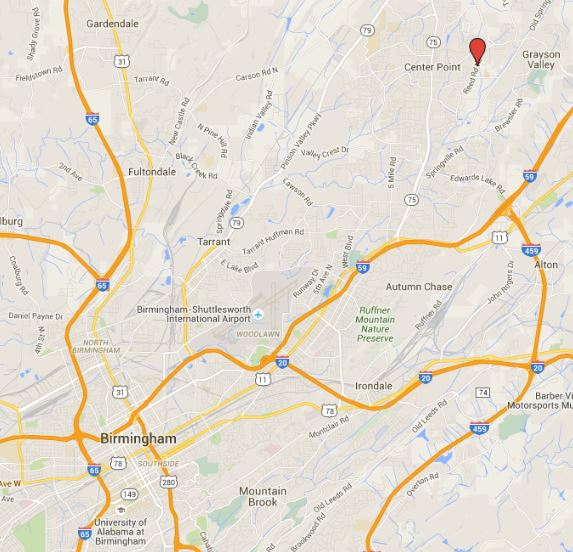
This property was put into service in September of 2014 and was the successful beta test to prove the concept of remote out-of-state investing. I acquired the property from a marketer that makes connections with the rehabbers in certain markets and finds buyers such as myself who are typically located in low price to value ratio locations (this does not necessarily mean high-priced locations) such as California, New York, Hawaii, Seattle, Portland, and basically the coastal areas that all the cool kids what to actually live. Marketers have their place if the buyer is totally clueless but once you purchase a few of these properties the marketer really does not offer much value. The only thing I see that they would offer would be someone to be the bad guy role in a negotiation but many of the marketers are buddy-buddy with the rehabber because of their business relationship and won’t stick their neck out for you. As the buyer, you need to take ownership of the due-diligence process and negotiations because that marketer is not a licenced agent and does not have a fiducial responsibility to you.
Mindset of the best Performers

Mental Mistakes of Investors w Marco Santarelli

Warning – Paradigm shift ahead! In the old Caste System people were split up in ranks to keep lower class people from rising up and keep those in power where they are whereas today, money/mindset is the real separator of the masses.
When I first got started in Real Estate investing I was lucky to have a good job and was able to skip right over the wholeselling/birddogging roles and go right into a buy and hold rentals with the conventional 20% down payment. Little did I know that I had just vaulted over about 80% of my local REIA members who had little money and not making any deals. To be in that 80% group was a terrible place not because of the endless books, seminars, training for the wholeselling/birddogging strategy but competition was fierce – imagine the start of a triathlon as the athletes jump into the first stage of competition -the swim, even the best athletes struggle to distance themselves from the pack as the pack pulls and sabotages those who try to distance themselves.
The Real Cashflow Quadrant – Turn Key Rentals Heat Chart 4/2016

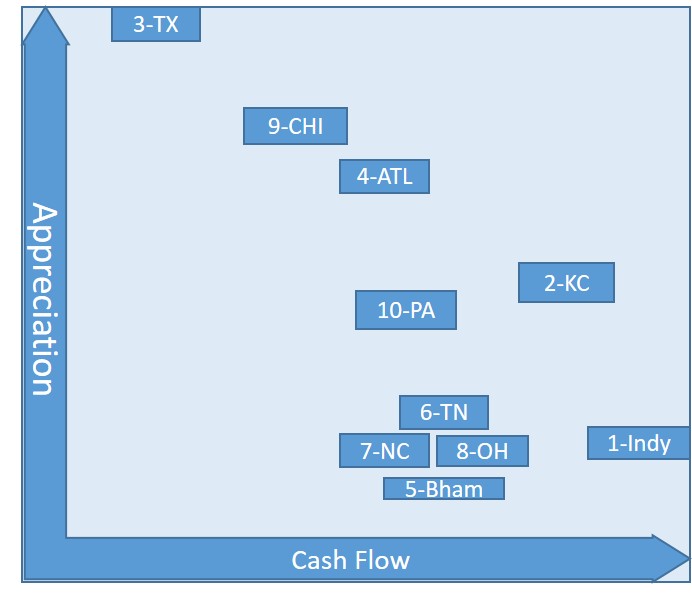
I’m going to take you back to high school math class for a moment. Remember the 4 Quadrants, they are labeled Quadrant 1 in the North East quadrant and Quadrant 2 in the North West…etc. The above graph only shows Quadrant I. To put it simply these markets in Quadrant 1, have median home Rent to Value ratios above 1% (a 100k property rents for more than 1000 per month – 1000/100,000=1%). These are the markets that investors like as cashflow investments because the income typically covers the mortgage and then some.
Continue reading “The Real Cashflow Quadrant – Turn Key Rentals Heat Chart 4/2016”
Don’t Forget! Capital Expenses “Cap-Ex”

Capital Expenses (Cap-Ex) are the large items on your expense list that are not repairs or maintenance. I repeat, this is in addition (account another 10-20%) to your normal repairs/maintenance for minor components. Cap-Ex is for example roof, water heater, HVAC, flooring, paint, cabinets, landscaping, windows, etc.
Return on Equity: Why I sold my High Appreciation Seattle Rentals

As an investor, what do you most love when it comes to real estate investing?
Is it the monthly cash flow? The cash- on cash returns? Or the return on equity?
Most investors will choose return on equity. I must say, it is something to boast about!
Well, you have all the right!
As a sophisticated investor, you need to distinguish how much money you’re going to make with your money invested in a rental property. Besides, property appreciation varies from time to time.
“We are almost paid off our property and cash flowing like crazy!”
– Unsophisticated Investor
Investing the Non-SPC Way
What is Return On Equity (ROE in Real Estate)
Return of Equity is the rate being measured from a real estate property investment. It is calculated as Profit (Cashflow) divided by Total Deployable Equity (if you sold a property don’t forget to include the selling commissions).
Unfortunately, a lot of real estate investors do not go through Return on Equity.

Forbes Article: Three Financial Metrics Investors Must Monitor To Evaluate A Property’s Success
But, Lane and other sophisticated investors in the group monitor this very closely because pruning investments is essential. You need to evaluate your assets/ investments in order for you to eliminate those that are not giving you much return. Then, you can focus on those investments (or enter a new deal) that are more valuable.
Note: Investors need to look at ROE to determine which asset to sell, refinance, or use a HELOC on. Basically, you’re looking to find dead or lazy equity.
How to Calculate Return on Equity (ROE in Real Estate)


DOWNLOAD: Worksheet to Calculate Return on Deployable Equity

As a real estate investor or any investors, consider your Return on Equity (ROE) as a means to evaluate the highest and best use for your capital and to be able to make adjustments to your portfolio over time.
As a real estate investor or any investors consider your Return on Equity (ROE) as a means to evaluate the highest and best use for your capital and to be able to make adjustments to your portfolio over time.
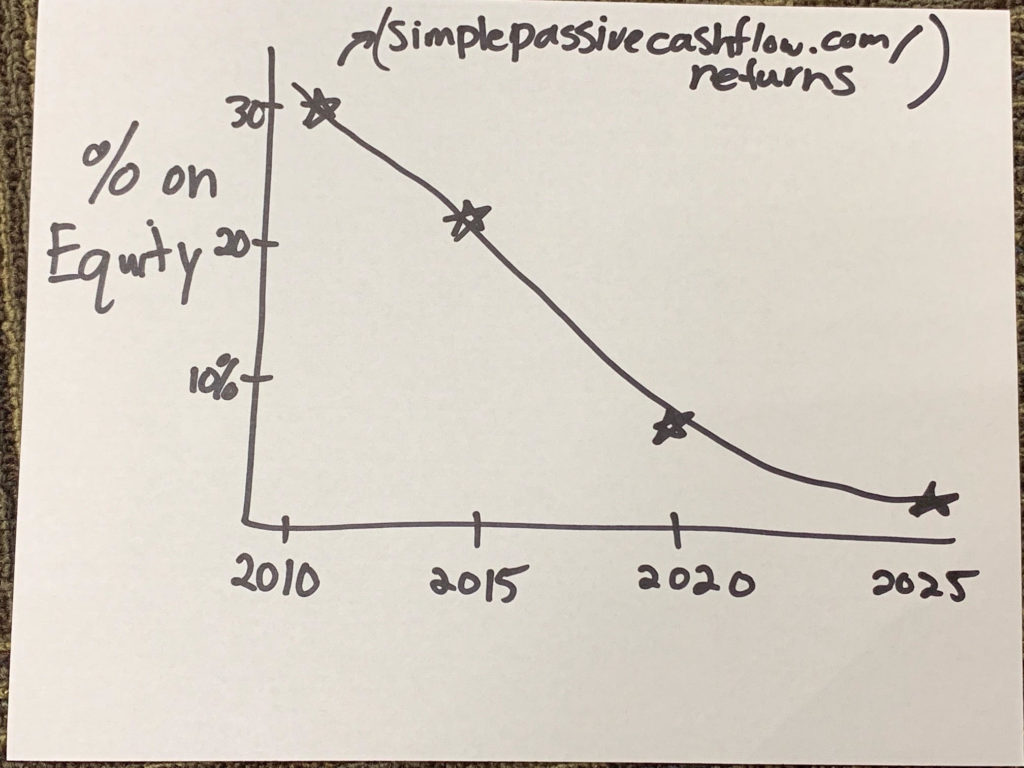
The saying “buy and never sell” will work but “buy and evaluate your ROE prudently” will yield high returns and safer capital preservation.
There are many metrics that Investors use to quantify the quality of their investments. COC, ROI, ROE, are to name a few.
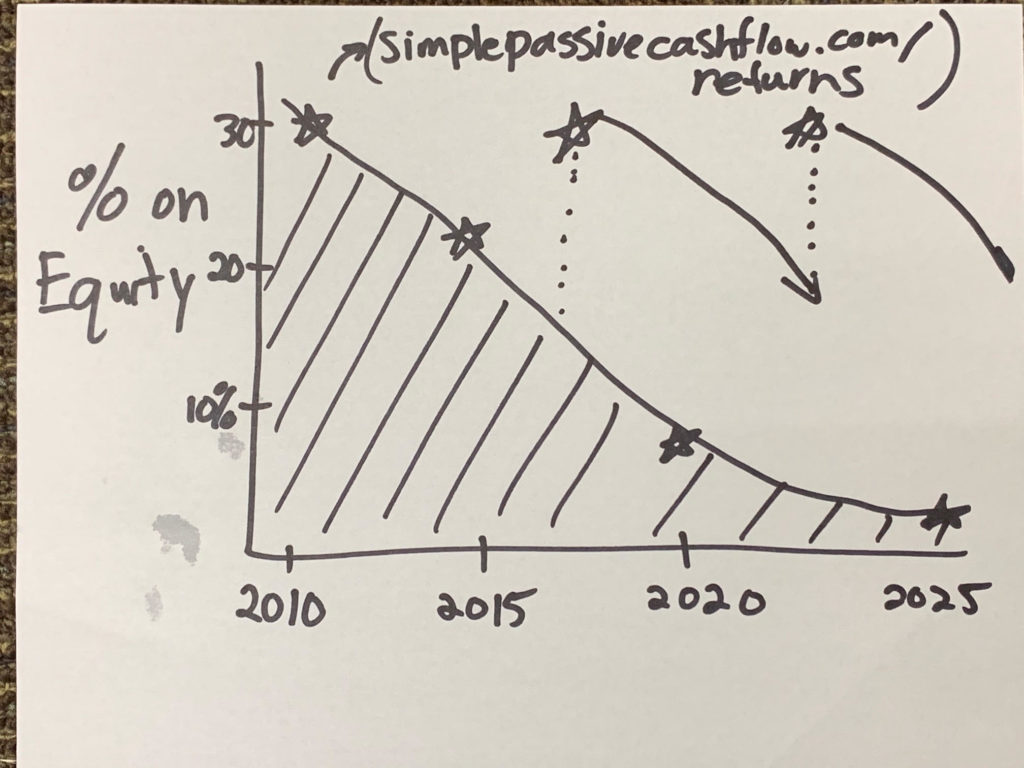
Sophisticated investors re-leverage after their return on equity goes down
Cash on Cash Return on Investment (COC Return)
The pre-tax year-end cash flow divided by the actual amount of original investment you have invested.
COC is used to compare your investment with other options excluding factions such as the use of leverage (mortgage), taxes, appreciation over time, and mortgage paydown over time. As time goes along and your investment goes well due to your tenants paying their rent as they should and the home going up in value due to inflation and market appreciation, COC becomes less relevant.
For example, if you purchased a property with $22,500 down payment, $5,000 in closing expenses, and $2,500 for some touch-up paint and new carpet, you are all-in for an original investment of $30,000. If at the end of the first year with your rental property in operation that you are able to profit $10,000 from cash flow after all operational expenses and debt service were paid, your COC return would be $10,000/$30,000 or 33%.
Sophisticated investors compare COC with other investments to determine the highest and best use for their liquidity going into an investment whereas ROE is used once the investment is owned. COC for mutual fund and stock investments have been known to have been in the 8-10% COC range.
Join our club to get full access to this “Return on Equity” Spreadsheet and more!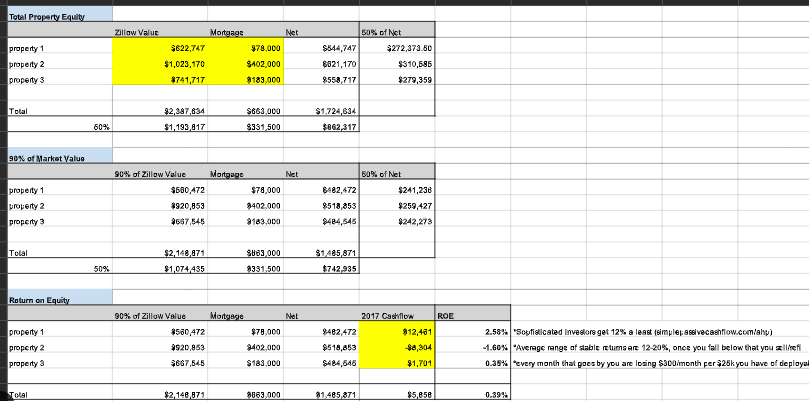
Annualized Return on Investment (Annualized Return)
Annualized return is used to evaluate an investment’s performance over time. Real estate is not a get rich scheme and many times if rehab is done to the property it will require a few years to complete the construction and stabilize the rents for the next buyer to feel comfortable and pay a higher price for the investment.
Annualized return takes into account the cash flow returns received during the hold of the property and the sale or refinances of a property that takes place at the exit. The annualized return is often used to compare syndications (private placements) with different business plans but similar lengths of ownership.
For example, if you received a 8% COC return for 5 years ($8,000 per year on a $100,000 investment for each of 5 years = $40,000). And then you exited the property via a sale at end of year 5 for a gain of $60,000. Your annualized return would be a total of $100,000/5-years or 20% a year. This is calculated with $40,000 in cash flow plus the $60,000 due to the general appreciation of the property.
“If you have an employee that does nothing or very little would you keep them around?”
Return on Equity (ROE)
One of the few downsides of real estate investing is that your investment is illiquid unless you sell or refinance the asset.
As you hold on to investments you are increasing you equity position over time via the following:
- Mortgage paydown
- General appreciation from the market
- Forced appreciation from any property improvements
Say you had a great investment kicking off 20% COC a year. Your return on equity shortly after purchase on a $100,000 home that you used $20,000 to acquire is making you $4,000 profit a year. In this case, your ROE would be 20% ($4,000 divided by $20,000).
Great!
But say a couple years go by and with a hot market the property is now worth $160,000. You return of equity on the $160,000 home that you used $20,000 to acquire is now making $5,000 profit a year. In this case, your ROE would be only 6.25% ($5,000 divided by $80,000). Note: This does not include mortgage paydown.
For the minor headaches rental property ownership brings 6.25% would not be worth it. I personally believe that when you ROE dips lower than 10-15% you need to look to make a change in your portfolio via 1) Cash out refinance, 2) 1031 exchange or, 3) simply selling the asset.
15% IRR is pretty attainable (tax free) these days. Here is the math in this video.
Of course this is just in theory and you got to be crazy to bet everything on one deal plus it’s going to take 1-3 years to get fully deployed (dead equity in your primary residence or high risk 401k) so there is some work ahead. But the point is it’s possible.
There is one intangible metric that we did not talk about here which is your Return on Time (ROT). I don’t believe this is an official term but something that is near and dear to Simple Passive Cashflow Followers. At some point, you need to transition from higher returns and higher headache investments to more scaleable investments where you investing passively.

After purchasing a couple rentals in the Seattle market and being the beneficiary of some nice appreciation, I evaluated the property’s performance with a ROE or Return of Equity metric. On of my rentals had appreciated all the way to $450k and my mortgage that I owned was $200k. Therefore, I had about 250K of “lazy” equity. If you kids are at home with you calculators that 250k goes in the denominator of the calculation. The numerator is the annual cash flow which was about $4K a year. Therefore my return on equity was less than 2%=4k/250k. Frankly, 2% is very poor compared to stocks (~8-10%) or properly leveraged Real Estate (~20-40%).
Calculate how lazy your current rental investments are with this spreadsheet: Link
https://youtu.be/wDFGXghwIC4
Video: If your interested in seeing a A-Grade rental in Seattle that does not cashflow (poor cashflow investment)
https://youtu.be/qn8DQ71V-6Y
I am sure someone somewhere is trying to invest in something similar and fooling themselves that they are making money on the project. But you are smart and you subscribe via RSS feed to this blog and podcast 😉
Long story short, I decided to sell these rentals to unleash this “lazy money” and get it working again with prudent leverage. This is what separates sophisticated investors who look at the numbers and your mom & pop investors who go by warm & fuzzy feelings of “hey I’m making cashflow, life is good”. Yes, Mom you are cashflowing but that is because you are halfway to 100% cash in the deal and you are taking on all that hassle and risk for a microscopic return.


ACTION PLAN:
- Arrange all your properties on a spreadsheet and calculate ROE, Cash on Cash Return, etc.
- Look for the “Lazy Money” to trade in for a better performing investment.


From 2009-2013, as I was buying rentals on my own I definitely made my share of mistakes. One of these was to paying down my mortgage (debt). Here is one of those checks where I paid down my debt. Little did I know that sophisticated investors don’t do this.