Applicants will have to qualify for the policy by completing a medical exam and having the insurance company review their application.
Other requirements may be needed depending on the amount of insurance being applied for.
In general, the cost of insurance is lower on this savings product, and the underwriting requirements are less stringent, making this policy easier to qualify for and also more affordable. If you are personally not able to qualify for the insurance policy, you could have a healthy individual that you might have an insurable interest in, create the policy (such as your spouse or children).
For properly structured whole-life policies there are no surrender charges, which is another benefit for whole life compared to IULs which typically have surrender charges for the first 10-15 years
Are you aware that there is more to it than simply saving your money in the bank and be in a better position?
Wanting to be more knowledgeable of how you can leverage the services of financial institutions rather than purely relying on what your financial advisor can offer?
Banking from yourself (with life insurance as the mechanism) allows cash flow investors to augment the investing they already are or will be doing.
Why?
Grow your money TAX-Free (Use the same loophole that the politicians put in the tax-code for themselves to use personally)
Asset protection – litigation and creditor-protected.
Your money grows in two places at the same time. In this secure policy and your higher yield investments (syndications + rentals)
Better than 401Ks, Roths, 529s because no government regulated restrictions on how can you use this money.
https://youtu.be/IMGW8HAi3pc
Just imagine that in 2016, I learned about this little-known financial hack utilized by smart money.
How come this was not taught to me early on?
You might be scratching your head and curious why am I sharing this with you!
Simple answer: I can’t be selfish to the learnings I got from my experiences! These are precious that I have to share.
You see, by being your own bank and using the Infinite Banking Concept you can create dividend-paying whole life insurance. You may consider this before getting into futures. Please note that it’s called life insurance BUT it’s just a tax code loophole to make a tax-free yield in an account that is sheltered from lawsuits and creditors.
Add this to the list of things your typical financial advisor or life insurance sales guys who they just do not get it. Why? Because, likely, they are still working for a paycheck and it actually decreases their commissions.
https://youtu.be/1zRLzon0Sjk
“Infinite banking” is just one term for this. The magic of the infinite banking concept is to create tax free “wash loans”. Where the dividend rate on the cash value is equal or greater than the interest rate on the loan and maximizing the use of Paid Up Additions, which have a lower commission rate than the regular policy – this is why most FPs don’t like this.
And for you high-net-worth folks still dabbling in paper assets, you won’t want to miss this other trick that I will reveal on there too – Email me for this info at Lane@SimplePassiveCashflow.com
This is a part of my 1-2 punch to avoiding liquidity anxiety and having an Opportunity Fund to go after deals as they come up. Let’s call this “on-deck circle” because it is better sounding unlike how the term “dry-powder” sounds.
Today, starting a small policy with 25% of your household’s annual cash flow is a good idea to start, even for asset protection that the policy provides (even in bankruptcy).
About half the states protect the whole life insurance policies payable to spouse or children with partial protection in all states. Additionally, these assets do not appear on your kid’s FAFSA . If you are like me and want to load your kids up with student debt (to get a BA in pottery or psychology) and ensure your golden retirement for numrouno (you) then this is a good strategy.
I appreciate our call a couple of years ago when you asked why anyone with a low income and small savings like me would get involved with IBC. You had recommended it only for those with a net worth above 500k. Using it in combination with your recommendation to move forward in real estate has allowed me to acquire 7 more units in the past couple of years. So thanks very much for that 15-minute call that has really been life-changing!
Infinite Banking is how cash flow investors enhance the investing they already are or will be doing.
Benefits
Net 5-6% Return (we’ll go over this later)
Tax-Free (we are basically using a loophole in the tax code that does not tax life insurance)
Safe / Predictable
Liquidity
Loan Provision
Death Benefit / LTC
Benefits Explained
Tax – Free growth on my earnings.
Steady, consistent, year after year “upside-only” accumulation, somewhere between 5% and 7%. No home runs, just single after single, each and every year.
To make certain that any gains I earned will be locked away and not subject to market downturns.
To allow me to borrow money personally without interest, without a payment schedule (I would want repayment optional), and without affecting my credit score.
To allow me to lend money to my family members at the preferred rates I designate.
To transfer to my spouse, children, grandchildren, or my favorite charity without taxation on the gains and without the expense of probate.
To be creditor-proof, protected from frivolous lawsuits.
To not have required distributions, like an IRA. If a withdrawal is taken I want it to be my decision and not the government’s. I don’t want them to ever tell me when, how much or how often.
To be backed by the strongest financial companies in the world. Stable companies that are over 100 years old.
To carry my personal family name, like the Phillips Family bank.
If you want the insurance death benefit and/or would like to use the banking strategy, then the best bet would probably be to get a new policy that designed for that purpose and dramatically reduced cost.
If you don’t really care about using the banking strategy then just cash out and walk away with no issue at all.
Strategy
Next up is this method of hedging yourself to a 0% loss. This is if the stock market goes down 10-20% in one year then you lost 0%.
Unfortunately, by taking this type of deal (that the rich do) you cap your upside at 12%. If the market goes up 14% you only get 12%.
To elaborate, hedging is a strategy being used to reduce the impact of negative effects to investment. In short, to hedge is part of managing risks.
Guess what!
Here is where the hedge strategy comes together. We leverage your investment by using 3X leverage. If the market goes up 7% you get 21%. In that case, where the market goes up 14% you only get 12% you actually get 36%.
Expect to net a 5-6% return. This comes from a gross interest credit of 4% guaranteed, along with a long history of paying dividends that are currently paying an additional 2-3%.
Loan Provision
Policies carry a unique guaranteed loan provision that makes it possible to use core wealth-building principles such as leverage, velocity, and cash flow to maximize the way your money works for you. Because money on a loan comes from the general account of the insurance company, NOT directly from the cash value, we can create value in more than one place at the same time.
Safety
100% safe from market volatility and guaranteed to grow. These mutual life insurance companies we represent have been paying dividends for more than 150 years. This includes times like the Great Depression, World Wars, and a myriad of different market cycles.
Liquidity
Unlike having money in a qualified plan such as an IRA or 401K, money is accessible at any time without the worry of a 10% IRS tax penalty. Liquidity can be the difference between capturing an opportunity or letting it slip away.
Tax Free Growth
Money grows and comes out on a tax-free basis, and unlike a Roth IRA, there are no contribution or income limits.
Death Benefit
Since we are using dividend-paying whole life insurance, there’s always a 100% tax-free death benefit. Although we’re primarily focused on the living benefits and cash growth, this is a significant benefit. It’s insurance we don’t have to pay for in any other way.
Long-term Care Coverage
Provides an efficient way to plan for the ever-increasing expenses associated with long-term care. By utilizing the accelerated death benefit rider (no additional cost), you can utilize a portion of the tax-free death benefit to cover long-term care costs.
Velocity Plus w/ Lane Kawaoka Webinar Outline (More to come…)
Purpose
Leverage
Max income w/ least amount of dollars
Alternative for retirement plans
Great for groups
Concept Structure
Leverage: $100k for 1 property? No, use $100k for 4 properties instead!
Here’s how $100k does the work of $400k:
Years 1-5: Policyholder and bank contribute
Years 6-10: bank only
Ratio: 25% policyholder, 75% bank
No collateral needed beyond policy
Product: Indexed Universal Life
Use an index
Cap
Floor
Capture 80% of upside
No downside
Policy structure: max cash growth/min costs
A Look at the Numbers
46-yr-old
$1M total going in ($500k from policyholder / $500k from the bank)
Then the bank takes over total
At year 15—pay off the bank loan
Age 65-90—tax-free income of $115k/yr
$250k goes in, a total of $3M comes out!
How it Works — Leverage Throughout
Spread — growth vs. loan interest
Leverage the bank for 15 years
Pay off bank loan using policy loan
Leverage Throughout — A Snapshot
Example numbers at year 15 after we pay off the bank loan:
Figures:
Total Cash Value: $1.8M
Loan Balance: $1.2M
Net Cash Value: $600k
Let’s say we get a 10% credit the next year:
$180k (calculated from Total Cash Value)
Loan grows by 5% —$60k
Growth in Net Cash Value — $120k (That’s a 20% gain on our net equity)
The overall return is 18%!
Primary Risks
High-interest rates
Poor performance
Some things to consider:
“Stress Testing”
80’s interest rates–$98k/yr income
Great Depression–$78k/yr income
Baseline income was $115k/yr
https://youtu.be/uzx-1-AfbqI
We are not talking about your father’s whole life insurance
Whole life insurance is only one part of the above strategy. below is a discussion on my thoughts on the product as it stands alone.
First off, it’s a product which you pay for. The providers (insurance companies) are using the best minds and big data to price out your coverage premiums which include marketing, sales commission to your FP, and a wee bit of profit for their company.
In most cases, if you die while owning life insurance, you get paid the death benefit, tax-free because of the step-up in basis at death
Term life insurance gets really expensive after the term ends and as you get older (cause its price by the chance of you dying).
Whole life insurance is designed to pay out when you die so you can see how it’s sort of like a bank account. The way we are using this policy is by taking loans against it.
https://www.youtube.com/watch?v=O_HE_HgsFLA
NOTE – A Guaranteed Universal Life policy if a flat death benefit where the Whole Life grows.
These policies allow you to accrue interest on the amount of cash value that is not being “borrowed out” of (technically borrowed against) the policy. People in the industry call this “direct recognition.” Just be aware that “non-direct recognition” pays dividends as though no money was borrowed against the policy. Just something to ask when setting up your policy.
Downsides of the Whole Life product
You are front-loading your costs and fees. This can be devastating for someone in the early stages of wealth building. (Almost as bad idea as paying off low-interest student debt or mortgages before investing)
I like the ability to use this vehicle as a means to bank from yourself but keep in mind that you should not need insurance you don’t need.
I think you should insure well against true financial catastrophes and self-insure against everything else. Yet I insure my iPhone because I am weird like that… actually, I justify it that I would search the world wasting my time for two weeks before going and buying a new device. So insurance for a phone would save me time since I would not hesitate to give up looking and put in a claim.
Returns are typically low (when compared to what we do in real estate investing)
So just getting a policy alone and not implementing the “wash loans” does not make sense.
Most times the commissions are maximized by the FP. This can get complicated on how to design this stuff so it’s an ideal situation for a greedy FP to pull one on you. By maximizing the use of “paid-up additions” while minimizing the amount of “regular policy” you can decrease the commissions and still execute this strategy.
80%+ of whole life policies are surrendered prior to death because their beneficiaries need to money beforehand. Perhaps on an ALF (even though some policies have this benefit).
It’s slightly more expensive for older people and smokers to get ensured however I have found it to be negligible (1-3K difference on a 50k premium) between a 30-year-old non-smoker and a 50-year-old non-smoker.
Smaller policies like for your kids have much more fees because the setup fees fit into the policy. So buying a $20K policy for junior who does not smoke might not be the best idea.
https://www.youtube.com/watch?v=M2B0ghvWH-w
Withdrawing Money via Loan
You can take money out of your Cash Value portion. When I contributed to my policy I got 70% of what I put in as Cash Value on day one to be able to take out as a loan. This I could use for deals or whatever I wanted. This is super simple as you can go online or call your provider and tell them “you want to take a loan from your Cash Value”. Simple they send you a check or ACH transfer and usually takes about a week.
Replenishing Money to Payback Your Loan
I am actually writing this to myself as it’s a little tricky and this way I remember the steps.
I print out a simple letter (examples below) and mail it with my check to my friends at Ameritas.
Example #1
5/1/18
Dear Ameritas,
My name is Lane Kawaoka (######).
I have enclosed a payment for $65,000.
Due to my flex rider please apply my payment in the following order:
$64,510.01 to the expire Loan balance (pay off loan then…)
Any excess to be paid to the $15,074.91 to the Annual Premium
Please advise when the next bill will take place via email.
Example #2
7/14/18
Dear Ameritas,
My name is Lane Kawaoka (######).
I have enclosed a payment for $60,000.
Due to my flex rider please apply my payment in the following order:
$64,510.01 to the Loan balance (pay off loan then…)
$15,074.91 to the Annual Premium
Any excess to be paid to overfund my account
In addition, please switch my premium billing to an annual basis and remove my automatic billing per month.
Please advise when the next bill will take place via email.
https://www.youtube.com/watch?v=Cb8xM46tqSY
Flex Paid Off Rider
In whole life policies, you have this add-on where you are allowed to add paid-up additions (purchasing larger death payout and cash value). In my policy, I need to put in at least 70% of $35,000 once every three years.
NOTE – There are other types of these riders where the requirement is to put a more consistent amount every year, but personally I prefer the one out of three-year arrangement because my business income fluctuates so much.
Without penalty, I can go over 120% or $42,000 every year as my max. If I want to put in more I would have to make a new policy and get another physical. This limits the risk for the insurance company if you are putting away infinite amounts of cash after deciding to pick up the hobby of skydiving while smoking 2 packs of cancer sticks a day.
Are you convinced? Let me know if you need a referral!
Infinite Universal Life (IUL) FAQ’s
Index Universal Life (IUL) Caps: Will They Rise When Interest Rates Rise?
Normally when we are talking about a banking policy we are talking about a whole life product, however sometimes an indexed universal life (IUL) is preferred, which is why it makes sense to work with only people you (we) trust. The cap defines the upper limit of the policy cash value crediting rate.
Typically (2014-2019) IUL caps have gradually fallen, leading some to wonder what would stop carriers from gradually dropping caps to the policy’s minimum guarantees. This concern is particularly common when the client is considering whole life as an alternative, because whole life discussions begin with guaranteed performance enhanced by dividends. Legally this is possible, and advisors may need some clarity to make a decision.
So, how relevant and valid is the concern that caps may fall to the level of policy guarantees?
Cap levels are essentially driven by the amount of money the carrier has available to purchase long options in support of its IUL book of business. While option pricing is a combined function of option budget, market volatility, and the price of zero-risk products, data indicates it is the option budget that is by far the overriding driver. This is particularly true when considered over the medium to long term.
It’s indisputable that the reason whole life dividends, universal life declared rates, and IUL caps have fallen over the last 20 years is the declining interest rate environment. As rates fall, the general account return must also fall because its portfolio is comprised of primarily fixed-income investments. When rates rise, bond returns in the general account will increase slowly as the life insurance carrier replaces maturing bonds and adds additional bonds with a new premium. The question is “Will the carrier keep the extra return instead of passing it on to the end client in the form of higher caps, dividends, or declared rates?”
The life insurance carrier would say that they take their profit in the form of money management fees, costs of insurance, and policy changes; thus regarding the improved yields as policy owner money. On the other hand, cynics would disagree and say the life insurance carrier will pocket the increased yield.
Let’s assume for the moment the cynics are correct, and that carriers have no regard for policyholders and deal only in their own self-interest. Well then, is carrier self-interest positively served by such behavior?
The answer is no. And here’s why…
IUL products are mostly sold to clients below the age of 65 who will live for a long amount of time. If interest rates rise but caps do not, then an IUL product becomes less attractive compared to similar products issued by competitors with higher caps and higher client yields. Healthy clients, encouraged by agents and other advisors, will surrender their policy so that they can move to more competitive products. Furthermore, this would create another problem for the original carrier because the remaining pool would be unhealthy, and this would result in more early death claims and therefore further losses.
Will, the original life carrier care about these lapses? After all, they won’t be paying a death claim and have already booked profit.
The answer is yes.
One of the great advantages of life insurance is that as standard practice the carriers guarantee the mark-to-market value of the bonds that support the cash surrender value. This was not an issue in a declining rate environment because the carrier could sell the attractive higher-yielding bonds and pocket the gain. However, when rates are rising, and especially if the rise is rapid, the reverse is true. Thus, clients induced to surrender by higher caps elsewhere create a significant mark-to-market liquidation loss for the short-sighted carrier.
For example, if the insurer has a general account with an average bond maturity of ten years (typical for the industry) the losses would be a 9% loss on the cash value surrendered if there was a 1% increase in underlying market interest rates, and a 35% loss if there was a 5% increase. For a single client, this is unpleasant but unlikely to break the carrier. However, if it happens on a large scale it creates an enormous loss that no senior management team is likely to survive.
Given the potential for considerable losses and that the carrier hits its profit objectives by passing through the increase in general account yield, the carrier is incentivized to pass through improved yields to the client in the form of higher caps. By doing so, the carrier attracts more premium while simultaneously protecting prior profits. By not doing so, the carrier risks mass surrenders which could result in the loss of hundreds of millions of dollars.
No one knows when interest rates will rise, but data and logic tell us that the life carriers will protect their profits. To do that they must pass on improved yields to the client in the form of increased caps and/or improved participation rates.
More IUL info to put you to sleep (just get a pro to work with that you trust not to stuff you in the high commission plan).
Private Placement Life Insurance (PPLI)
It’s basically a variable universal life offered by some banks and insurance companies. The one thing you CAN’T do is invest with it however you want. Although you can customize the “subaccounts” you invest in, you CANNOT do your investments through that policy. You have to use hedge funds or mutual funds (known as subaccounts when used in insurance policies). It’s just a VUL on steroids. But you wouldn’t want to borrow money from it while those accounts go up or down with the markets.
So think of it as a 401K where you are stuck with the bad investment options.
https://www.youtube.com/watch?v=ECJ4QRdoahk
Physical Exam and Interview Tips:
Previous
Next
https://www.youtube.com/watch?v=IAFHII8yBdQhttps://www.youtube.com/watch?v=48JCThIKbJEhttps://www.youtube.com/watch?v=vYF5AaASUgk
Process of Applying for a Policy (2020)
Day One
Complete Application
Called my guy and completed an application in the online portal. Had a short discussion on how much I was looking to put in per year and how long of a time horizon. This is where it is critical to have a peer network around you to bounce these ideas. You want to know how much you are putting into these policies and how to configure them before you talk to the sales guy.
Day 3
Additional Information
The process took about 15 minutes. I had to answer some basic health/lifestyle questions and some more specific questions like when I went to the doctor last and what was it for and did I have any pre-existing calculations.
Good questions to ask so you are on the same page with your IBC broker:
Can You Help Me Understand the Following:
% rate the CV grows
% rate I pay on loans
how much % rate the outstanding loan amount grows or if it does… this part always confuses me and I heard that it is different in every policy
What is the minimum I need to put into the account every year. And how much I need to put to not lose my ability to over fund?
And just verifying that the max is 250k a year?
Historically, does the increase in loan rate coincide with increase in dividends and vice versa?Not sure if all IBC companies are the same but per Chris regarding Penn, “Both the dividend rate and loan rates can change each calendar year. In Penn Mutual’s case, they paid 6.34% for about 12 years in a row (longest of any company without decreasing), and then decreased a few years ago to 6.1%. The loan rate has remained at 5% that entire time. If the dividend rate significantly increases or decreases, the loan rate follows suit
The %rate the CV grows when there is a loan vs when there isn’t a loan
Can you still overfund after year 5, and, if so, how much?
https://www.youtube.com/watch?v=dA8Iv8zJON4
Infinite Banking FAQ’s
Wait I’m still super confused?!? How do I optimize it?
It took me a long time to understand myself and it really helps to have a few people around you to talk you through it (other than the insurance sales person). That is what our Mastermind is for.
You just want to make sure you are customizing whole life insurance for the three “levers”.
1) Liquidity – Max2) Interest rate – minimize3) Death pay out – minimize The rest really has to do with how much your sales guy is taking in commissions.
OMG this sounds amazing… make money in two places?!?
Slow down buddy it is cool that you are making money two places, tax free (because it’s life insurance), and provides litigation protection but don’t forget you are paying a price for this. There are heavy fees in the beginning (30% of what you load in) which does decrease as the years go by and goes down to around 10% by year 3.
DO NOT FORGET THAT YOU LOST the opportunity cost of the money paid as fees. None of those fancy (confusing spreadsheets) include this.
An IBC is not really for a guy under 200-400k net worth because that person needs to invest every free dollar they can and cannot afford to pay the fees for the benefits of an IBC plan. It’s more for people who are loose or inefficient with their liquidity. Or in other words, have 30-100k+ of cash hanging around not doing anything frequently.
For me I am always broke when you look at my bank account, because I suffer from severe liquidity anxiety (don’t want any cash making less than 10%). Often I will work with clients who have 100k’s of money just sitting around so we use IBC as a means to slow them down so they can become a Sophisticated investor and make a bit of yield in an IBC.
Where does the 4% growth in cash value come from? They have to be putting the money into the stock market for you to get growth, so how isn’t this risky if the product is still linked to the stock market and its associated volatility?
It’s crazy huh! But when you get outside the world of retail investments 4-5% is the baseline and 12-15% is pretty attainable without going crazy with risk. That is what really frustrates me about mainstream financial advice and wall-street investments.
The insurance companies have 2 sources of income, insurance products, and investments. I think of them as a big syndication company. They have their insurance business and raising money from people to be part of the mutual company. All those people out there buying term insurance feed the main business, they collect way more money than they payout. And then people that buy the whole life policies are part of the mutual company, essentially have shares in the company.
They pay us out a return (the death benefit will pay out unlike term policies which eventually expire) but raise the money now to support the business and buy assets. They’ll overpay for class A, stabilized assets, and take returns of 4% where the market may be only willing to pay for 8%. They do also buy bonds and make loans. But they don’t invest in the stock market. So they pay out the guaranteed return of 3% (similar to a pref) and then at the end of the fiscal year they look out how they did and pay the mutual owners a dividend. They are forced to buy insurance on all of their written policies to raise cash to pay them should they have a problem. They also aren’t a bank so they don’t get to participate in fractional reserve lending. They have much stricter regulations in how much cash they have to keep on hand to service the policies which is another reason they are only paying 1-2% dividends per year.
The insurance company is investing its assets in investments that the insurance company thinks can meet its obligations under the contract. Anecdotally, I’ve seen insurance companies buying real estate, buying government debt, and AAA corporate debt. I am sure they have access to investments the average retail investor does not. How they manage to give you a guaranteed rate is probably a “trade secret” otherwise everyone would do it. My understanding is that the insurance company has another company “reinsure” just in case it can’t meet its obligations. The insurance company can also pay “policy dividends” over and above the guaranteed rate, but policy dividends are not guaranteed.
I’ve been burned before with Life Insurance that was sold to me by a 24-year-old out-of-college salesperson and everyone says whole life insurance is a scam. What can I do with my old policy?
Have no fear my friend you basically have three options:
Cash it out and just walk away with the cash that’s in it… In that case, you obviously no longer have a life insurance policy so the death benefit goes away… Because of the way it was designed, it possibly does not have enough built-in cash value yet for there to be any tax consequence so you don’t have to work about that…
Borrow against this policy and use the money that way… You can use it as a properly design self-banking instrument, the downside is that it’s not a great cash building policy so there’s more cost in it than what you’d like to see and the loan rate may not be really favorable.
Open a new policy (one that is designed for cash build-up) and do a 1035 exchange into and this time get a policy optimized for banking… The nice thing here is that there would be little cash right upfront to boost the new policy because we are using the old one… The downside is just going through the process of getting a new policy with physical evaluation etc…
What’s the difference between a 35-year-old and a 52-year-old male’s IBC?
1) 161k vs 156K first-year cash value
2) Someone’s widow will have 3M more dollars to blow when their FI obsessed husband is dead
35 Year Old52 Year Old
Previous
Next
Insider insights of Infinite banking within the Family Office Ohana Mastermind – SimplePassiveCashflow.com/journey
Life is funny, about the time you achieve something you realize that there is something else to go after.
“Obviously I’m a few years older than you but the writing is absolutely on the wall, I was at work last night and had a critical care where I was having to intubate and put central lines in anyhow my aunt was actively having a stroke at the same time and my cousins were asking for guidance on what to do and how far to push the limits, I made the right decision cutting back no question, family first” – Hui Member
When I was going after that magic number “10” single family homes I was all consumed by the chase. Then when I got there the next goal was 1,000 units. Got there and it was the same result. Taking a step back I realized that happiness was not about getting to a magic number or properties or money (although it is a great way to keep score).
I wanted to get back home to Hawaii after 14 years of living in Seattle. Done! (And you can see why by visiting)
For a long time, I have written down my “I would be happy when…” or IWBHW’s and they always change and I am always chasing the next thing. Not until recently did I realize that it was not about the chase to the next goal but embracing and enjoying or the Journey… Follow along on mine.
We all have heard about the Gallup article that said that once someone has $75,000 of income a year their happiness does not grow by leaps and bounds. I’m not here to debunk it but to ask why and more importantly how can I apply it? [I personally thing 75/k a year does not cut it in Hawaii/California/Seattle – most of us are shooting to that magic critical mass number of 4.5M net worth because at that point you can pass the trust off to clueless offspring and it can still grow]
After quitting my job in 2019, and transitioning to a life of working on what I want to instead of working for someone else (obligation) I discovered that everyone will always work. If you think retirement is just golfing… well that’s fine but many people SPC investors find that their life energy is better served to go into something bigger. But it does not have to be a structured 40-80 hour work week. As little as 8 hours a week is all this study says we need to achieve autonomy. However I find I still work 10 hours everyday on building the SPC community and adding more content.
I have built up a large network of other investors who have enough “simple passive cashflow” and the common thought pattern switches from making money to getting back time and living a more fulfilled life.
Unfortunately, happiness is not as easy as in a video game
These days I ponder… how I can hack happiness? After all, more money won’t make that much difference. (Although I would like a MercedesTesla Convertible Porshe/Corvette since its safer than my electric bike.
I tried using Maslow’s hierarchy as a framework to dissect happiness but I have found it to be a little too bit “basic” as it applies more to those in third world countries and people with real problems in life. I don’t want to sound basic I mostly have “first world problems” which I am very grateful for.
In 2016, I went down to Texas to attend a Tony Robbins seminar and discovered my current framework to backward engineer happiness.
Mr. Robbins outlines six human needs:
1) Growth
2) Contribution
3) Significance
4) Uncertainty
5) Certainty
6) Love and Connection
The lowest on the spectrum of human needs is to be Loved/Connection. I talk to so many people in my free investor calls and it is very apparent who are givers and who are takers. Why do people act so selfishly and so seriously? Perhaps it takes an old soul to realize it but in the end relationship that we build on the journey are what really matter and what we will cherish. (per Ray Dalio)
Action item: How can I get more Love/Connection? Schedule it? Attract more people of that nature? Create a podcast and network of other like-minded investors.
This $6.2M home in Hawaii looks pretty lame when you focus on the fact that is not filled with people and without meaningful relationships.
Certainty and Uncertainty are complete opposites. Certainty is having a reliable and safe life but at some point, we thirst for spontaneity.
Action item: How can I get more Certainty/Uncertainty? How do I build a routine? How do I put myself in places to get lucky? How do I free myself to go on more controlled impulses?
Significance is about feeling special.
Action item: What do I do that is my competitive advantage? Where can I get praise?
Contribution is about aligning your life’s work for the benefit of others. A mission. Apparently, Mr. Robbins did not endorse the mission of sitting on a beach with an unlimited supply of piña coladas and taking food porn pictures while gallivanting the world as a tourist. Nor did he support playing it safe with a bunch of passive investments.
Action item: What has been your biggest pain point growing up and maybe you can help others? What pisses you off most in this world? Realize that you might have to take a bit of monetary risk here to make a bigger impact.
Why do you think I accept non-accredited investors into my projects? Not because I love being super careful to follow SEC regulations. Certainly not because I have to expend so much energy to educate non-accredited investor and they invest all their money in just a couple deals. I do it because the middle-class non-accredited investors who go to work every day need these types of investments the most and damn it, I’m going to do that because it’s the right thing to do.
And the final need is Growth. Improving as a person.
Action item: Think about the different aspects of you life (physical, relationships, money, spiritual, to name a few), which ones need work? Many call this the wheel. I call it a stool (four pillars: health, relationships, spiritual, money/business) because I try to make things simple.
Tony Robbins six needs is a great starting point to see how we can increase our happiness. If you really think about these are the things that really make us happy. Lets us put focus on what makes us happy because in the end, that is what really matters. And the score of the game 😉
In another study, researchers asked 10,000 people to list 10 happy moments. This generated a corpus of 100,000 happy moments called HappyDB.
Here are the patterns that came up.
Here is where the team/comradary componet came into play…
Too often passive cashflow is associated with scammy multi-level marketing ploys to get people who don’t have the money in the first place to buy into expensive education systems. If the goal was to just make money and not to create value there are many things you could do such as sell drugs or sell a testicle.
“Hey man… let me tell you about passive cashflow and how you can get rich with little to no effort… do you feel that… its called entropy man!” (In a sleazy tone)
As mentioned before SPC-1.0 is getting into the rental property game and getting your mindset out of the Dave Ramsey/Millionaire Next Door lizard brain where you are just focused on putting food on the table and making ends meet. As you build up your cashflow you move from more scarcity mindset to abundance mindset.
“It is unlikely for someone to transform from a scarcity mindset to an abundance mindset (without a life altering experience ie. life-death experience, LSD, tribal drugs, or passing of loved one) without reaching or getting on the path to financial freedom. On my journey to financial freedom, I was cheap with my money and time. Somewhere along the way my outlooked changed but it is a process… you cannot just meditate or recite mantras to and obtain an abundant mindset. Perhaps scarcity mindset is the fire under your ass to do something. And beware of “Cheap Easy Free people” (CEF) along the journey because it typically a sign for a scarce mindset. CEFs are usually 1) not very much fun, 2) have lame relationships and friends, 3) looking out for themself first.”
SPC-2.0 is turning into more of a passive investors as I have traded my single family home rentals to more scalable limit partnership positions in syndications, and now after I have cashflow (food on the table) I can take some risks and go after SPC-3.0 which is Simple Passion Income.
Being a working W2 professional I have a soft spot for those in my position… It makes no sense for a computer engineer who has a family and working 50 hours a week at a $200K W2 job to do what is required to become an operational lead on an apartment deal. Doing such would require 12-18 months of relentless work without monetary gain and little success to build relationships with brokers, travel to the markets.. and put up hard money to close the deal.. I have tried to make a team atmosphere where talented professionals can dip their toes in to “scratch their entrepreneur itch” yet keep their regular salaries.
“Entrepreneurship is all about you! A job is more about sucking up and politics.”
All too often the entrepreneurs out there reaching success are not those who possess the skillsets but they just went after it and got lucky. Don’t get me wrong they deserve it because of all the sacrifices but imagine if you combined that grit with talent?
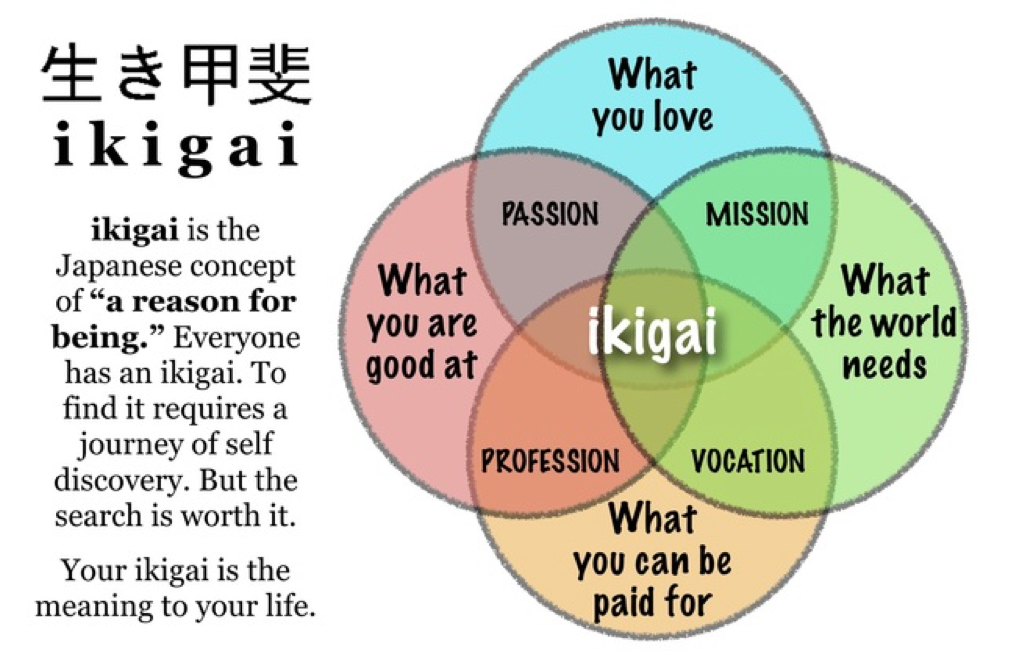
Ikigai is the alignment of doing something that is 1) you passion, 2) makes money, 3) you are good at and 4) good for the world. When you get this it is like arranging the Infinity Stones on the gauntlet and a higher level of achievement and happiness.
What is SPC-4.0? Maybe mentoring the next generation but at that point, we are playing with house money!
SPC followers are typically younger than 30 or older than 35. My observation is that when people have kids, that takes all precedence.
“What do I love to do and get paid to do it” Russell Grey or the Real Estate Guys Radio show.
The pursuit of an entrepreneur dream is not for everyone.
It requires an investment in time and money. And whenever you make an investment, you take on risk. In this case its taking time and energy away from a day job that already makes a lot of money.
In order to get enough critical mass behind an idea to turn into a thriving business, you must devote time, often many years. There are no guarantees that your efforts will be rewarded a lot of time luck is required. This Time Risk is that all of your time will be for nothing.
The saying “good is the enemy of great” comes to mind here. For many high paid working professional, you make enough money to be happy but part of what we are going for is not the extra wealth but “passion income.” Feeding that entrepreneur itch or as Buck Joffrey says that primal to our core instincts.
Below are some money ideas that I have come to adopt. If there are any that do not make sense to you please feel free to reach out.
1) Money is not everything… but it sure makes life easier
2) Define the Rules of the Game
On my calls with people, I often talk about defining the monthly cashflow goal (5k-20k for most) where they will create the lifestyle that they want. Only fools work past that point. The exception is unless they find that the act of creating value as sport and fun.
3) Time is interchangeable with Money. You can trade your time for money all day. But you cannot buy time! But you can buy freedom!
4) Experiences are the currency of Happiness, Social capital trumps monetary capital
5) Unproportionate wealth comes to those who create value. Trading things buy low sell high is a gimmick.
Ben-Shahar shares four archetypes in his book called Happieroutlines how we fall into these four “the happiness archetypes”:
Rat Racer – enjoy the idea of a future destination, but neglect the present
Hedonist – enjoy the journey (right now), but neglect the future
Nihilist– enjoy reliving the past, but neglect the present & future (because it’s hopeless)
Happiness – enjoy the experience of climbing toward the peak
The happiness archetype is the ideal.
Except from the 12+ Time Best Selling Book:
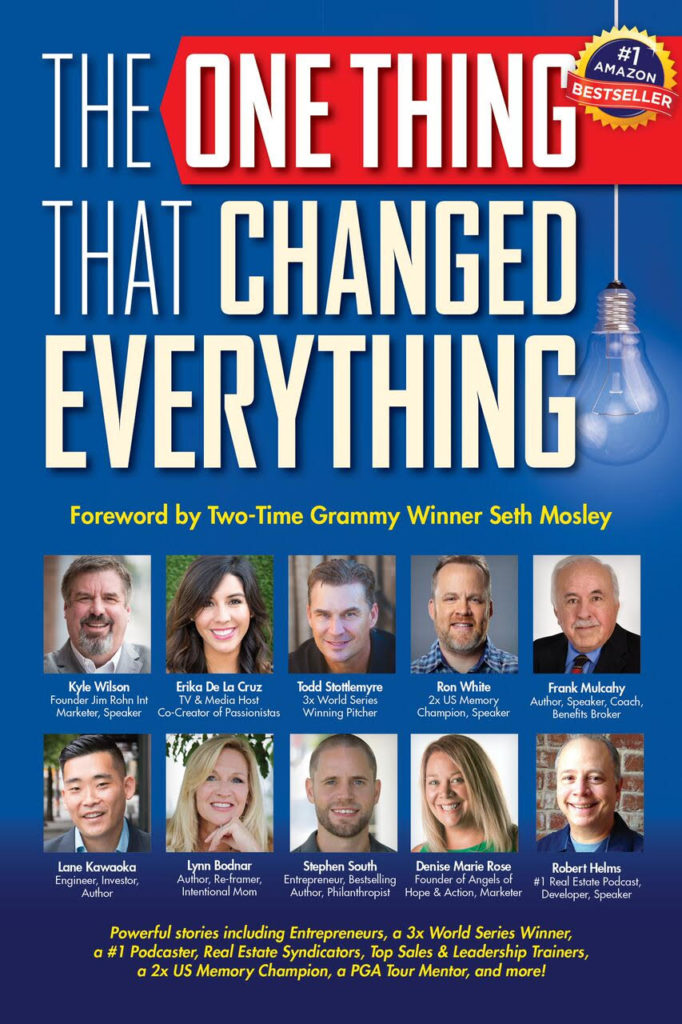
The One Thing That Changed Everything: The Engineer Who Escaped the Rat Race and Achieved Escape Velocity
I walked the linear path for much of my life. Raised as part of the disappearing “middle-class” programmed me to study hard in school, checking the boxes on extracurricular activities, cramming for the SATs, and getting a high GPA to get into college, all to live a “practical” life.
Growing up, we were told to “waste nothing” and turn off the lights every time you leave a room. I still feel guilty to order a soft drink at a restaurant as opposed to tap water.
In college, while other cohorts were playing Frisbee in the quad, I was stuck in the basement of the industrial engineering lab. Why was I not playing the sun? Because Google told me what the highest paid undergraduate professions were. Driving on autopilot for much of my early twenties, I went for a higher-level master’s degree and tested to become professionally licensed as an engineer for the job security.
Upon entering corporate America, I spent my first five years of my career working for a for-profit, private company as a construction supervisor managing a bunch of entitled journeymen who were older than my parents. Facing the rigors of junior level employment, I played my role as the young guy, traveling 100% of the time for my company, sacrificing quality of life, as I navigated the operational clusters, toxic management, and other backstabbing pawns in the company.
I have a lot of scar tissue from that decade of working for the man not to mention building someone else’s dream. You tell me how engaged you would be if meeting protocol was to sit next to your superior and not speak unless directly instructed to or if you were asked to address a director two levels up by mister or misses!
One day an internal company email went out notifying of a friend/ex-direct report had died in a work accident. My boss was uncompassionate about the situation, looking out for the big bad machine first (mostly his annual bonus and agenda). This really put things into perspective for me.
As a corporate road warrior, it was novel being on company expenses all the time and maxing out on airline and hotel points, but you can only have steak and lobster so many times… The only people who cared about my platinum status were the other suckers in first class who were working for the paycheck or an acceptable quarterly review. Although I am grateful that I had a well-paying job post-2008 recession, I traded the most important resource, time, for money.
The linear path instilled delayed gratification, living below my means, and an overall scarcity mentality of saving money instead of earning more, being more. I was entranced by the pervasive Wall Street marketing to blindly put money into a company sponsored 401K plan only to “hope and pray” that compound interest would carry me to a secure retirement.
Let’s not even talk about the student loans I had…
I knew where this path was going…I mean I did the math and it told me so. This is my story of how I freed myself financially, how I took ownership of my life’s direction, and the series of events that allowed me to find my calling.
Seeing the (Economic) Matrix
A steady diet of ramen noodles and a free birthday latte per year made it possible in 2009 to purchase my own home to live in. Being a bachelor who was only home on the weekends, I realized that having this large home was a waste of money. I made a decision to rent it out and became a real real estate investor. You might be thinking that this was the big change, but at the time it was simply a lot of beer money after collecting the rents and paying the mortgage.
I don’t know if it was the beer or being love drunk with cash flow, but I opted out of the linear path in my early twenties.
From that point on I devoured podcasts, books, and online forums on every keyword iteration of passive real estate investing. At a few hundred dollars of passive cash flow per home, the process was simple, buy a rental property where the income exceeded the expenses and mortgage, then rinse, wash, and repeat. Like a space shuttle that accelerates through gravity and escapes the atmosphere into Zero-G, this was my way to financial freedom. Up to that point, the biggest breakthrough in my life was discovering the .MP3 format that compressed and played music digitally in my teens. Using this intellectual technology, I progressed intentionally to eleven rentals in 2016.
At that time, a few of my friends wondered why my ramen noodle diet was being replaced by Starbucks coffee and yummy double bacon and egg breakfast sandwiches. They wanted a piece of the action too. Duh, it was about time seven years later, said the little red hen who did all the work by herself…. As much as I liked helping people, I got tired of answering the same questions. So what does any other late Gen-X/Millennial do but start a blog? Unfortunately, the words I write, even if spelled correctly do not usually make proper statements in English, so I uploaded my Simple Passive Cashflow podcast to iTunes where I could ramble and honestly talk about what I was going through as an investor.
I began living more consciously, opting into more meaningful engagements with people and projects, and searching for meaning and purpose. I was beginning to ask myself, “after sitting on a beach with my unlimited supply of piña coladas and time…then what!?” Needless to say, my motivation for working in the hostile work environment that I once tolerated dwindled, so I switched to work in the non-profit public sector. I started to see the economic “matrix” where people essentially trade time for money and the rich let others build their dreams.
Being an introvert, it was paradoxically energizing to see my audience grow as I began in-person meetings and online groups I sponsored. I provided hundreds of free coaching sessions to guide newbie investors. With my engineering background and a little “bro-science,” I saw patterns arise in the stories from well-paid professionals who were led into an unfulfilling lifestyle unaligned with their passions. Abolitionist Henry David Thoreau said, “The mass of men lead lives of quiet desperation and go to the grave with the song still in them.” People do not have any time to look inwards and are constantly living with anxiety and self-doubts because they are working like machines in order to meet their basic needs without the freedom to find their true passion.
Why did so much hard-work lead to financial scarcity and lack of fulfillment?
This self-selecting group of hard-working professionals searching for more all had a common thread. A moment that pushed them over the edge and made them realize that the path they were on was unacceptable.
These are some of those tipping points:
Seeing younger, less experienced workers being “red-circled” as future management and advanced through the company “fast-track”
Being fired to cover up shortcomings in a budget
Internal theft by upper management
An affair by a superior lead to bankruptcy of a startup company affecting many innocent employees
Chronic drain of working with deadbeats
Getting lost in the office politics of getting your objectives completed when they do not align with your boss’ objectives
A retirement party for a coworker is catered with crappy Chinese noodles due to the cost control
When you don’t get the job because you do not have enough grey hair
Because you have too much grey hair
Being criticized for not being business savvy from those who live paycheck to paycheck (when you have a personal portfolio of a few hundred rental units)
Sitting through endless meetings that should have been sufficed with an email
Circle jerk meetings where the boss’ dumb ideas are exalted by their minions
When your boss with no technical experience misuses terms like artificial intelligence, big data, machine learning, and deep learning
Being enslaved with the “golden handcuffs”
Seeing an ambulance come to the office routinely during layoff season
Being around the negative W2 worker speak and adopting the prevailing victim mentality
The road warrior gets an early quit on Friday only to see the spouse at home with the pool boy
Watching your friends receive the Seiko stainless-steel watch retirement gift
If you have found a calling in something you are good at and truly love doing it…clap, clap, good for you. Keep doing what you are doing and consider yourself lucky. If you relate to any of the moments above, read on.
This is ME today January 2023…
https://youtu.be/HThWJmOupCQ
The One Idea
My online journal resulted in many emails of gratitude and acknowledgment because I was empowering people with the “how to” and inspiring them to take a leap of faith to change their financial life forever. I suspect the most effective part of my message was showing people that if little, awkward engineer me could do it, how bad could it be?
I started up-leveling my peer group, and through osmosis, this brought me to a Tony Robbins event where I literally walked on burning coals! There were a multitude of top-down and bottom-up techniques Tony Robbins spoke about during the intensive four-day event. One of those lessons was “things happen for a reason,” and boy, was I glad I did not leave to use the restroom when he outlined the six human needs:
1) Growth
2) Contribution
3) Significance
4) Uncertainty
5) Certainty
6) Love and Connection
Here was the game-changing moment…. Tony Robbins said, “The most important thing is contribution because the secret to living is giving. If you catch onto that, you start realizing that there’s nothing you can get that comes close to what you can give. Life is calling all of us to be more than just about ourselves and that is when we get that spiritual hit.”
Apparently, Mr. Robbins did not endorse the mission of sitting on a beach with an unlimited supply of piña coladas and taking food porn pictures while gallivanting the world as a tourist. Nor did he support playing it safe with a bunch of passive investments.
Later that Easter, I was baptized, and the message there too was “go forth” and help others.
Then another of my mentors, real estate legend Robert Helms, said, “When you are successful you have an obligation to send the elevator back down.” I made it to my penthouse and now I and this elevator are heading back down to get folks!
We all have a finite time on Earth and an empty canvas to create a legacy. This was my one shot! Opting out of the linear path was not about getting financially free and sailing off into the sunset, but it was about standing up for change and creating the greatest impact!
The fan mail all followed a common thread of pain. Many hard-working professionals who are busting their butt on the linear path are being misled down a comfortable life of un-fulfillment. Many of them were enslaved by the “golden handcuffs,” running in the hamster wheel of the day job working for someone else. Some, like doctors, lawyers, dentists, accountants, and engineers make more money to get the big house and nice car, but in the end, they are just a bigger hamster. The dogma of the Wall Street “buy and pray” method is a cover up to insidiously steal investment returns from the people who are doing all the work.
Life is a three-phase screw job:
Phase 1: You enter the workforce with the worst jobs with the lowest pay. Time is abundant.
Phase 2: When marriage and kids enter the picture (and ailing grandparents) this is the time when one should be excelling at their time- consuming career. Money is abundant.
Phase 3: Your teenage kids hate your guts and your health starts to fail. Time is abundant.
The Next Chapter
My mission is to teach and empower good people to realize the powerful wealth-building effects of real estate so they can spend their time on more important ventures and passions instead of working long hours and worrying about their financial troubles.
https://youtu.be/azOtb5zY7J4
For the parents and the next generation: Sports help children (and people in general) to have a healthy lifestyle early on. Not only that, sports teach them discipline, grit, confidence, persistence, and teamwork.
SimplePassiveCashflow.com seeks to educate those looking for diversification and better returns outside of traditional investments such as mutual funds and stocks. This is part of a large effort to redirect billions of dollars going to the corrupt Wall Street roller coaster and help the shrinking middle-class find safer and more profitable investments in projects that benefit Main Street such as affordable workforce housing rather than luxury housing for the rich.
The true meaning of wealth is having the freedom to do what you want, when you want, and with whom you want. Building cash flow via real estate is the simple part. The difficult part occurs after you are free financially to find your calling and fulfillment. But that’s a great problem to have 😉
Warning – If you have been following the holistic wealth building strategies at SPC you understand that debt is a tool and you need to use said tool to acquire more and more assets that produce more income, more tax write offs, and build your net worth.
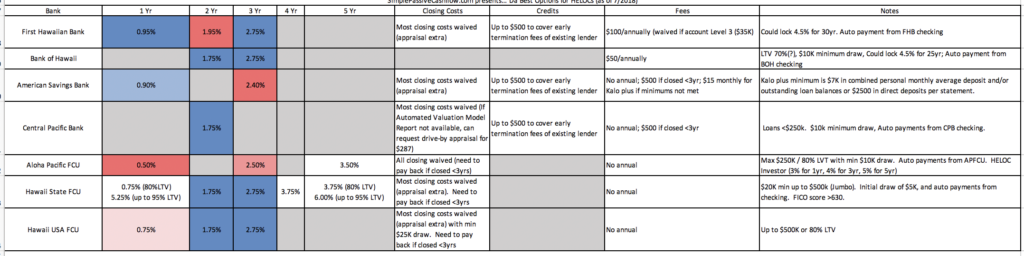
The following downloadable cheat sheet was made for Hawaii residents but the concepts discussed are typical as it is a confusing game. What is a HELOC (Home equity line of credit)?
A line of credit where the collateral is the existing equity in your home. Think of a credit card where your max limit is a portion of your equity in your home with some actually good rates. Pros:
It’s a line of credit where if you don’t use it there is no interest being accrued.
Low-interest rate because it is seen as a low risk loan from the banks perspective
A good way to get access to liquidity in a pinch. Especially when starting a new investing strategy and need proof of concept. Cons:
There is a possibility of the bank calling a loan due or changing the terms as the economy changes
Its not the best way of using equity because you should just sell the asset and be deleveraging into more fixed debt (very counter-intuitive I know but most things are)
What is LTV?
Loan to value. So if your home is worth $100,000 and you have $50,000 left on your mortgage then your LTV is 50%. I’m confused… this all sounds great but just tell me what to do
Option 1: Initiate a HELOC with Aloha Pacific CU for 1yr @ 0.5%. Then either go with ASB or CPB. They both will cover up to $500 for early termination with Aloha Pacific (which would be some of the closing costs that were waived) and no annual fee. For ASB, as long as you have $2500/month in direct deposits then there are no other fees – setup an automatic transaction from another bank recurring every month to take care of that, extra credit if you send that same $2,000 right back a few days later (that’s almost like money laundering). At the time of origination, can check rates to see if you go with another 1 yr (with ASB) or 2yr (with CPB). If you need to do a third time – a few years out, then go with whichever one you didn’t go with for the second HELOC. These rates change and so do the fee structures so try to learn this stuff and connect with other investors. A good way to do that is come to have a beer with other sophisticated investors at ReiAloha. Notice CPB is put in the 2nd order because they will waive the cancellation fees from the host bank prior. Yes, we thought this out like the Sunday arm chair quarterback strategies-out the running back rotation of the Denver Broncos.
Option 2 (for the lazy): Although this is not optimizing the rates this method is a little simpler if your time is so valuable like you are coming up with the cure to some rare form of cancer. Take the lowest of the 2-3 year HELOCs and just go with them. This minimizes movement and makes your life simpler. Perhaps it makes your life so simpler that you free up time and mental bandwidth to invest in real assets such as rental real estate or passive syndications? I’m still confused… walk me through a real-life example
Someone who just did this with a credit union… for a $200k loan, the closing cost was about $1200 (which were covered by the cu) and he paid $700 for an appraisal. He intends to hold for 3 yrs, so he didn’t get much details on how much of the closing costs he would have to pay back…. for this scenario, we estimate that all $1200 and would have to be paid (which $500 of that would be covered by the new lender). Thoughts about appraisals
In order to cut costs some banks will do a desk review to determine the value of your property. This usually is more conservative figure and hurts you because you want your home to appraise for the most that it can in order to qualify for the biggest loan. These desk reviews utilize the tax assessed value which usually lower than if you paid $500 for a real appraisal or a cheaper “drive-by” appraisal. Sometimes it might be worth it to pay the extra fees to get a real appraisal instead of the lazy man method. It might be obvious but have a conversation on which appraisal is being used or be disappointed like when Coke switched your C&H sugar for corn syrup. What about for a high leverage option (above 80%+) and low leverage option or will all of them not touch higher than 80%?
Higher leverage HELOC are available but not openly published. The author of this guide did not want to waste their time finding such fringe data since it changes so much and did not want to wait of a consultation from another bank employee. The collaborator did note that Hawaii State FCU was one of the few Credit Unions that openly published a higher LTV (up to 95%). Note – Hawaii banks are much more conservative on appraisals and terms than on the mainland. You may want to have a bank on the mainland if they will give a HELOC out of state. Typically anyone can get into most Credit Union after all they just want your money to sit in their bank paying you 0.01%. Sometimes you just have to donate $10 to some friends of the library account to gain membership. Thoughts about fees
Be cognizant of closing costs are. The credit unions don’t have an early termination fee, however, you got to pay back closing costs. For the banks, there is a $500 termination fee and rates are higher, but maybe a better route if you got to pay back waived closing costs with the credit unions… especially since ASB and CPB will cover up to $500 early termination. Why are you doing this?
Equity in your home is lazy money. It is not yielding a return and in fact it is a liability for lawsuits. The wealthy try to control everything and own nothing (encumber their assets with debt). In addition, typical investment yields range from 12-25% for stable, cashflowing assets, that hold their value even if the economy weakens. Fine tuning:
“At some point you are going to ask the following: Assuming the delta between the one and two year helot is 1% and we are talking about a 200k loan… That’s 2k. Is it worth it to run around one afternoon and move stuff around online???
Are you going with the one year one first then get the two year from the next one? At this point it may make sense to get on a coaching call for 30 minutes to get an expert opinion.
Also it is possible to get a HELOC on a non-owner occupied home (rental property) but if you are considering so read this… simplepassivecashflow.com/roe” Conclusion
Overall the process is pretty painless. You might have to run around looking for your mortgage files, HOA documents, or insurance but once setup it works just like another checking account. Download link
Flip the Script on the Banks
Summary: Pay a 30-year mortgage in 5 to 8 years by paying back your mortgage with simple interest instead of amortized interest.
I recently discussed this in my Forbes article here.
Is this something new?
We all know it’s a sellers’ market, with the lack of deals out there and the majority of the Simple Passive Cashflow Podcast listeners looking for something to invest their cash in. Good times, if you ask me. This strategy is nothing new but now the strategies that are, “trending,” like bell bottoms, tights, and neon colors but forgotten. One of these old plays from the playbook is called the Mortgage Equity Arbitrage Strategy also known as, the Australian Banking system.
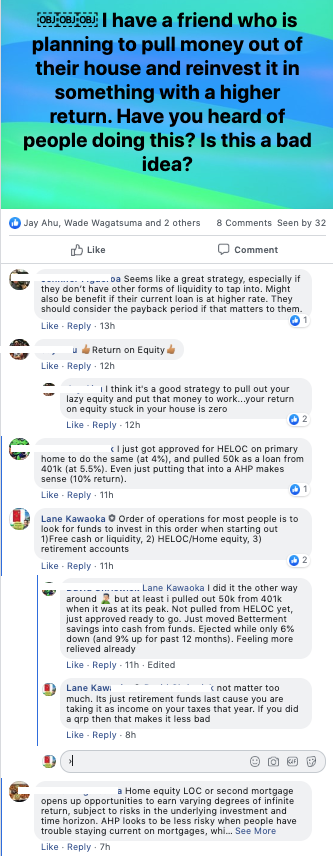
First off, let’s talk about good debt versus bad debt. Obviously, an 18% interest rate paid on something like a credit card is bad debt. But taking a 4% HELOC (Home Equity Line of Credit) or loan from your life insurance policy can be good debt. Especially, if you are putting the loan proceeds into AHP at 12%, a MFH Syndication at 20%, a Turnkey rental at 30%+, or another higher risk syndication at 35%+. Just don’t buy jet skis or other doodads with the money… I don’t know why it’s always jet skis as the example. Maybe something to do with the fact that it is a mini-boat, and boats are known as the worse purchase known to man.
What you do with the liquidity from the debt is what really matters. Traditionally, it has been good to go into debt for a college education paying 4-8%… unless you are getting a glass blowing degree… or maybe a psychology degree so you can trick yourself into thinking college was worth it… or Asian studies degree because you are going to have to get used to ramen noodles in your adult life… or a Communications degree to be able to spin your financial reality. Ok I admit, I had a pretty depressing college experience…
Other Resources:
https://simplepassivecashflow.com/podcast-105-jordan-goodman-affiliate-connections-mortgage-rate-optimization-dolphin-mentality/
https://simplepassivecashflow.com/spc028-chris-myles-explains-downside-using-helocs-pay-off-mortgages-teaser-life-insurance/
https://simplepassivecashflow.com/heloc/
Additional reading…
Webinar – Hui Webinar – How to pay your 30-year mortgage in 4 to 8 years with Mortgage Rate Arbitrage – https://www.youtube.com/watch?v=yysbua0nOaM&t
SPC105 – Jordan Goodman – Affiliate connections + mortgage rate optimization + Dolphin mentality – https://simplepassivecashflow.com/podcast-105-jordan-goodman-affiliate-connections-mortgage-rate-optimization-dolphin-mentality/
Here is the download link for Jordan’s text on the mortgage rate optimization strategy: https://drive.google.com/open?id=1XajKX3Otl9egfIbTnPBsr49wf7pDZHsO
Helocs hurt your credit score… However if you are a Passive Investor not needing to qualify for PITA rentals, already a home (no need to qualify for a mortgage for some time), or have ample income to support a car loan… it might make sense to run the HELOC hot for a minor credit score hit (25-100 pts). Most personal finance will say absolutely say not to hurt your credit score but in our world this decision is very personal and where the investor needs to empower themself (get around the right people) to choose the right set of options moving forward.
Text “simple” to 314-665-1767 to download the Hui Google Drive files and the 2018 Rental Property Analyzer
For a free electronic version of my bestselling book in 12+ categories text the word “ebook” to 587-317-6099.
Please help the show by leaving a review: http://getpodcast.reviews/id/1118795347
Join the Hui Deal Pipeline Club! SimplePassiveCashflow.com/club
Pardon the grammar – I’m an Engeneer, Enginere, Engenere… I’m good with math!
________Here are the Show Notes________
Jay Papasan is a bestselling author, vice president and executive editor at Keller Williams Realty International, and co-owner, alongside his wife Wendy, of the Papasan Properties Group in Austin, Texas. His most recent work with Gary Keller on The ONE Thing has garnered more than 200 appearances on national bestseller lists including #1 on the Wall Street Journal bestseller list. Before joining Keller Williams Realty, Jay served as an editor at HarperCollins Publishers, where he worked on such bestselling books as Body-for-Life by Bill Phillips and Go for the Goal by Mia Hamm.
Jay serves as Gary Keller’s co-author and executive editor on best-selling titles including: The Millionaire Real Estate Agent, The Millionaire Real Estate Investor, SHIFT: How Top Real Estate Agents Tackle Tough Times, FLIP: How to Find, Fix, and Sell Houses for Profit,HOLD: How to Find, Buy, and Rent Houses for Wealth, and The ONE Thing: The Surprisingly Simple Truth Behind Extraordinary Results. He also co-authored SHIFT Commercial.
Best investing books Simplepassivecashflow.com/books
The domino theory – momentum
18-25% total return for SFH
Start small – and go small first fast
Co pairing tasks
Focusing question – what is the one thing I can do that will make everything else go away
411 – annual goals
Work a maze backwards – begin with the end in mind
Text “simple” to 314-665-1767 to download the Hui Google Drive files and the 2018 Rental Property Analyzer
For a free electronic version of my bestselling book in 12+ categories text the word “ebook” to 587-317-6099.
Please help the show by leaving a review: http://getpodcast.reviews/id/1118795347
Join the Hui Deal Pipeline Club! SimplePassiveCashflow.com/club
Pardon the grammar – I’m an Engeneer, Enginere, Engenere… I’m good with math!
________Here are the Show Notes________
Aside from blog, owns 15 rental properties in Northern Colorado generating $7K/mo passive income.
Harder to cash flow around Denver. Looking out-of-state.
Since Sept 2015, has not purchased new SFH. Focusing on commercial, flipping, which was best use of time.
Always demand for low-end flips (less risk v. high-end).
Write own goals, don’t rely on other people, and think differently to develop himself.
Don’t C.E.F. – especially if you’re not a contractor.
Some opportunities in purchasing primary residential properties, but not going to stay there forever.
If you want to be creator and sell houses full-time, get a real estate license. If part-time, not really recommeneded unless you own a couple properties already and can expend time.
Goals for more passive income ($100k/mo) and freedom = happy.
Change your mindset and try. Otherwise, you’re stuck where you are (ex: frugal). What’s your motivation and dreams?
Let people drink their haterade.
Tough to let go, but happier to save time by hiring out on blog, website, e-mail, property management, etc.
Not a tech-savvy guy, but build blog and all that SEO!
Wished more good people to hire directly instead of 3rd parties.
Don’t force yourself to buy something – especially in a sellers market.
Are you taking action that’s getting closer to your goals or treading water? Take time for yourself.
Always lot of stuff to do, but don’t stress about it. A couple mistakes or not getting things done will not ruin you.
First blog comment was fulfilling. Drives motivation on how to help give back to others.
Check out www.investfourmore.com and podcast. 453 articles and 117 podcasts.
Text “simple” to 314-665-1767 to download the Hui Google Drive files and the 2018 Rental Property Analyzer
For a free electronic version of my bestselling book in 12+ categories text the word “ebook” to 587-317-6099.
Please help the show by leaving a review: http://getpodcast.reviews/id/1118795347
Join the Hui Deal Pipeline Club! SimplePassiveCashflow.com/club
Pardon the grammar – I’m an Engeneer, Enginere, Engenere… I’m good with math!
________Here are the Show Notes________
Income has a cap
Bought first house at 21
Take business profits into buy and hold rentals
Say out of Seattle
Mount Vernon WA
Tell the agent in super simple terms
Comments on meetups
Should i get started now?
Time is the most important resource. You can trade time for money and vice versa. It is pretty rare that you can not throw money at a problem and make it go away. And if you have kids!
Some hacks I have implemented updated 8/1/18 (See how far I have come)
Using disposable chopsticks, plates, bowls, clubs, and forks to minimize time to wash dishes and put away. Also need less space for more of this “stuff”. I think we do not realize how much not only time we waste on this but water and electricity go into this.
Use Uber as much as I can to minimize stress, the chance of an accident, 50 cents a mile per the IRS in wear and tear to your vehicle but most importantly you can bring your laptop and get some work done.
Leasing a car – such a great decision. Its fun, the numbers make sense if you are able to grow your money at more than 14% a year, and don’t have to deal with any maintenance issues.
Eat out. It just tastes better too. And no cleanup, prep, grocery shopping, etc.
Send me some of yours!
I stumbled upon a great visualization of your time. Basically, the yellow below is the time we sleep, blue is leisure, and light blue is at work. See the diagram here http://flowingdata.com/2017/05/09/adulthood-days/
Two takeaways:
If you have not started investing… when the heck when? Get a mentor and compress the learning curve, decrease costly mistakes, and get on with your life!
“Fiverr is the world’s largest marketplace of talented online freelancers who pride themselves on
getting things done for you. On time, on budget. Designers, developers, writers – everything you
need for your next project is here. Now let’s tackle your to-dos, today!”
“Fiverr’s global community of freelancers have delivered tens of millions of
high-quality Gigs from over 150 service categories across 190 countries.
Fiverr is a global online marketplace offering tasks and services, beginning at a cost of $5 per job
performed. Freelancers use Fiverr to offer services in more than 150 categories, to customers
worldwide. Currently, Fiverr lists more than three million services on its site.
Fiverr is the world’s largest marketplace of talented online freelancers who pride themselves on
getting things done for you. On time, on budget. Designers, developers, writers – everything you need
for your next project is here. Now let’s tackle your to-dos, today!
Join over 11M businesses who use Fiverr’s freelance services.
Fiverr is the world’s home for digital, creative and professional services, providing a one-stop shop
for millions of digital services, all at your fingertips.
Fiverr is a digital marketplace that allows you to make your business better, stay on budget and get
things done in just a click.
Fiverr is the easiest way to get everything done, at an unbeatable value.
Need something now? As the world’s home for digital, creative and professional services, Fiverr
provides one-stop shopping for millions of digital services, all at your fingertips.
Fiverr gives you instant access to millions of Gigs from people who love what they do, in just a click.
Need something done? Let someone else take care of it! Get everything from resume help, to
designed invitations, to cool gifts, all at an affordable price. Whether you’re building a business, or
just looking for something unique, find it on Fiverr!”
Some of you had questions about Virtual Assistants which I have had some growing pains with…
Take 1: I went to various countries/regions Craigslist where I heard there was cheap virtual labor such as the Philippines, Ukraine, Latin America, Eastern Europe, Etc. I created a generic posting for a Virtual Assistant and a link to a Google Form that I created that was supposed to farm data of willing workers and ask binomial questions such as if they had experience with graphics, audio editing, Excel, English, and how much their hourly rate was. This was a success and the idea was that I would create a database that I could BCC the emails to competitively bid projects. Unfortunately, when I sorted my list for the desired skill I was looking for, I discovered that many of the potential candidates sent generic resumes back. They did not even read the job description. I guess as the saying goes “shit in shit out.” Tim Ferriss talks about giving strange instructions to potential job candidates such as a requirement to fax in their application (in an age of limited fax access) to see which candidates follow directions and can overcome minor Resistance of not having fax machines.
Take 2: It seems like the tasks are taking a lot more time than it should. To some respect, that is to be expected. What I am trying to wrap my head around is the cultural differences not to mention the language barrier. In some of these Asian cultures, honor and face are utmost importance and sometimes it is culturally the normal to lie to save face. In America, we preach stepping up and admitting fault and moving on which I believe is a true demonstration of high value. So it’s a little frustrating… I know the internet sucks at these places but give me a break. I am just surprised they are not telling me their dog ate the GoogleDoc. Successful people take ownership and I accept this as MY fault in terms of me not having my job scope defined and linear instructions for the virtual assistant to carry out. If my virtual assistant misses on the deliverable or takes too long I take full responsibility.
Afterthoughts: A great discussion at a recent Mastermind I attended around this topic. Seems like a lot of people are backtracking from cheap (sub 8 dollar an hour labor) and opting for higher quality workers. I believe the vision of an employee is to get something done cheaper than your personal hourly rate, also get it don’t faster, and with a “Sir… I was completing task X and I found this wrong in our process so I took care of it and wanted to discuss this with you.” I don’t know if I will ever achieve this level of initiative in any person trading their time for money but one can only dream. Until then I will try to switch to a more project-based system as opposed to having a VA on call for a 10-40 hour set time. The cons of this project-based methods are that it requires more touch points for me to keep micromanaging each project and this is the exact reason I am looking for help in the first place. Time is the most important thing Jelly Bean. https://www.youtube.com/watch?v=BOksW_NabEk
The Random list of tasks to outsource:
1. Organize your travel (including learning your travel preferences). This includes making all your travel arrangements,
organizing all your flight info into your favorite travel app, and even remotely monitoring your travel to be ready to deal with
any missed flights or oversold hotels.
2. Handle billing disputes.
3. Help setting up bills onto auto payment on your credit card.
4. Address and mail cards, letters, and packages. Sure you may still handwrite the thank you, but do you really need to look up
the address and post the letter?
5. Update your contact manager (or CRM database).
6. Screen your e-mail and handle low-level responses. This includes deleting or archiving things you don’t even need to see.
7. Update your blog and social media accounts.
8. Organize and manage your filing system, both paper-based and scanned e-files.
9. Take dictation (either live or via recordings, perhaps using Voxer, one of my favorite apps).
10. Set up appointments and hold your schedule.
11. Gather all the needed data and prep information for all your appointments. For example, I ask my assistant to put to the
memo of any appointment she posts to my calendar any recent email exchanges and the contact information of the person
I’m meeting with. This saves me untold time when you compound this service over 15-20 meetings I hold each week.
12. Daily clean-up of your office, including refilling items.
13. Screen phone and e-mail so you don’t get the interruptions.
14. Take notes at key meetings and follow up with attendees on key deliverables.
15. Keep a master chart/list/calendar of your projects and deadlines and set reminders.
16. Tickler all birthdays and anniversaries, holidays, or other important dates, and even arrange for gifts, cards, or phone calls
that make you look good.
17. Update his or her own “Project List” so that all the tasks and deliverables they are responsible for in one place for you to
review.
18. Get, open, sort, forward, handle, and if need be shred your mail.
19. Coordinate with outsourced vendors when you have an IT issue. You just work from a back-up computer for the day and let
him or her troubleshoot it with your IT vendor.
20. Order things online for you and handle any product returns or service issues.
21. Handle any personal errands or schedule any household repairs. Yes this is perfectly reasonable as it saves you time that
you can reinvest in creating value for your company.
22. Notarize your documents by becoming a Notary Public in your state.
23. Help you to streamline your office—filing, sorting, and systematizing wworkflow
24. Basic updates to your Web sites.
25. Create and continue to refine the “expert system” for how to be your assistant (this one should be part of their job function
right from the start). This way if you promote your assistant they have created the core system for your next hire. If they leave
you to work elsewhere, the transition is much less painful.
26. Dealing with tech troubles on your phone or tablet computers. They can do this during the day when you’re in the office doing
other more valuable work.
27. Any parts of your projects that he or she is capable of doing for you. Constantly be on the lookout for things to try them out
doing. For example, my assistant helped expand the syndication reach of my business articles by over 100,000 annual
readers.
28. Download movies or audiobooks
29. Search for contacts of people you need to meet
30. Bookkeeping with a CPA or without one
31. Edit videos
32. Make calls
33. FInd sellers
34. Take Calls from leads
35. Call banks to find a portfolio lender
36. Assemble a list of podcast guests to contact